GRAVÜR DÜNYASI
Digital Engraving Library
| Artist | Daniel Maclise (1806-1870) |
| Engraver | Robert Staines (1805-1849) |
| Date | 1855 |
| Technique | Steel Engraving |
| Category | William Shakespeare And His Works |
| Source | The National Gallery Div 2 Comprising The Pictures Known As The Vernon Collection And A Selection From The Works Of Modern Sculptors (London, James S.Virtue) |
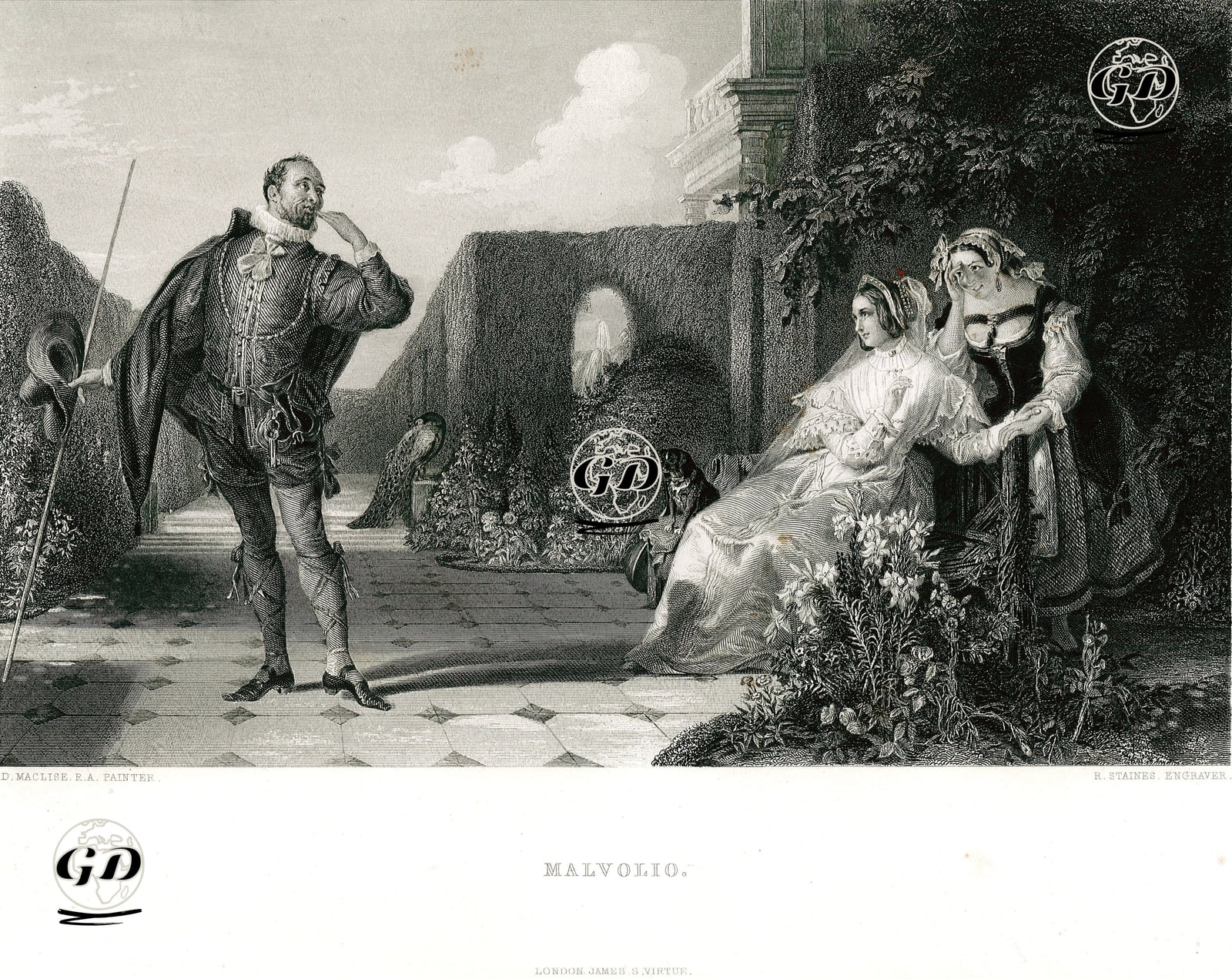
Twelfth Night, one of William Shakespeare's most famous comedies, is a masterpiece that combines elements of love, identity confusion, and humor. It premiered in January 1602 at the court of Queen Elizabeth I. Named after the 12th day of Christmas, this period symbolizes joy, identity shifts, and the reversal of social roles. The story takes place in the fictional country of Illyria and begins with Viola, separated from her sister by shipwreck, disguised as a man and entering the service of Duke Orsino as Cesario. Orsino is in love with the beautiful Olivia, but Olivia is smitten with Cesario, the female Viola. Meanwhile, Viola also secretly falls in love with Orsino, and the play revolves around a love triangle riddled with misunderstandings. A side story satirizes the social structure of the period through the pride and deception of Malvolio, Olivia's butler. In the end, truths are revealed, identities are resolved, and happy reunions occur. The play is one of Shakespeare's immortal works, depicting the complexities of love and the contradictions of human nature in a language both romantic and humorous. This engraving depicts the famous scene from Act 3, Scene 4 of the play. In this scene, set in Olivia's garden, Olivia and her lady-in-waiting, Maria, are waiting to meet Malvolio. However, Malvolio has been tricked into believing Olivia is in love with him by a forged letter. Therefore, he appears on stage wearing yellow stockings and cross-tied ribbons. This attire, which Olivia particularly detests, makes her a laughing stock. In the engraving, Malvolio approaches Olivia with a confident air, his head proudly raised, and a feigned smile on his face. Malvolio's arrogance and overconfidence, along with his imitation of a gentleman's airs and manners, are beautifully expressed through humor. The composition clearly reflects the dramatic contrast between the characters. On the right, Olivia, the lady of the house, and Maria, her maid, are sitting side by side. Olivia, with her expression half-amused, half-disgusted, and the maid Maria, watching Malvolio with amusement. The flowers and garden details in the foreground of the engraving establish an atmosphere befitting Shakespeare's pastoral stage settings. The light falling on Malvolio emphasizes his position as the "tragicomic center" of the scene. This scene is a prime example of Shakespeare's visualization of the themes of hubris, delusion, and humiliation in human nature. Malvolio's vanity, his greatest weakness, becomes a tool of social satire.