GRAVÜR DÜNYASI
Digital Engraving Library
| Date | 1856 |
| Technique | Steel Engraving (Text on Reverse) |
| Category | Maps |
| Source | Pictorial History Of The Russian War 1854-5-6 - W.R.Chambers London & Edinburgh |
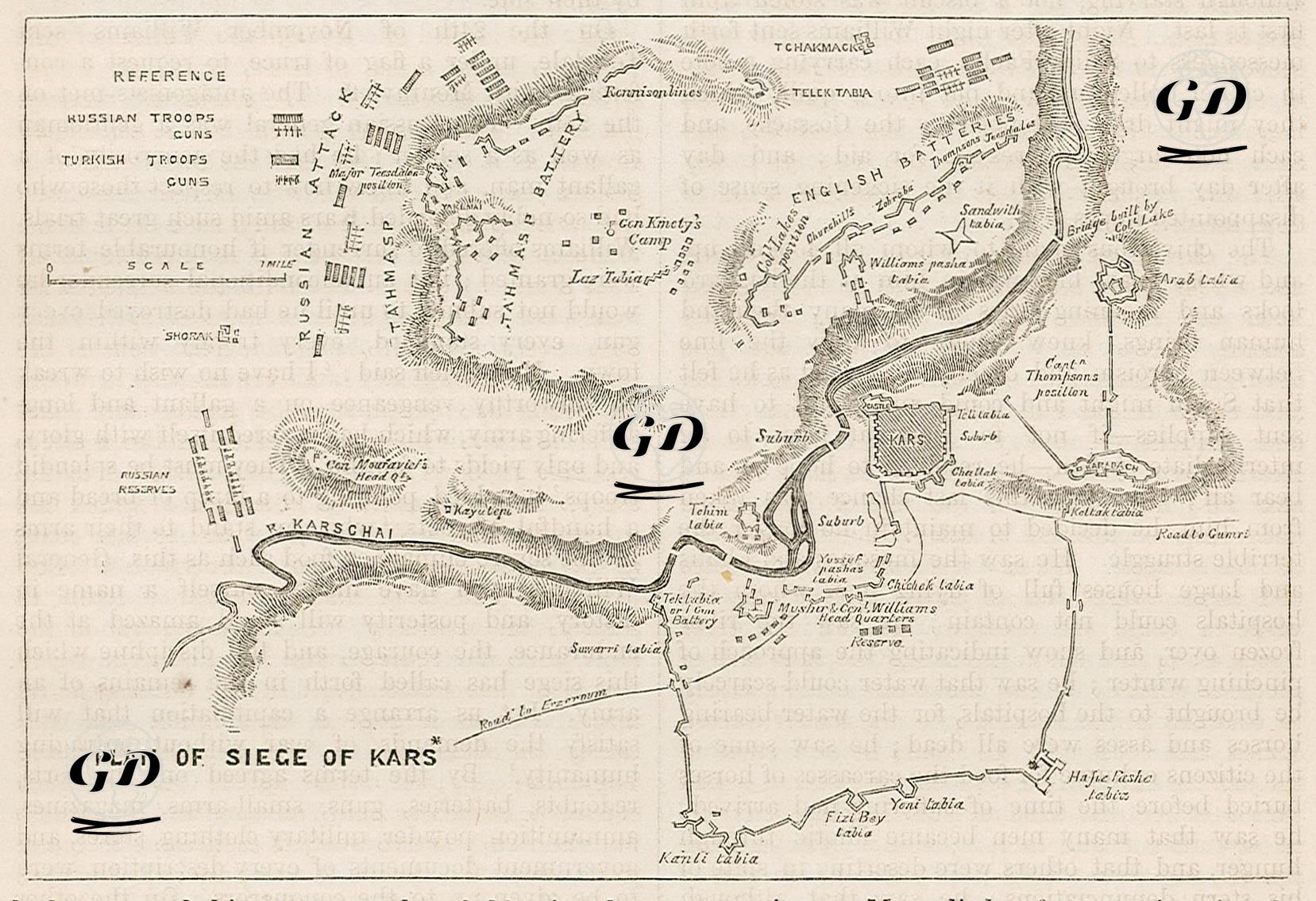
The map depicts the siege and battle of Kars, one of the most critical clashes between the Ottoman Empire and Russia on the Eastern Anatolian front during the Crimean War. It was one of the most successful defenses of the Ottoman army against the Russians, and is considered one of the turning points of the war, both tactically and in terms of its impact on international opinion. Kars City and Castle was the most important defense point on the eastern side of the Ottoman Empire, and the Russians wanted to increase pressure on Istanbul and Eastern Anatolia by capturing it. A Russian army of approximately 50,000 men under the command of General Nikolay Muravyov laid siege to Kars in June 1855. The city and castle were defended by a garrison of 17,000 men under the command of Ahmed Muhtar Pasha and British officer General William Fenwick Williams (who received the title of “Baron of Kars” after the war). The castle faced serious logistical difficulties during the siege: food, medicine and ammunition shortages were acute. General Williams organized the local people and established redoubts, trenches, reserves and artillery positions around the castle. On the map, the forts, trench lines and military fortifications around Kars Castle are meticulously depicted; the positions of both Ottoman and Russian troops, artillery batteries and defense lines are shown in detail. In the legend in the upper left corner of the map, Ottoman and Russian military units and artillery batteries are distinguished with different symbols. On the morning of September 29, 1855, the Russian army under the command of General Muravyov launched a large-scale attack on the forts to the east and southeast of Kars. Having captured these forts, the Russians would be able to establish superiority in the center of Kars with artillery fire. However, the Ottoman side had fortified the defense very well under the leadership of officers such as General William Fenwick William and Hungarian-born Ismail Pasha (Kmety). The Ottoman soldiers prevented the Russians from approaching the fort with bayonet charges, artillery fire and hand grenades. The fighting around Tahmasb Fortress continued throughout the day. While the Russians suffered approximately 8,000 casualties, the Ottomans also lost several thousand soldiers. The Russians were forced to retreat before they could capture the position. The Siege of Kars ended with the surrender of the Ottoman garrison after about five months of resistance, due to military inadequacies, famine and disease.