GRAVÜR DÜNYASI
Digital Engraving Library
| Engraver | Robert Scott (1777-1841) |
| Date | 1822 |
| Technique | Copper engraving |
| Category | Maps |
| Source | Published by Blackie & Son, Glasgow |
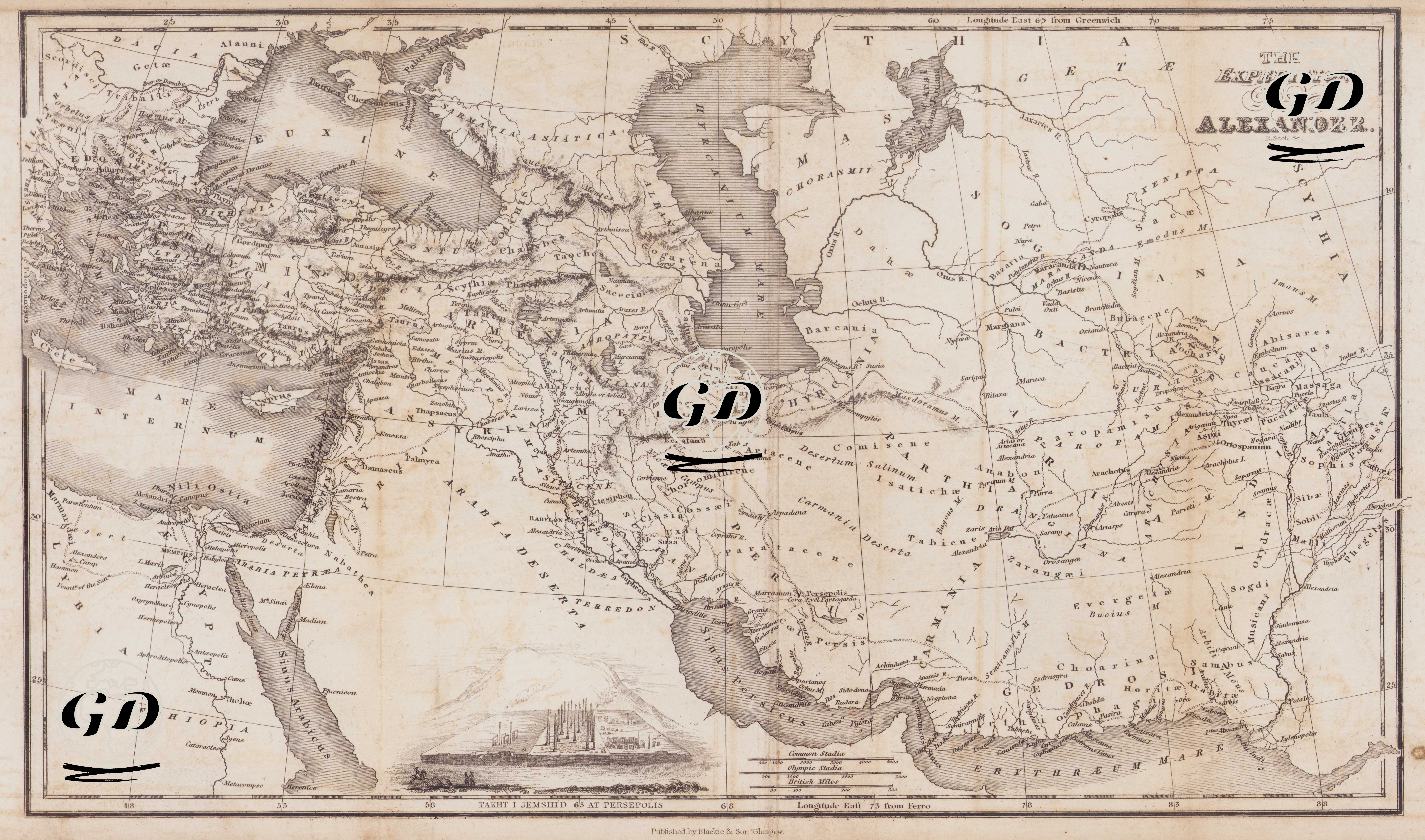
This map is an ancient geographical map that depicts Alexander the Great's military campaigns from east to west, and geographically visualizes his Asian Campaign between 334 and 323 BC. The map covers a wide area starting from Greece and extending to Anatolia, the Levant, Egypt, Mesopotamia, Iran, Central Asia and India; the place names are mostly given with Latinized ancient names. Alexander's campaign begins in Macedonia in 334 BC. He crosses the Hellespont into Anatolia and wages war against the Persian Empire, advancing to the heart of the Persian Empire with important battles such as Granicus (334 BC), Issos (333 BC) and Gaugamela (331 BC). With the conquest of cities such as Babylon, Susa, Persepolis and Ecbatana, Alexander becomes the absolute ruler of the East. His expedition extends further east, via Bactria and Sogdiana, north of Afghanistan, to the northwest of India, that is, the region of today's Punjab. On his return from India, he returns to Mekran and Persian lands via the Gedrosia (today's Baluchistan) Desert. The end of the expedition occurs with the death of Alexander in Babylon (323 BC). The composition covers a vast area, starting in the west from Macedonia, Thrace, and the Aegean region, and extending through Asia Minor, the Levant, and Egypt to the east, encompassing Mesopotamia, Persia, Bactria-Sogdiana, and India. Thus, the main regions and passes mentioned in the narrative of the expedition are read through ancient regional names rather than modern political boundaries. The map's language is typical of engraved cartography. Coastlines and hydrography are clearly defined linearly, with occasional hatching and shading to create a topographical mass effect. Furthermore, a spatial order is established using a latitude-longitude network. The scales in the lower section show different units such as stadia (ancient measurement) and British miles. The addition of the image of "Takht-i Jamshid (Persepolis)" to the map elevates this work beyond being merely a map showing locations.