GRAVÜR DÜNYASI
Digital Engraving Library
| Date | 1876 |
| Technique | Woodblock Engraving (Newspaper-Text on Reverse) |
| Category | Maps |
| Source | The Graphic (December 16 1876-Page 598) |
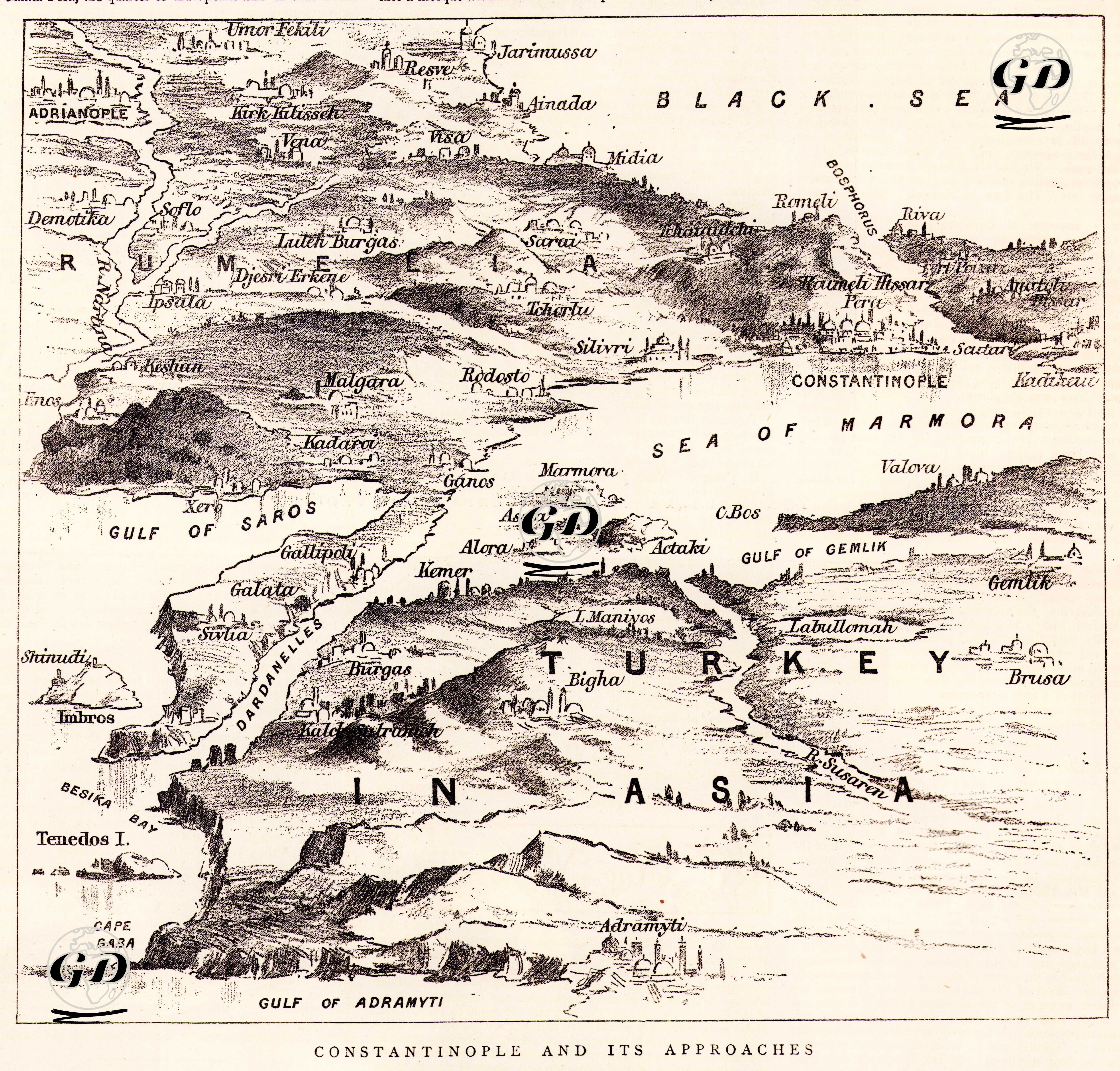
This map titled “Constantinople and Its Approaches” and its accompanying newspaper article, published in The Graphic newspaper on December 16, 1876, aimed to present both the geographical beauty and strategic importance of Istanbul to the Western public. This map is a picturesque map type that depicts Istanbul and its surroundings from a bird’s-eye perspective. Buildings and cities are drawn as three-dimensional silhouettes, mountains, rivers, seashores and cities are given in the form of pictorial landscapes, islands, seaways and coasts are decorated with architectural symbols and military ports, fortresses and straits are particularly emphasized. The map covers a wide geography starting from Thrace and extending to the Dardanelles, the Sea of Marmara, Istanbul and the Black Sea, and cities such as Edirne, Gelibolu, Silivri, Bursa, and Gemlik along with the Bosphorus, the Golden Horn and the Prince Islands are shown in detail. The newspaper article praises the magnificence of Istanbul’s approach from the sea, the natural beauty of its ports and its historical texture; Monumental structures such as Hagia Sophia, Sultanahmet, Süleymaniye and Valide Sultan Mosque are highlighted. While the city’s different cultural layers (Byzantine, Ottoman, Levantine) are introduced through architectural and social structures, Istanbul’s status as both a commercial and political center is reinforced through areas such as Galata, Tophane, and Sarayburnu. The map and text were published just a week before the declaration of the First Constitutional Era and on the eve of the ’93 War, and serve to inform and guide the public about Istanbul’s geopolitical importance. In this respect, this visual-text duo, which offers both an aesthetic and political narrative, positions the Ottoman capital as both an “exotic” and “strategic” center in the eyes of Europe.