GRAVÜR DÜNYASI
Digital Engraving Library
| Artist | Jakob Van Der Schley(1715-1779) |
| Date | 1750's |
| Technique | Copper Engraving |
| Category | Maps |
| Source | Histoire Generale Des Voyages, Ou Nouvelle Collection De Toutes Les Relations De Voyages Par Mer Et Par Terre |
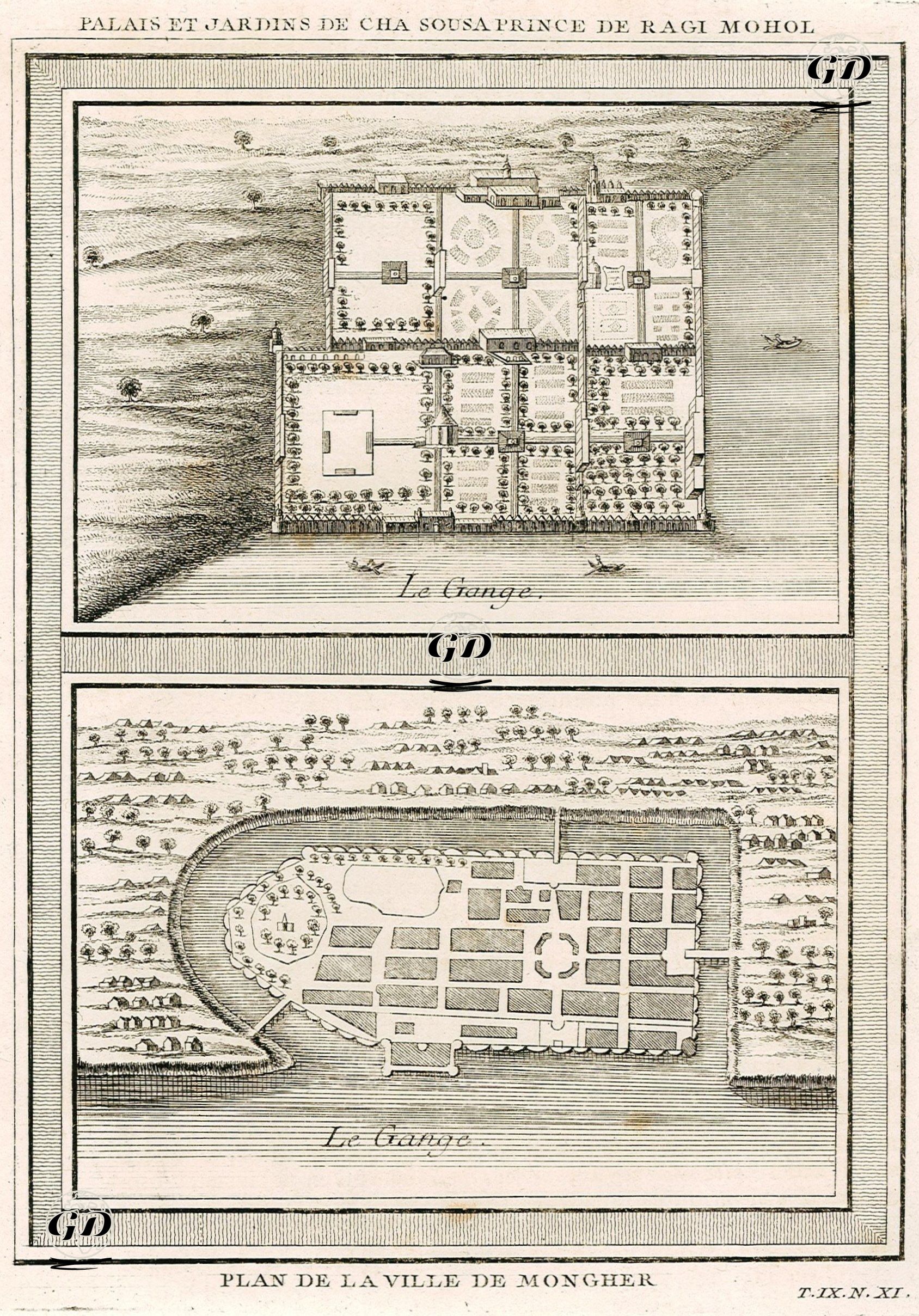
This detailed engraving presents two distinct but thematically related visual plans reflecting the architectural and urban layout of Mughal India in the 17th and 18th centuries. The image at the top of the engraving, titled "Palais et Jardins de Cha Sousa Prince de Ragi Mohol," depicts the palace and garden complex built by Mughal Prince Shah Shuja in Rajmahal. "Cha Sousa" here is the sonorant spelling of Prince Shah Shuja's name in French sources; "Ragi Mohol" is the variant of Rajmahal used by European cartographers. Shah Shuja (1616–1661) was the second son of the Mughal ruler Shah Jahan. During his father's reign, he was appointed viceroy (governor) of the provinces of Bengal, Orissa, and Bihar (1639–1660). During this tenure, Rajmahal became the capital of the Bengal governorate and a major administrative center, and this elegant palace complex was constructed. The palace was designed as a structure planned according to the traditional four-armed charbagh garden layout, surrounded by pools in the middle, geometric paths and terraces. This location overlooking the Ganges River is a powerful example of both water-based urban planning and the aesthetic and symbolic understanding of Mughal architecture. The image titled "Plan de la Ville de Mongher" at the bottom of the engraving presents the plan of the city of Monghyr (modern-day Munger). This riverside city, like Rajmahal, was a strategic point in the Ganges Valley. The engraving depicts the city with a regular geometric layout, presenting it as a central settlement surrounded by fortification walls. Within the rectangular city walls, main roads, small neighborhoods, and likely administrative or military centers were carefully placed. The harbor-like or quay-like structures along the Ganges River emphasize the city's economic relationship with the river. Like Rajmahal, Munger was a center of both commercial and military importance during the Mughal period.