GRAVÜR DÜNYASI
Digital Engraving Library
| Engraver | Ernst George Ravenstein (1834-1913) |
| Date | 1877 |
| Technique | Woodblock Engraving (Newspaper-Text on Reverse) |
| Category | Maps |
| Source | The İllustrated London News (December 15 1877-Page 580) |
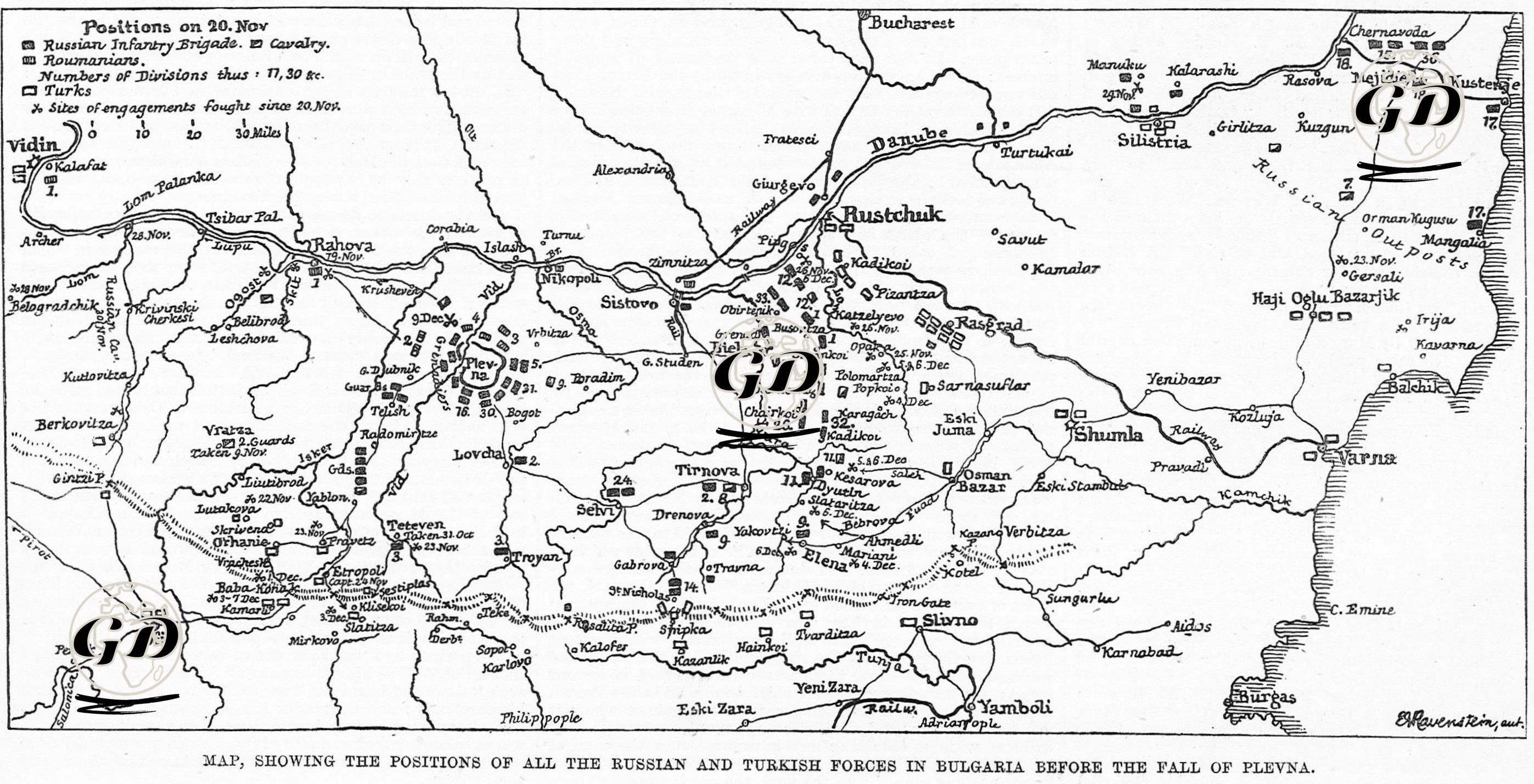
This map and accompanying news item, published in The Illustrated London News on 15 December 1877, comprehensively illustrates the positions of Ottoman, Russian and Romanian military forces in Bulgaria just before the fall of Pleven. The map provides a detailed picture of the final positions on 20 November 1877 and the battle lines up to 9 December. The dotted rectangles on the map represent Russian infantry brigades, the circled rectangles represent Russian cavalry units, the lined rectangles represent Romanian units, the open rectangles represent Ottoman units and the crosshairs represent the areas of fighting since 20 November 1877. The dates of the battles as of 9 December 1877 are also indicated on the map (for example, around Tsibar Palanka on 30 November; Baba Konak on 7 December; Lovça on 9 December). The unit numbers are shown in numerical order to give a realistic distribution of Russian and Romanian divisions. The map also includes important logistics centers along the Danube River, such as Vidin (Widdin), Kalafat, Ruschuk (Rustchuk), Silistra (Silistria) in the north and Varna, Balchik, Kustence in the east. The new geopolitical situation that emerged after the fall of Plevne on December 10, 1877 was commented in the news text. As follows; Turkish forces in Western Bulgaria were under serious threat. Mahmud Ali Pasha's army around Orhaniye (Orhanie), Kamarlı and Baba Konak became defenseless against Russian, Romanian and possible Serbian advances with the fall of Plevne. The map clearly shows the Turkish positions and possible retreat routes on this line. In the event of Serbia's active involvement in the war, it is foreseen that the region from Vidin to Sofia will fall. In Eastern Bulgaria, Suleyman Pasha's army is lined up starting from the Danube line and extending along the Slivno, Varna and Shumen lines. This region is defended by four important fortresses (Ruse, Shumen, Silistre and Varna) known as the "Quadrilateral" (Four-Fortress Line) and fortified against the Russians. This defensive line still stands as a strong defensive line and is supported by a railway network. The map shows this line clearly, especially the positions of the Russian troops around Ruse and Silistra are noteworthy. In central Bulgaria, the line of Tarnovo–Gabrova–Shipka is of critical importance. The Turkish troops under the command of Rauf Pasha, who was recalled to Istanbul as Minister of War, tried to defend the roads leading to the Shipka Pass. However, the map and the news text indicate that the short-term fall of Elena did not constitute an advantage for the Russians and that this action was ineffective. As can be understood from this, the Ottoman troops were delaying the Russian advance by means of positional defense on this front. The main front where the Russian forces were concentrated was along the line starting from the south of Pleven and extending through Lovça, Tirnova, Gabrova, Biela and Rusçuk to Silistra. It can be clearly seen on the map how the Russian troops advanced along the front line and were positioned at bridgeheads and railway centers on the Danube. In conclusion, this map is a map of the military balance in Bulgaria at the time when the siege of Pleven entered its final phase in the Russo-Turkish War of 1877. It can be clearly read on this map that with the surrender of Osman Pasha, the Turkish resistance in Western Bulgaria was broken, the Sofia and Maritsa Valley line came under threat, and yet the defense line in Eastern Bulgaria (the Quadruple Castle System) still stands. In addition, it can be visually observed on the map that Russian troops were advancing south along the Danube in a coordinated manner, while the Ottomans were trying to hold on to the Balkan Mountains line. This map strategically reveals the final military picture before the fall of Plevna, one of the fateful moments of the war.