GRAVÜR DÜNYASI
Digital Engraving Library
| Artist | Philippe Marie Guillaume Vandermaelen (1795-1869) |
| Engraver | De Lahoese |
| Date | 1840's |
| Technique | Copper Engraving-Original Hand Colored |
| Category | Maps |
| Source | Etablissement Geographique De Bruxelles Fonde Par Ph.Vandermaelen, Brussels 1830 |
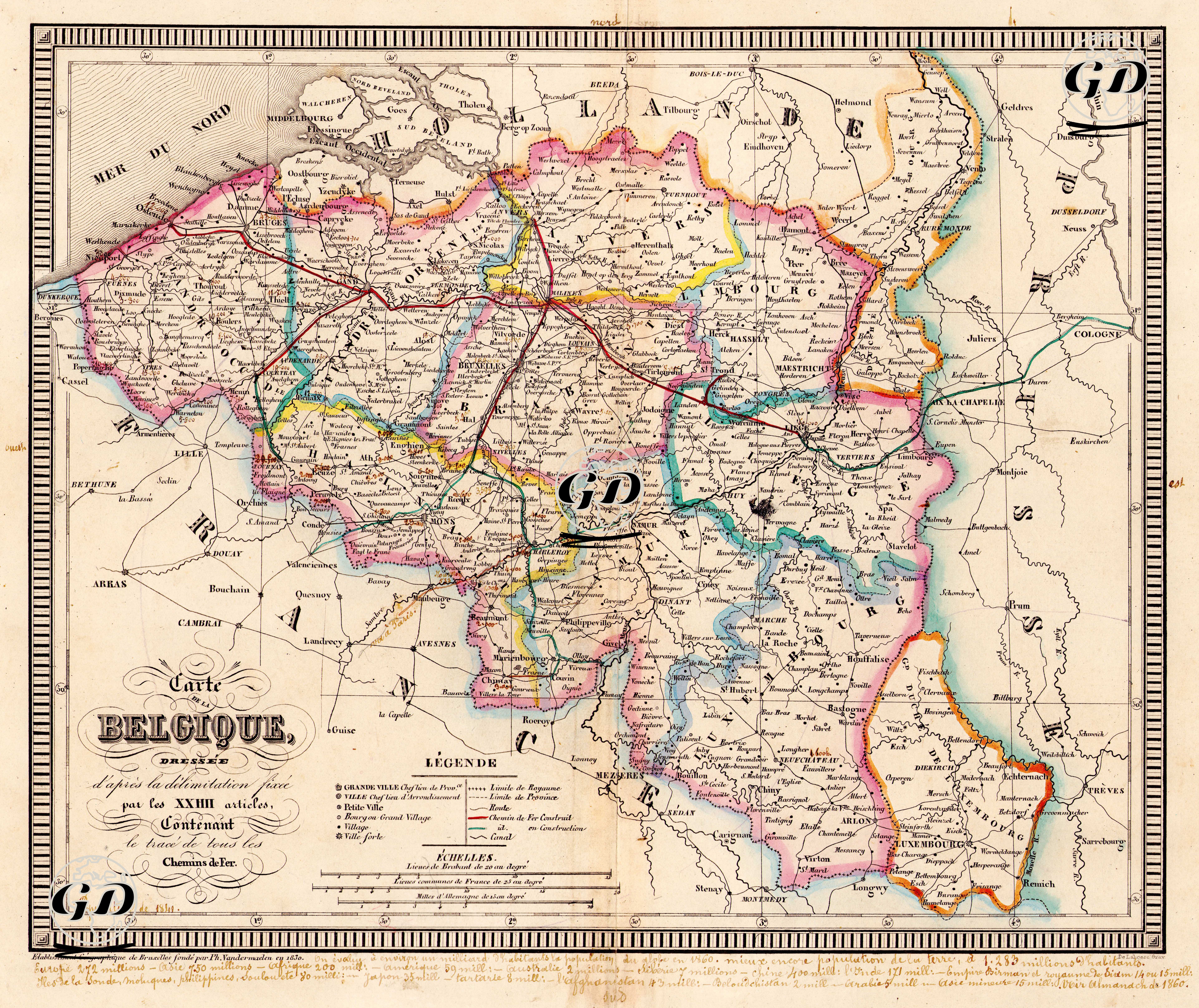
This map is a historical and geographical document based on the Treaty of London of 1839, detailing Belgium's borders and railway networks. The caption in the lower left corner of the map reads "Belgium Map, dressée d'après la délimitation fixée par les XXIIII articles, contenant le tracé de tous les chemins de fer." This caption can be translated into English as "Map of Belgium, and Routes of All Railway Lines, Prepared According to the Boundaries Determined by the 24-Article Agreement." The "XXIIII articles" reference here refers to the 24-Article provision of the Treaty of London, signed in 1839, which officially recognized Belgium's independence. This treaty was ratified by the United Kingdom, France, Austria, Prussia, and Russia, thus officially demarcating Belgium's international borders and guaranteeing its neutrality. The administrative structure of Belgium is shown on the map through the provincial borders, separated by colored lines. Symbols in the central legend box distinguish major cities (Grandes villes), provincial capitals (Chef-lieu de Province), fortress cities (Villes fortifiées), collegiate cities (Villes avec église collégiale), and villages (Villages). The most striking element is the railway network, shown in red. As the title suggests, this map provides detailed railway routes. The steam railway line between Brussels and Mechelen in Belgium, opened in 1835, was the first steam-powered railway in continental Europe. The map also clearly reflects Belgium's geopolitical position. The borders with Prussia (present-day Germany) to the east, Luxembourg to the southeast, France to the west, and the Netherlands to the north are clearly marked. In this respect, the map highlights not only internal borders but also external borders that shape international balances. Scale charts are presented in both French miles and geographic degrees, increasing the scientific accuracy of the map. In conclusion, this map is a multi-layered historical source that visually reveals not only the topography of Belgium but also the borders fixed by the 1839 Treaty of London, its early railway infrastructure, its neutrality status under international law, and its orientations in the modernization process.