GRAVÜR DÜNYASI
Digital Engraving Library
| Artist | Jean Baptiste Bourguignon D'Anville (1697-1782) |
| Engraver | Joseph Bye (1779-1817) |
| Date | 1808 |
| Technique | Copper Engraving |
| Category | Maps |
| Source | London Published By F.C. And J.Rivington July 1 1808 |
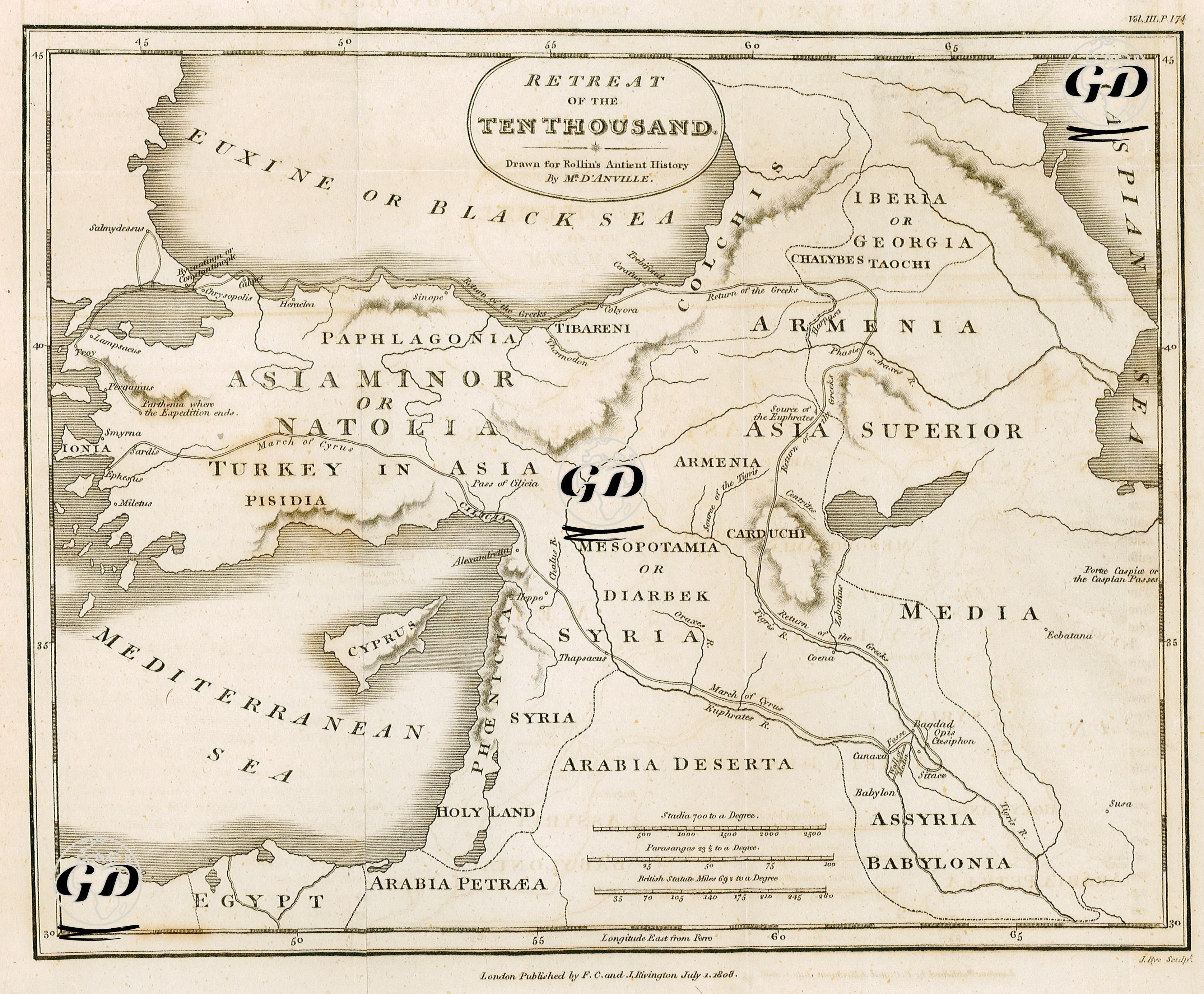
This map dated 1808 was prepared based on the campaign described in Xenophon's work "The Return of the Ten Thousand" (Anabasis—Greek for "Upward Expedition"). This geographical narrative visualizes the campaign of the young Persian prince Cyrus, who, as described by Xenophon, led a campaign of Greek mercenaries against his brother Artaxerxes II near Babylon in 401 BC to seize the Persian throne. The subsequent defeat of Cyrus's death, and the subsequent great retreat (Anabasis) of approximately 10,000 Greek soldiers who advanced with him into Mesopotamia, attempting to cross enemy territory and reach the Black Sea coast. The map depicts the routes of the military campaigns with two distinct lines. These two lines represent the different stages of the military campaign: one for the advance (March of the Greeks), the other for the return (Return of the Greeks). The campaign began in Sardis (near present-day Manisa-Salihli), the Lydian city of Cyrus, the camp of the Persian prince Cyrus. Sardis was where Cyrus mustered his army. The army then marched eastward through Phrygia and Iconium (modern-day Konya). On the map, this region is divided into Lycaonia and Pisidia. These were regions far removed from the Greek world and inhabited by semi-independent Anatolian tribes. The army then descended southeastward, passing through Tarsus and the Cilician Gates. This point was crucial because it consisted of narrow passes and was strategically difficult to capture. Cyrus's army encountered diplomatic and logistical difficulties in passing through these areas. The expedition continued into Mesopotamia (modern-day Iraq) via places such as Thapsacus, where the Euphrates River flows. This crossing point, shown in detail on the map, was one of the most challenging and risky phases of the campaign. Near Cunaxa, east of the Persian capital Babylon, the main target, Artaxerxes II, brother of Cyrus the Younger, was encountered. The Battle of Cunaxa was fought here, and Cyrus lost his life. On the map, this region is shown east of the inscriptions "Babylon" and "Media." With the death of Cyrus, the army, having lost its leadership, initiated the famous "return of the ten thousand" (Anabasis), which involved 10,000 Greek soldiers, finding themselves surrounded in enemy territory, electing new leaders from among themselves and returning northward toward the Black Sea. The double lines depicting the return route on the map, marked by the phrase "Return of the Greeks," indicate the direction of the struggle to reach the Black Sea. This dramatic return began in the mountainous region of Carduchi. Here, the soldiers battled mountainous terrain and warlike tribes. This region is described as one of the most arduous stages in the Anabasis. The second stage was carried out through the mountainous regions of eastern Anatolia, traversing difficult snowy passes in the dead of winter. After months of marching, the army reached the Black Sea coast and finally Trapezus (Trabzon) on the Black Sea coast, where the chants of "Thalatta! Thalatta!" The cry (Sea! Sea!) is etched into memory as an iconic moment in military historiography. In the following phase, the mercenaries advanced westward along the Black Sea coast, reaching port cities such as Cerasus (Giresun), Kotiora (Ordu), Sinope (Sinop), and Heraclea Pontica (Karadeniz Ereğli), before finally reaching Byzantium (Istanbul). Some units returned by land via Bithynia and Thrace (Thrace). This line, shown at the western end of the map, represents the final phase of the campaign. This period saw the soldiers clash with some local tribes and receive renewed offers of service as mercenaries. The map meticulously depicts each stage of this grand march, conveying to the viewer both the spatial and historical reality of the period through the place names, rivers, mountains, and ports along the route.