GRAVÜR DÜNYASI
Digital Engraving Library
| Artist | John James Dower (1825-1901) |
| Engraver | John James Dower (1825-1901) |
| Date | 1855 |
| Technique | Woodblock Engraving (Newspaper-Text on Reverse) |
| Category | Maps |
| Source | The İllustrated London News (January 20 1855-Page 57) |
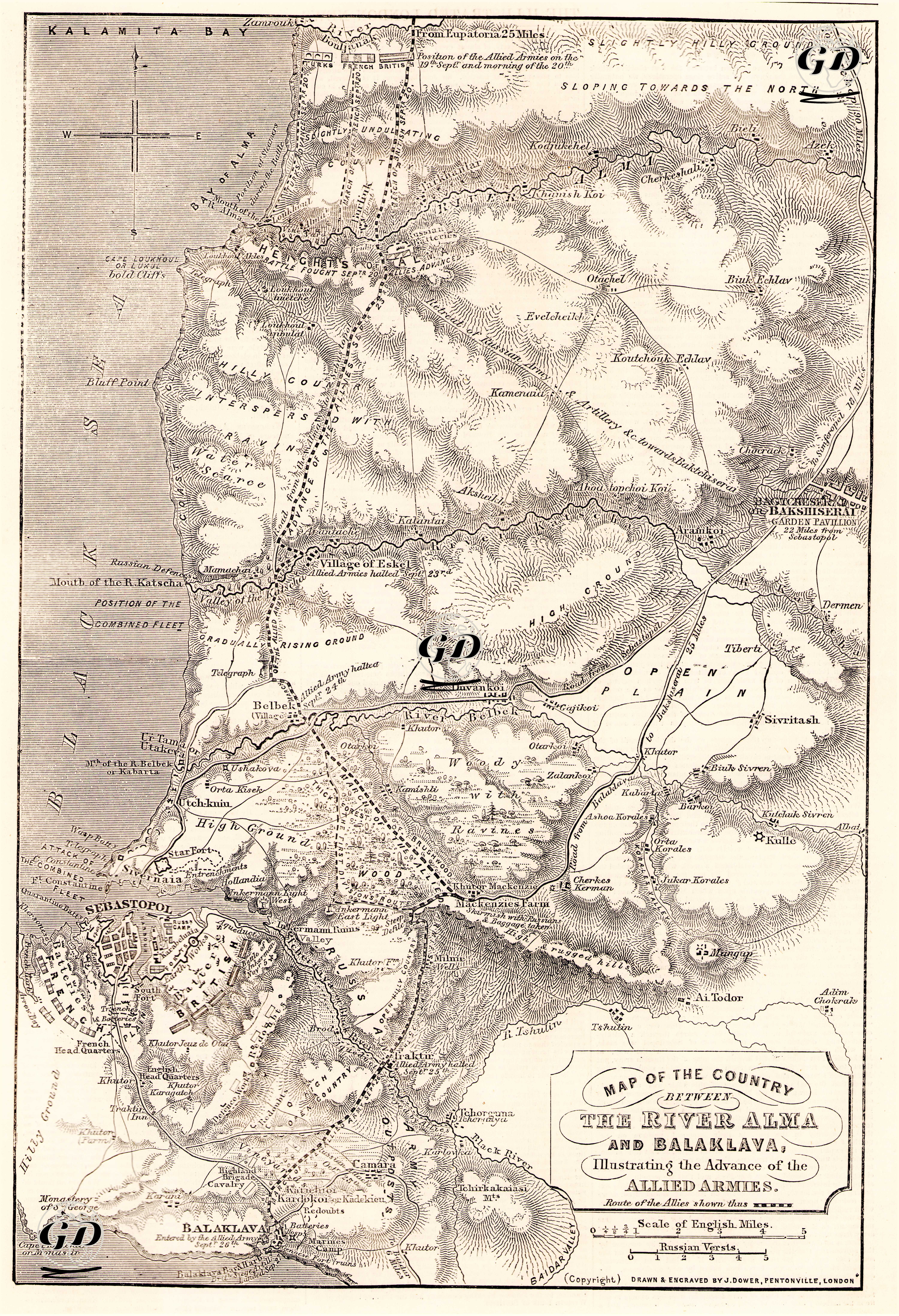
This map shows the area between the Alma River and Balaklava during the Crimean War and the route of the Allied Armies' advance in this area in the autumn of 1854. This line covers the route from the point where the forces landed on the Crimean Peninsula to the siege of Sebastopol. In the northern part of the map, an Allied offensive starting from the Alma River and the Gulf of Kalamita and Eupatoria in the northwest is seen, from here the military advance southwards to the siege of Sebastopol is marked step by step with dashed lines, and along the line, battlefields, positions, villages and topographic features are shown in detail. In particular, the famous battle on the Alma River (September 20, 1854) is known as the first major Allied attack on Crimea, and on this map the positions of the Russian forces positioned on the west bank of the river and the Allied forces positioned on the east bank are clearly marked, and the places where the Allied armies crossed the river are detailed with hilly terrain and elevations. In the center of the map, the Belbek River and the Inkerman region stand out; this was a strategic battleground during the siege of Sebastopol. The locations of British headquarters, French troops and Russian defensive lines are indicated in detail, and points of military, religious and geographical importance such as the "Monastery of St. George", "Tchernaya River", "Heights of Inkerman" are clearly defined on the map. The Port of Balaklava is located in the south of the map and is of great importance both as a logistical support point and in terms of the Battle of Balaklava (1854). The British headquarters, field hospitals and supply routes in this region are shown in detail, and especially the supply lines of the Allied armies, their connections with ports and mountain passes are shown. In the newspaper article related to this map, some negative comments were made regarding the advance of the Allied armies; The advance of the Allied armies from the Alma River to the Port of Balaklava before the siege of Sebastopol began in the autumn of 1854 has been evaluated in military history as a period full of both great hopes and serious strategic mistakes. The period of hesitation following the first victory led to missed opportunities due to the different priorities and hesitations of both the French and British commanders in making decisions. During the Battle of Alma, the previously decided attack plan was deviated from, which caused especially heavy losses for the British troops. The fact that Lord Raglan and Marshal St. Arnaud did not pursue the enemy after Alma and did not immediately head towards Sebastopol allowed the Russian army to regroup and strengthen its defenses. Some British officers, especially those who opposed the French commander's decision to circle from the south, argued that the city could be taken directly with a quick attack. However, these views were not accepted, a siege decision was made, and a three-week waiting period was experienced during this process. During this period, the Russians fortified the south of Sebastopol by mobilizing women and children; they formed an effective defense line against the Allies' limited number of cannons, insufficient ammunition, and uncoordinated engineering work. The differences in timing and strategy between the British and the French, the inadequacy of artillery power and planning deficiencies caused the city of Sebastopol to be taken at a time when it could have been easily captured. As a result, the Allied armies were unable to take advantage of a major strategic advantage that would determine the course of the war, which led to the prolongation of the war and greater losses.