GRAVÜR DÜNYASI
Digital Engraving Library
| Artist | Eduard Charlemont (1848-1906) |
| Engraver | Richard Paulussen (1852-1906 ) |
| Date | 1894 |
| Technique | Photogravure |
| Category | Theatre,Opera And Ballet |
| Source | Die Theater Wiens; Das K.K. Hofburgtheater seit seiner Begründung, von Oskar Teuber und Alexander von Weilen - Gesellschaft für vervielfaaltigende Kunst, Wien |
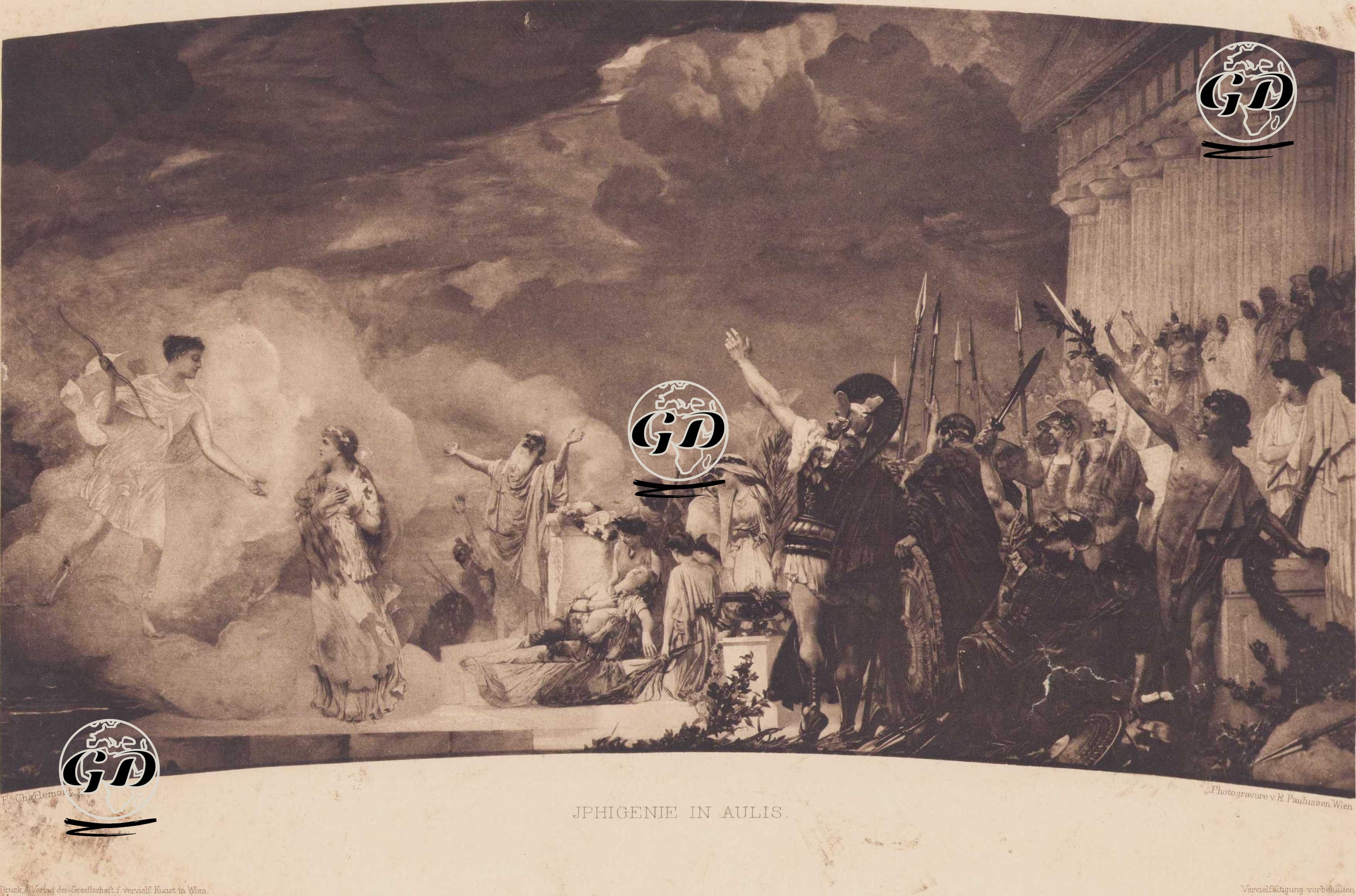
This engraving, published in 1894 in "Die Theater Wiens," a journal of Viennese performing arts, was designed by Eduard Charlemont and engraved by Richard Paulussen. It depicts in detail the ceiling fresco "Iphigenia in Aulis" in the Vienna Burgtheater. The engraving is based on Euripides' play "Iphigenia in Aulis," one of the great works of ancient Greek tragedy. In this dramatic scene depicting the final section of the play, the Greek army, about to embark on the Trojan War, is prevented from embarking on its campaign because the goddess Artemis has stopped the winds. It becomes clear that a sacrifice is necessary to appease the goddess. Agamemnon, the army's commander-in-chief, agrees to sacrifice his daughter Iphigenia to appease the goddess's anger. However, just as the sword is about to fall upon Iphigenia's head during the sacrifice, the young girl suddenly disappears. Artemis accepted the sacrifice, and after this miraculous event, the winds blew again and the army was able to continue its campaign. (In some interpretations, Artemis saved Iphigenia and placed a deer on the sacrificial table in her place.) The explanations about this engraving in the book "Die Theater Wiens", which includes this engraving, are as follows: The scenes of preparation for the sacrifice and the goddess's rescue are depicted as two separate sequences; even Iphigenia's figure is repeated twice: in one, she kneels at the sacrificial altar, resigned to her death, and looks down with humility at Artemis, who stands beside her in a benevolent manner. The temple's forecourt and sacrificial area extend down to the sea; the Doric columned gallery (peristyle) on the right side is a very successful stage setting, although the perspective is somewhat distorted towards the edges. The Achaeans are arrayed in rows before the temple columns; they are also packed tightly on the platform below. Helmets gleam, swords drawn, shields raised, spears pointed skyward. This scene is a magnificent composition, entirely armed with weapons. All are marching towards the expedition and the battle. In the foreground stands Agamemnon, wearing the high royal helmet, depicted in full accordance with Homer's armorial description. He is turned on his side, his left foot raised, and with a lively arm gesture, he points to the dense cloud mass bringing the anticipated sea breeze into the sky. This figure is rich in pictorial vibrancy and, with its pathetic expression, possesses a dramatic character in the French style. Behind him, a young man of powerful build shouts loudly, holding a sword in one hand and a laurel branch in the other. This same intense excitement permeates the entire crowd of warriors. Some of them are depicted as recognizable as commanders. Intense movement and loud shouts everywhere; the entire scene creates a theatrical effect, like the stirring finale of a great heroic opera. The old bearded priest at the head of the altar, his hands raised in prayer, is a fairly conventional figure, resembling a typical stage priest. The female figures create a simple yet emotional tone amidst this harsh male action. Off to the side, two young girls, holding palm branches, gaze timidly and respectfully at the stage. Those in the center bow with compassion to Iphigenia, prostrate before the altar. And now, the redemptive divine act takes place. Artemis, depicted with arrow and quiver, soars toward the grateful, resurrected maiden. Luminous divine clouds emerge impressively from the dark storm clouds. However, these figures are defined only to the extent of the miracle, without elaborate detail. At the outermost edge of the stage, on either side, are other deities: Pallas Athena by the temple, Poseidon on the banks of the ecstatic Euripides—but Poseidon's figure is now almost disconnected from the overall composition of the stage. The engraving presents not only a dramatic mythological event but also the fundamental elements of tragedy: divine justice, the inevitability of fate, and human helplessness—with a dazzling theatrical aesthetic. Such scenes, found among the ceiling decorations of the Burgtheater in Vienna, demonstrate how the 19th-century fascination with classical culture was transferred to the theatrical stage and the visual arts. The moment of Iphigenia's salvation presents the audience with a universal narrative that touches both the human and divine planes.