GRAVÜR DÜNYASI
Digital Engraving Library
| Artist | Franz Matsch (1861-1942) |
| Engraver | Wilhelm Woernle (1849-1916) |
| Date | 1894 |
| Technique | Photogravure |
| Category | Theatre,Opera And Ballet |
| Source | Die Theater Wiens; Das K.K. Hofburgtheater seit seiner Begründung, von Oskar Teuber und Alexander von Weilen - Gesellschaft für vervielfaaltigende Kunst, Wien |
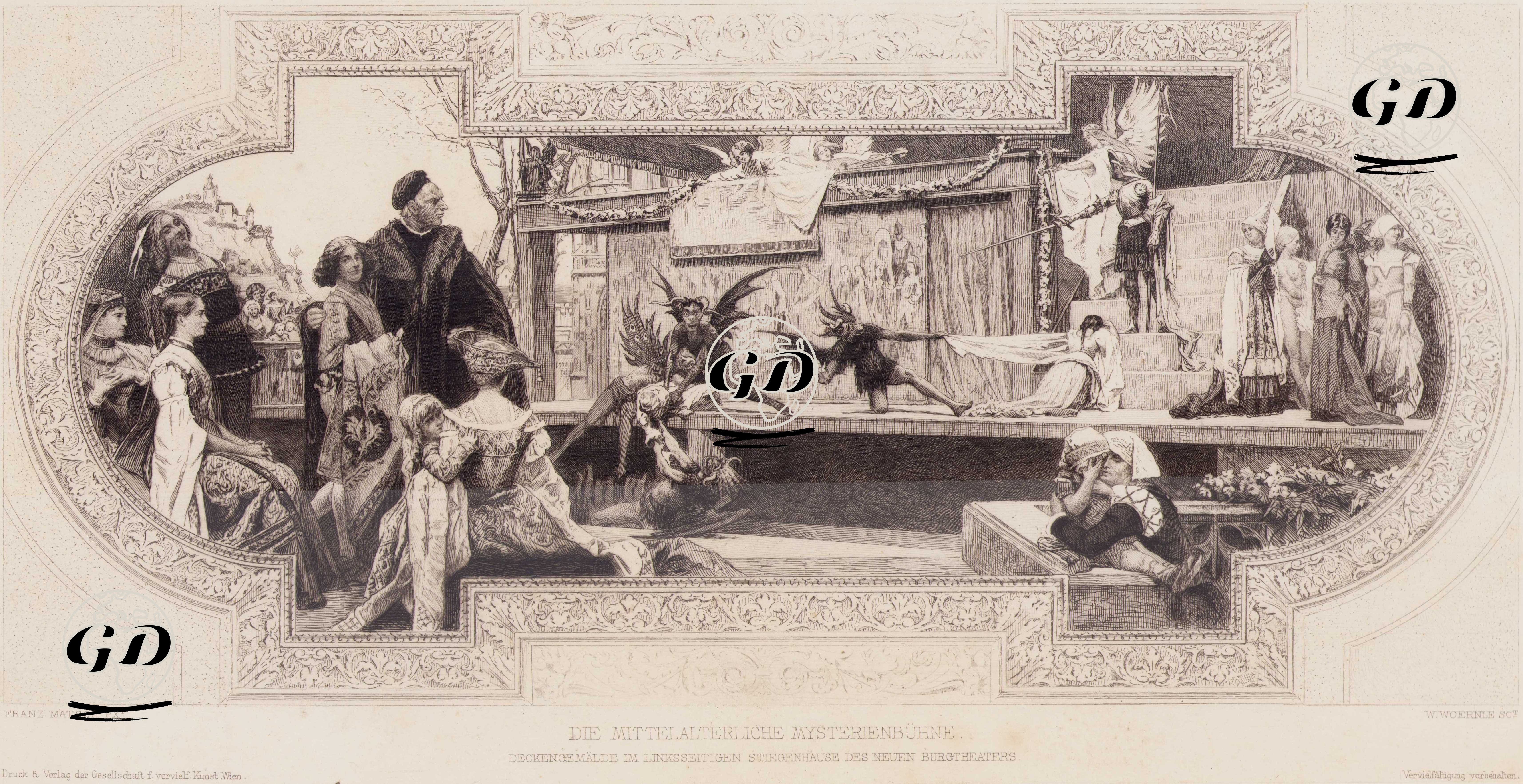
This engraving, published in 1894 in "Die Theater Wiens," a document of Viennese performing arts, was designed by Franz Matsch and engraved by Wilhelm Woernle. The engraving is based on the composition "Die Mittelalterliche Mysterienbühne," or "Medieval Mystery Theater," a ceiling decoration by Austrian painter Franz Matsch, located on the left-hand landing of the new building of the Vienna Burgtheater. The term "medieval mystery theater" describes scenes from medieval religious plays, particularly those depicting Christian sacred stories, the life of Jesus, his crucifixion, and the lives of the saints. This engraving features a dramatic, multi-layered stage arrangement that recreates the tradition of medieval religious theater. The composition centers on a "diablerie," or devil's play, reflecting the mystical and allegorical mindset of the Middle Ages, visualizing the struggle between the powers of hell and heaven over the human soul. The explanations made in the book regarding this engraving are as follows; This scene is a composition filled with characteristically profound imagery. It places us squarely in the midst of the fantastical world of the Middle Ages. A "devilry spectacle" is being played out on stage, or rather, a struggle between hellish spirits and heavenly emissaries over the disputing souls. This is closely related to a similar depiction in the fresco "The Triumph of Death" in Campo Santo in Pisa. The comical yet terrifying demons are like those depicted by Hieronymus Bosch, the painter of hell. They also recall the "dry devils" in the second part of Goethe's "Faust." The demons have already seized a victim: a woman sinner, prostrate and praying, is being pulled violently by her clothing. But at that very moment, a saint-knight in shining armor and a high helmet (probably St. Michael) appears and protectively extends his sword over the woman. At the same moment, white-winged knights, holding a cross in their hands, appear. an angel flies onto the stage in a savior-like manner. This celestial intervention represents the eternal struggle won by heaven's representatives against the powers of hell. At the back of the stage is a "decorative wall painted with stories of earthly virtue and sin." On the platform to the right of the stage, a group of women prepare for the scenes to come offstage. One of them is nude and presumably will play the role of Eve. The audience is rendered with the finest painterly sensitivity, and the most impressive costume studies reappear in this scene. The clothing, for obvious reasons, particularly the need for veiling, approaches the Renaissance character. Next to the Gothic balustrade at the front of the stage, a mother, frightened by the demonic wiles of her child, tries to calm him. However, the main figures in the audience are on stage left: an old man dressed in a fur and wearing a beret, gazes intently at the stage, seemingly imbuing everything with a deeper meaning. A beautiful young man stands beside him, his arm around him. In the foreground, a woman in lavish attire and an ornate hat sits with her back to the audience, accompanied by a small girl. A little further to the side, two elegant female figures catch our eye: one, a well-mannered and elegant young woman, her hands clasped in her lap, appears to be watching the play with awe. The other, with her hands crossed in front of her chest, wears an expression of astonishment. Next to them, a handsome but arrogant young nobleman appears to be enjoying the performance or the surroundings. Behind the stage, there is another area for the common people. Beyond this area, a Dürer-style landscape is visible: a sloping rocky outcrop, topped by a castle and a small chapel. The engraving stands out not only as a religious representation, but also as a visual document of the revival of historicism and symbolism in late-19th-century Austria. The theatrical poses of the figures placed on stage, the costume details, and the attention to facial expressions demonstrate that Franz Matsch's design was not merely a spectacle but also a commentary on the ideological and aesthetic approaches of the period. The entire composition invites the viewer to seek meaning not only in the dramatic scene itself but also in the emotional reactions of the audience. From this perspective, the "Medieval Mystery Theatre" is an audiovisual ritual transferred to woodcut, both with its iconographic richness and theatrical narrative language.