GRAVÜR DÜNYASI
Digital Engraving Library
| Artist | Godefroy Durand (1832-1896) |
| Date | 1877 |
| Technique | Woodblock Engraving (Newspaper) |
| Category | Ottoman Empire And Turkey |
| Source | The Graphic (December 29 1877-Page 609) |
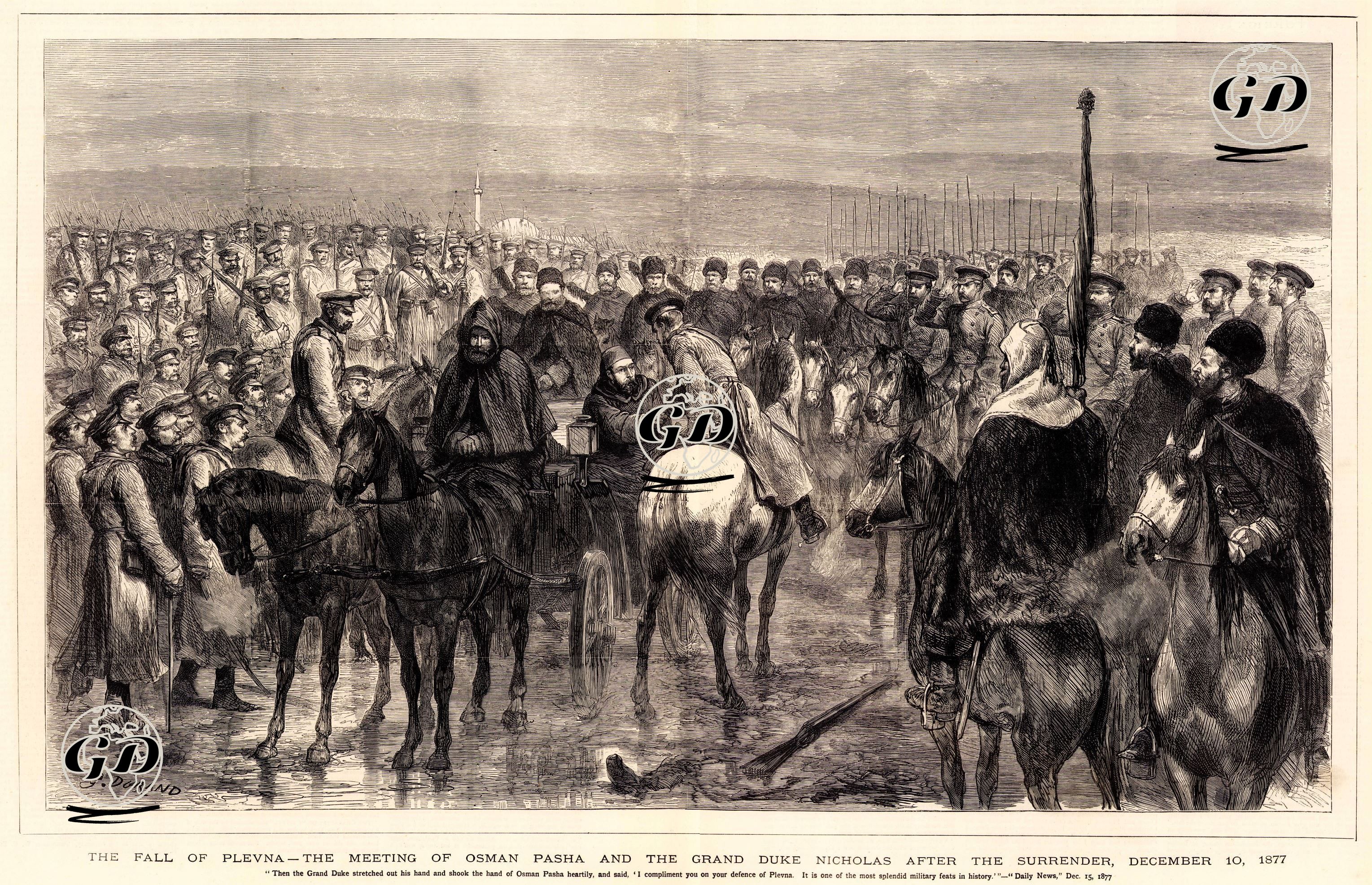
This engraving depicts one of the most poignant and historic moments of the Russo-Turkish War of 1877–1878, the meeting between Osman Pasha and Grand Duke Nicholas after the Defence of Plevna. After five months of resistance, Osman Pasha surrendered, wounded, to the Russian army on December 10, 1877. However, this surrender went down in history as a scene of honor rather than defeat. This engraving, published in The Graphic News newspaper on December 29, 1877, immortalizes that moment. The newspaper's news text related to the engraving is an article written by a war correspondent who witnessed the moment of Osman Pasha's surrender. The Turkish translation of the news text is provided below in its entirety, preserving its original meaning; "THE MEETING OF OSMAN PASHA AND THE GRAND DUKE NICHOLAS - On the tenth of this month, after a weary siege of five months, and a last desperate effort on the part of the besieged to break through General Todleben’s inexorable circle of steel, a white flag was seen in the Turkish ranks, and a loud shout went up from a thousand Russian throats. Plevna was on the point of surrender. A Turkish officer, Tewfik Bey, chief of Osman Pasha’s staff, then rode up to General Skobeleeff and his staff with a flag of truce, and informed the Russians that Osman Pasha was wounded and ready to treat for surrender. After a few words with General Strukoff, of the Czar’s staff, Tewfik Bey rode back to his chief. A conference took place between General Ganetsky and Osman Ghazi, and in an hour the latter had surrendered with his whole army to the Russians. The greatest sympathy and regard was shown on all sides to Osman Pasha, whose bravery and skill all admired, and the wounded General was placed in a carriage and driven into Plevna. Hearing, however, that the Grand Duke Nicholas was coming in his direction, Osman Pasha turned back to meet him, and the subsequent interview is thus graphically described by the correspondent of the Daily News: “The Grand Duke rode up to the carriage, and for some seconds the two chiefs gazed into each other’s faces without the utterance of a word. Then the Grand Duke stretched out his hand, and shook the hand of Osman Pasha heartily and said:—‘I compliment you on your defence of Plevna. It is one of the most splendid military feats in history.’ Osman Pasha smiled sadly, rose painfully to his feet in spite of his wound, said something which I could not hear, and then re-seated himself. The Russian officers all cried, ‘Bravo!’ ‘Bravo!’ repeatedly, and all saluted respectfully. There was not one among them who did not gaze on the Hero of Plevna with the greatest admiration and sympathy. Prince Charles, who had arrived, rode up, and repeated unwittingly almost every word of the Grand Duke, and likewise shook hands. Osman Pasha again rose and bowed, this time in grim silence. The war correspondent describes Osman Pasha as follows: ‘He wore a loose blue cloak, with no apparent mark on it to designate his rank, and a red fez. He is a large, strongly-built man, the lower part of whose face is covered with a short black beard, without a streak of grey. He has a large Roman nose, and black eyes. The face is a strong face, with energy and determination stamped on every feature—yet a tired, wan face also, with lines on it that hardly were graven so deep I fancy five months ago; and with a sad, enduring, thoughtful look out of the black eyes.” ‘It is the face of a great military chieftain,’ said young Skobeleff. ‘I am glad to have seen him. Osman Ghazi he is, and Osman the Victorious he will remain, in spite of his surrender.’”