GRAVÜR DÜNYASI
Digital Engraving Library
| Date | 1864 |
| Technique | Woodblock Engraving (Newspaper-Text on Reverse) |
| Category | Ottoman Empire And Turkey |
| Source | The illustrated London News (December 24 1864) |
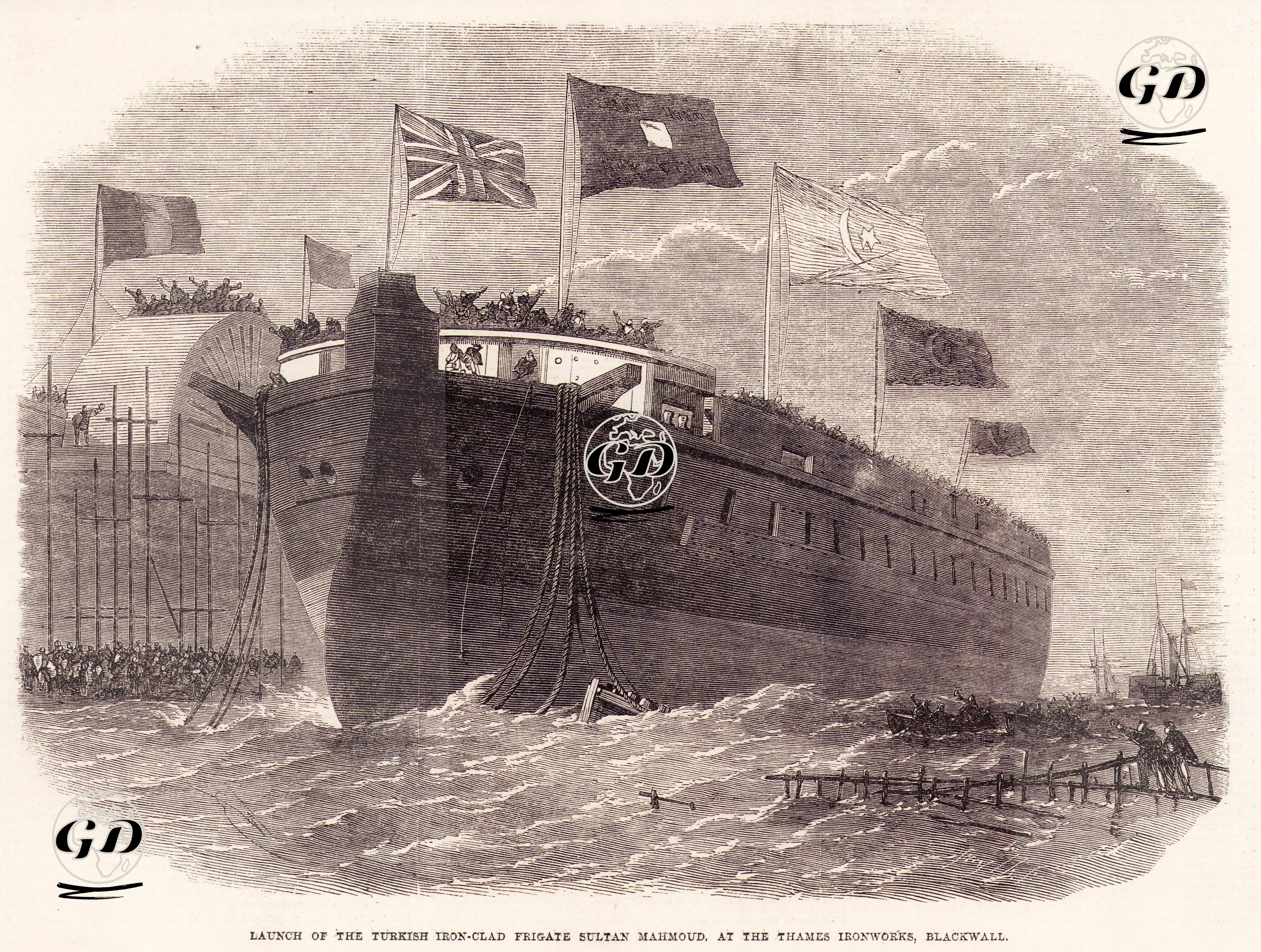
This engraving depicts the Ottoman armored frigate Mahmudiye, launched at the Thames Ironworks in London on December 13, 1864. The image depicts Mahmudiye, adorned with British and Ottoman flags, being ceremonially launched before a large crowd of spectators. Named after Sultan Mahmud II, Mahmudiye was built at the Thames Ironworks in England as part of the Ottoman navy's modernization drive. The ship was 91.4 meters long and 16.9 meters wide, and could reach a top speed of 13.5 knots with its steam-powered engine. Equipped with 25 Armstrong guns, the ship's powerful spur bow, typical of the period, gave it the ability to engage enemy ships. Her armor belt was 140 mm thick, and the battery compartment was protected by 127 mm thick iron plates. Mahmudiye, which joined the Ottoman fleet in 1866, was not sent to the front during the 1877–1878 Ottoman-Russian War due to its strategic value, but was kept in port throughout the war. After the 1880s, she became unnavigable due to poor maintenance, her engines rusted, and her hull became heavily coated with moss. Between 1892 and 1894, she underwent a comprehensive refit, with her Armstrong guns removed and replaced by Krupp guns. However, this refit proved insufficient against contemporary navies, and she was effectively unusable during the Greco-Turkish War of 1897. Mahmudiye was officially decommissioned on July 31, 1909, and after serving as a barracks ship in Kasımpaşa between 1909 and 1913, she was dismantled. In Ottoman naval history, Mahmudiye is remembered as a magnificent warship that embodied the will to modernize in the steam-powered ironclad era of the 19th century, yet simultaneously as a symbol of her inadequate maintenance and financial constraints, preventing her from fully realizing her potential.