GRAVÜR DÜNYASI
Digital Engraving Library
| Date | 1854 |
| Technique | Woodblock Engraving (Newspaper-Text on Reverse) |
| Category | Ottoman Empire And Turkey |
| Source | The İllustrated London News (April 22 1854-Page 364) |
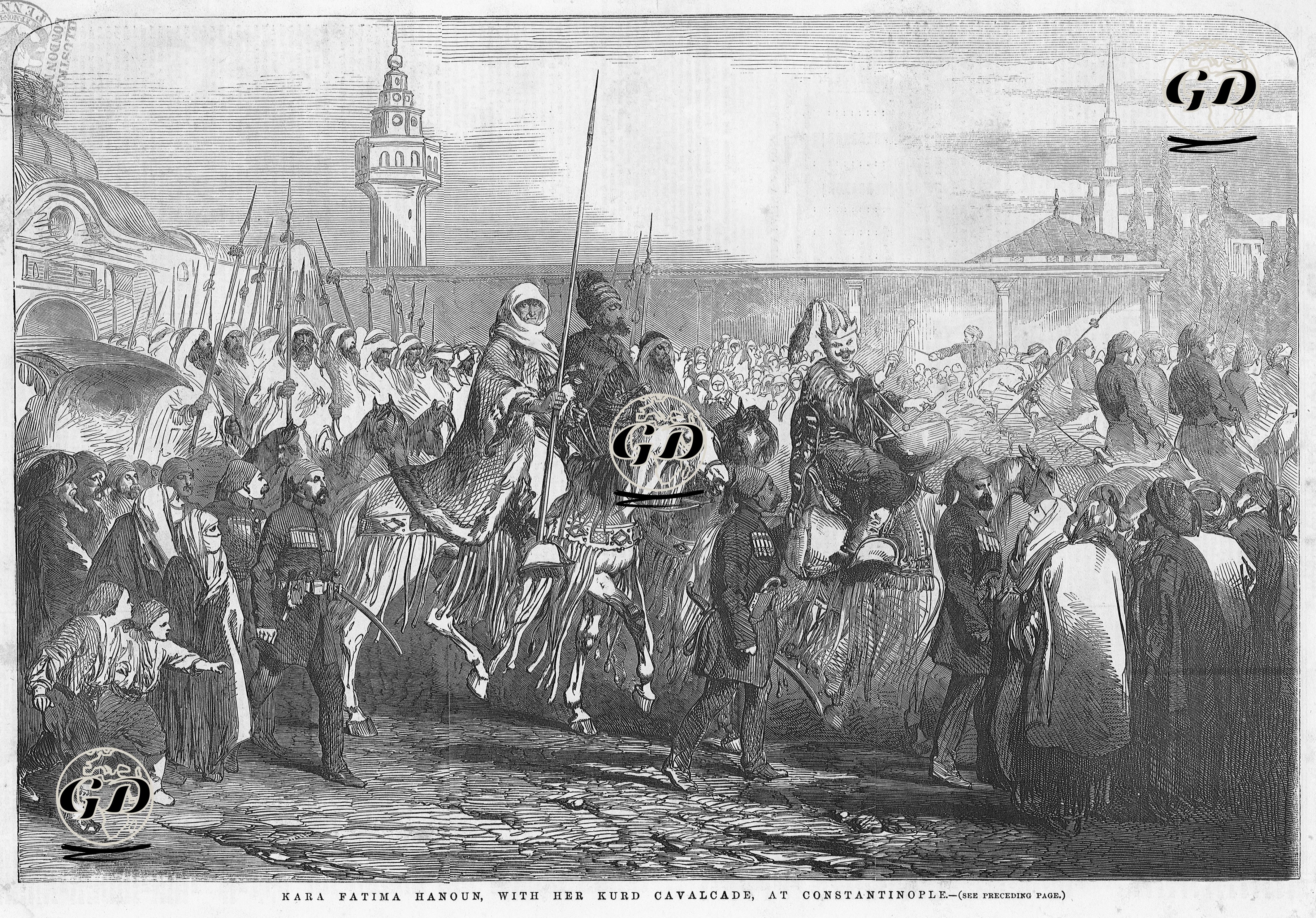
The "Kara Fatma Hanım" in this engraving should not be confused with Kara Fatma, the heroine of the War of Independence in history, or with Kara Fatma at the Aziziye Bastion in the 1877-1878 Ottoman-Russian War. Kara Fatma was the leader of a large Kurdish tribe that lived in the Maraş and Cilicia regions and had a capacity of four thousand horsemen, who came to Istanbul with approximately three hundred Kurdish horsemen to join the Ottoman army during the Crimean War. This tribe, one of the "irregular" groups that were not under direct control of the Ottomans, came to Istanbul as a volunteer for support in order to show loyalty to the Ottoman Empire by taking advantage of the war against a non-Muslim state. Kara Fatma Hanım's unit was sent to the Crimean front via Istanbul. Kara Fatma, whose real name is not exactly known, is also known in Western sources as "Fatima Hatun", "Black Beauty", "Kurdish Amazon" and "Black Princess"; She is depicted as an old, dark-skinned, and small-built woman with a masculine appearance, with her horseback riding, dress, open face, and harsh expressions. There were also rumors in some newspapers that Kara Fatma's husband was in prison and that she joined the war to show her loyalty to the Sultan and save him. In Ottoman documents, Kara Fatma, a member of the Cerid Tribe, was awarded a gold medal and a salary by the Sultan for her contributions to the Crimean War. In the engraving, Kara Fatma Hanım is depicted as a warrior woman leader in traditional dress, riding a horse in front and carrying a spear, while Kurdish horsemen in traditional dress advance behind her in a ceremonial atmosphere. The Western press symbolized her to show the active role of women in wartime. This incident, which also attracted great interest from the people of Istanbul, is both a rare example of a female leader in the Ottoman Empire and a historically important scene representing the Ottoman's multi-ethnic voluntary loyalty system and its modernizing image towards the West.