GRAVÜR DÜNYASI
Digital Engraving Library
| Artist | Joseph Nash (1809-1878) |
| Date | 1876 |
| Technique | Woodblock Engraving (Newspaper) |
| Category | Ottoman Empire And Turkey |
| Source | The Graphic (October 07 1876-Page 341) |
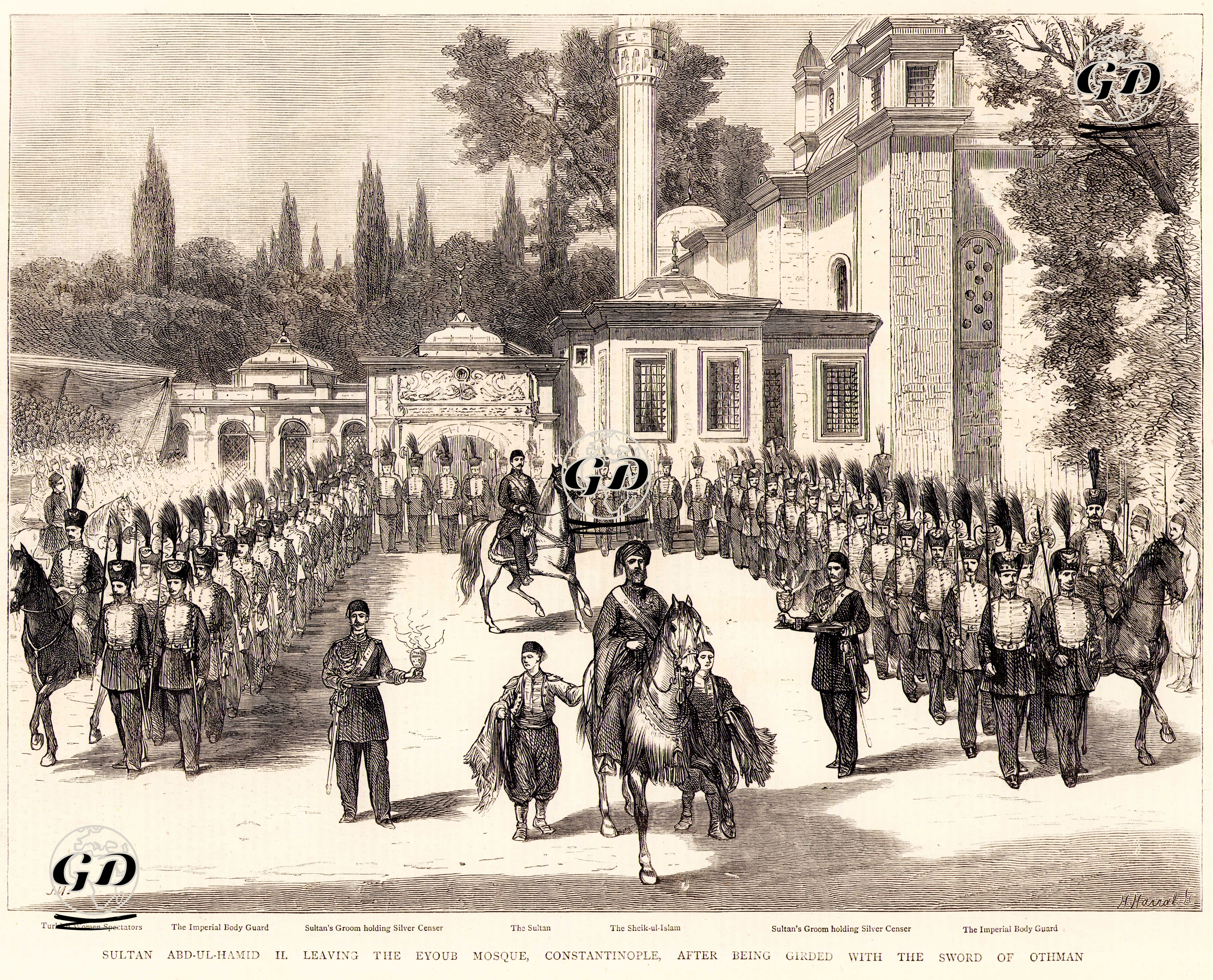
The traditional ceremony performed upon the accession of Ottoman sultans to the throne is known as the ‘culus’ and constitutes one of the most important indicators of legitimacy in imperial politics. The enthronement ceremony of Sultan Abdulhamid II, who ascended to the throne on August 31, 1876, was also conducted in accordance with classical Ottoman customs: The public witnessed the proclamation of the new sultan with cannon fire, state officials and ulema pledged their allegiance with an allegiance ceremony, and the tradition of the enthronement gift was continued. The most important phase of the ceremony was the sword-girding ceremony held at the Eyüp Sultan Tomb. Girding a sword on September 7, 1876, in the spiritual presence of Abu Ayyub al-Ansari, one of the companions of the Prophet Muhammad, Abdulhamid II thus legitimately ascended the Ottoman throne and officially began his reign. This engraving, published in The Graphic newspaper on October 7, 1876, depicts Sultan Abdulhamid II as the heir to the throne. It depicts Abdulhamid leaving the Eyüp Sultan Mosque after the sword-girding ceremony, the final stage of his accession to the throne. The newspaper's news text is as follows without any changes; "THE INSTALLATION OF SULTAN ABD-UL-HAMID II.-The final act of the installation of a new Sultan is his investiture with the Sword of Othman or Osman, the founder of the Ottoman race, and whose scimitar is kept as a most sacred relic in the Mosque of Eyoub, which covers the tomb of that great Mussulman saint, Abou Eyoub, the companion of the Prophet, and who fell in A.D. 675 while leading his Saracens against the walls of Byzantium. This mosque is considered most holy, and no Giaour is tolerated within its precincts, the writer once being nearly stoned for venturing to peep into the courtyard. It is situated on a hill on the Stamboul side of the Golden Horn, and was built by Mahomet the Conqueror, after the conquest of Constantinople, in 1453, being constructed entirely of white marble. The investiture of Abd-ul-Hamid took place on the 7th ult., and was conducted by the Mollah Hunkiah, who is a lineal descendant of the old Sultans of Iconium. Of the ceremony itself there is little to say beyond that the sword was presented to the Sultan with the usual formula, “Take it with faith, for it is God who sends it thee.” After this the Sultan, who had come to Eyoub by water in his state caique, mounted his charger to make the customary ride through the city, the line of route being densely crowded with Christians, Mussulmans, Europeans, and Asiatics of both sexes to see the procession pass. The loudest demonstration throughout the route was the singing of detachments of school children, who, placed at intervals, shrieked forth an ode in honour of their new Padishah. The procession was neither long nor gorgeous, and there were comparatively few troops, the most noticeable being the Sultan’s Body Guard, wearing a uniform of scarlet embroidered with gold, and a curious velvet cap with a broad gold plaque in front. There were various dignitaries, both of Church and State, all splendidly mounted, and foremost amongst them Hassan Kairoullah Effendi, the Sheik-ul-Islam, who, robed in white, immediately preceded the Sultan. Abd-ul-Hamid himself, mounted on a magnificent white charger, was dressed in a richly jewelled military uniform, and wore a diamond-hilted sabre, but no aigrette or jewel in his fez.—Our illustration represents the cavalcade coming out of the gate of the Eyoub Mosque immediately after the ceremony."