GRAVÜR DÜNYASI
Digital Engraving Library
| Engraver | Antonio Verico (1775-1828 ) |
| Date | 1827 |
| Technique | Copper Engraving |
| Category | Ottoman Empire And Turkey |
| Source | Il Costume Antico E Moderno O Storia Del Governo, Della Milizia, Della Religione, Delle Arti, Scienze Ed Usanze Di Tutti İ Popoli Antichi E Moderni, by Giulio Ferrario Vol. 4 (Europa) |
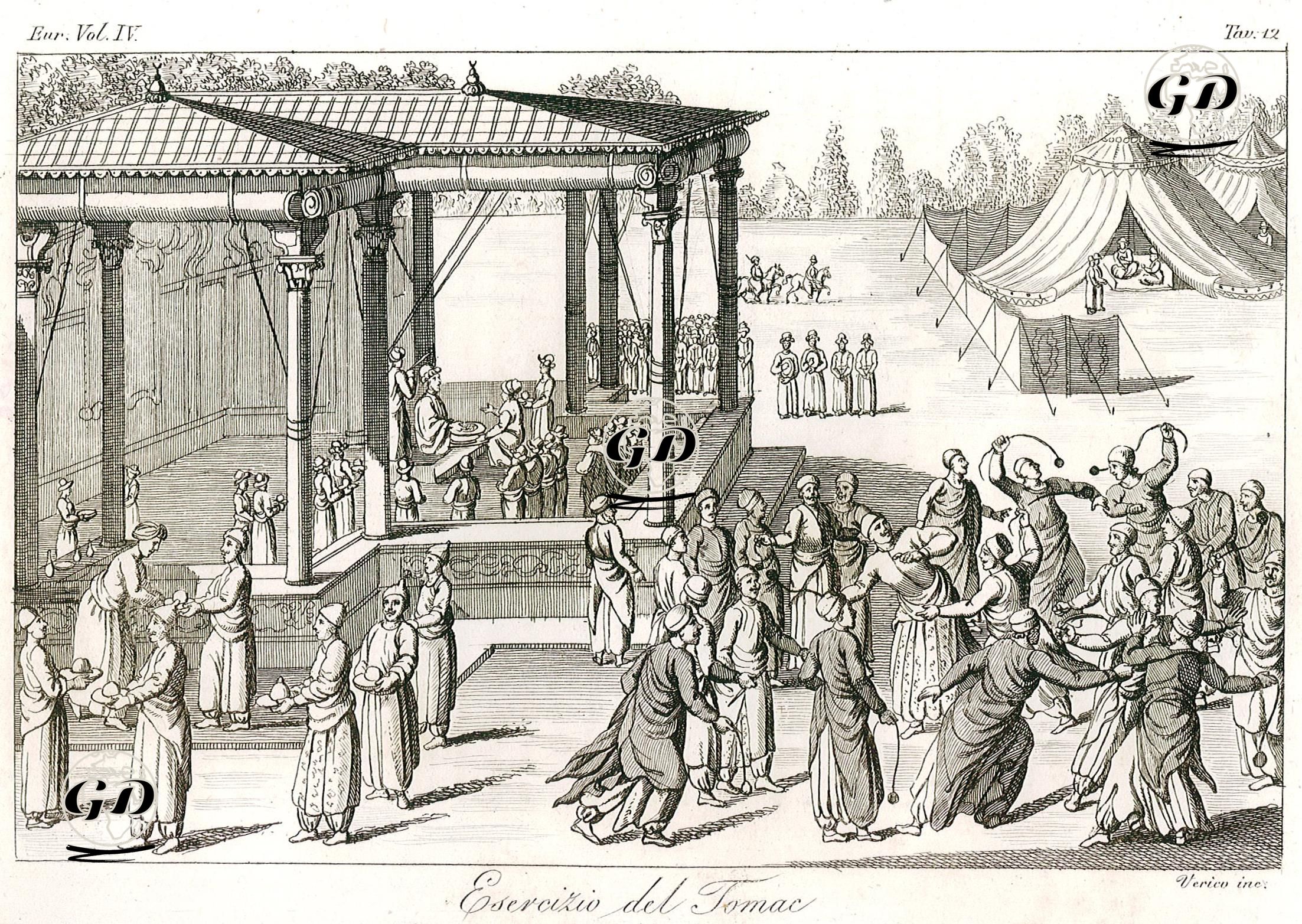
This engraving, titled "Tomak Game," depicts a traditional stick game that was both a palace entertainment in the Ottoman Empire and part of the Janissary Corps' training and training program. Aiming to develop military discipline, agility, and combat reflexes, this game is also notable for its ceremonial aesthetics. The players' rhythmic and synchronized movements, reflecting the Ottoman court's understanding of order, grandeur, and collective harmony, made tomak both a military exercise and a visual spectacle. The game takes its name from the word "tomak," meaning a short, thick stick or mace carried in the hand. The tomak used in the game was created by wrapping a flat ball of compressed felt in a leather sheath. A braided whip handle was attached to the end, usually 70–80 cm long and woven from six thong wraps. The game was played by two teams of six. The aim was to strike the opponent's back with the tomak, thus eliminating them from the game. These dances, performed in a wide open space, were often accompanied by the sounds of drums and trumpets, and performed in the presence of the sultan and foreign ambassadors. The engraving brings together all the elements of Ottoman festive culture. In the foreground, players compete while brandishing tomak sticks; in the middle, court officials watch from a pavilion (kiosk); and in the background, ornate tents, officials, and mounted guards. This composition simultaneously embodies the hierarchical structure of Ottoman ceremonial order and the "orientalist" perspective of European artists. For European artists, the tomak dance was not merely a game; it was a representation of Ottoman order, power, and grandeur. Today, the tomak dance is performed in various forms in some regions of Anatolia, particularly at village weddings. However, objects such as sashes, belts, or handkerchiefs are now used instead of actual tomaks, and the dance has become more of a folk dance form focused on entertainment.