GRAVÜR DÜNYASI
Digital Engraving Library
| Artist | Melton Prior (1845-1910) |
| Date | 1877 |
| Technique | Woodblock Engraving (Newspaper-Text on Reverse) |
| Category | Ottoman Empire And Turkey |
| Source | The illustrated London News (April 21 1877-Page 377) |
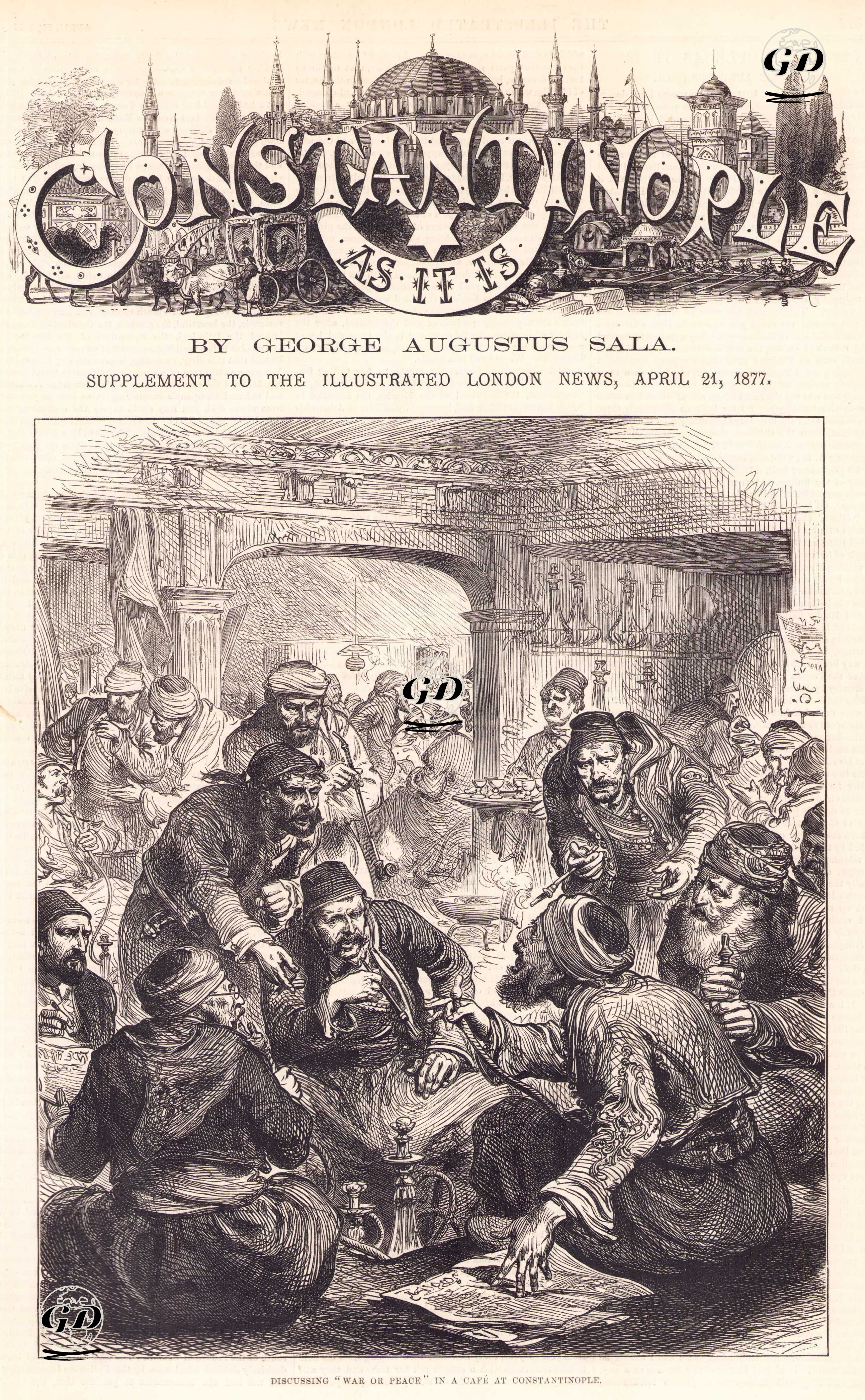
This engraving, published under the title "Constantinople as it is" in the supplement of The Illustrated London News on April 21, 1877, brings together both the general appearance and the social atmosphere of the Ottoman capital on the same page. The composition beneath the title, centered on the dome and minarets of Hagia Sophia, emphasizes the city's religious and historical identity. The domes, minarets, tents, carriages, and scenes of daily life scattered throughout the area aim to present Istanbul's "Eastern exotic" and "modernized cosmopolitan" face to Western readers. This image reflects not only the orientalist perspective frequently seen in the British press of the period but also how the Ottoman capital was perceived by the international public. The main scene beneath the title depicts Turks, Greeks, and Armenians gathered in a coffeehouse before the Russo-Turkish War of 1877–78, heatedly debating "war or peace?". The period in which the newspaper was published coincided with the final days of the period leading up to the Russo-Turkish War of 1877–78. Amidst the opening of the Constitution and the Ottoman Parliament, the Balkan Uprisings of 1876, international debates on the "Eastern Question," and increasing tensions with Russia, Istanbul's coffeehouses became one of the primary public spaces where current events were discussed and debated. The engraving depicts Greeks, Armenians, and Turks, dressed in attire evoking different ethnic and religious identities, engaged in a heated debate in the same space around the question of "war or peace?" This engraving represents the daily practice of the Ottoman Empire's multi-communal public sphere. The hookah pipes and pipes, tiny coffee cups, the Arabic-script signboard on the wall, oil lamps, and ewers on the shelves all point to both the material culture of the space and the routine of verbal and deliberative politics. This unity shows that the pre-war expectations and concerns of different communities came together under the same roof and that the state's war/peace decision was discussed not only at the palace and army level but also among the urban public.