GRAVÜR DÜNYASI
Digital Engraving Library
| Artist | Vernier |
| Engraver | Augustin François Lemaitre (1797-1870) - Lemas |
| Date | 1840 |
| Technique | Copper Engraving |
| Category | Ottoman Empire And Turkey |
| Source | Turkey Volume Of L'Univers Pittoresque, Paris |
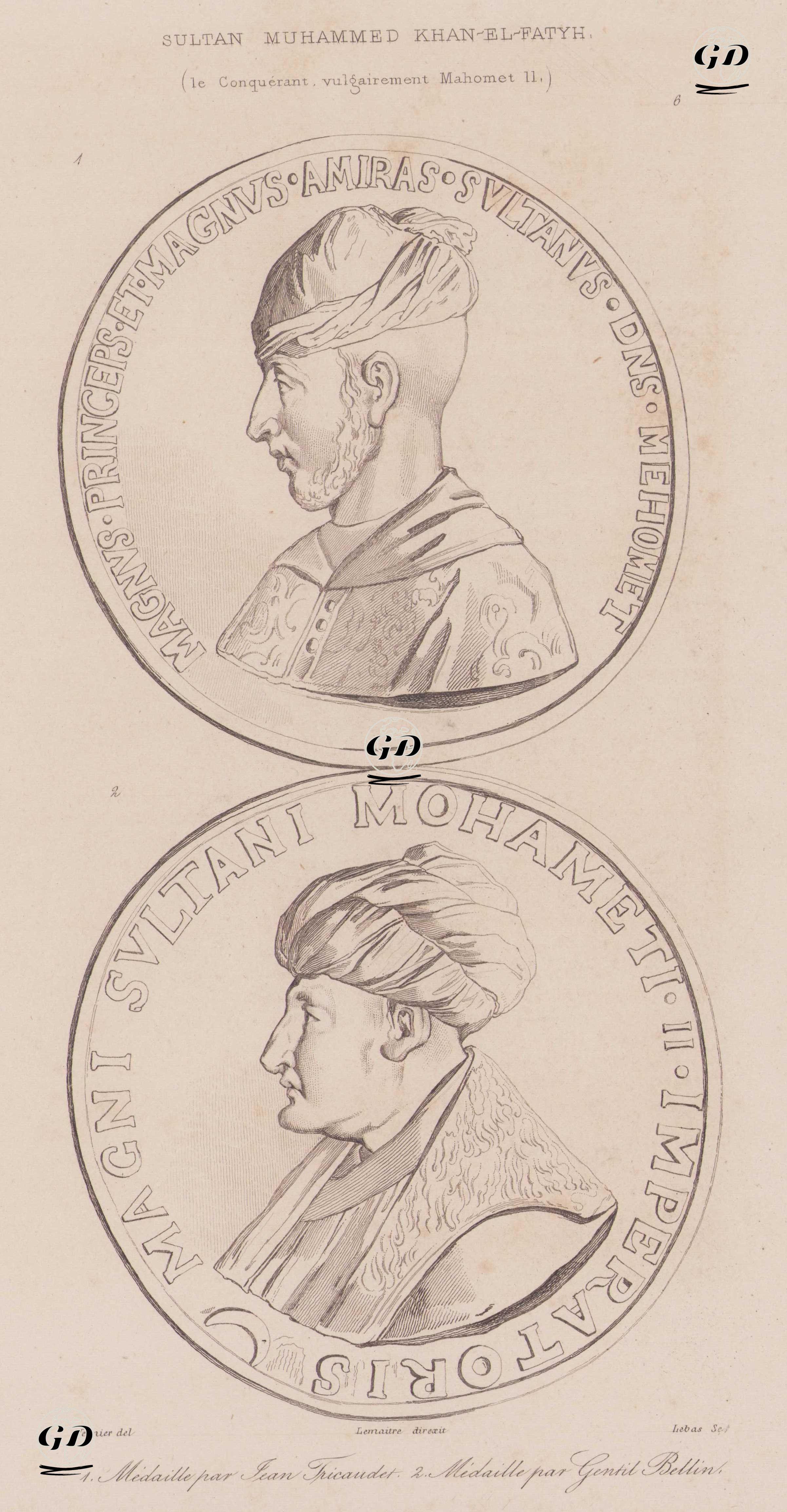
Born in Edirne in 1432 as the son of Murad II, Mehmed II was sent to Manisa as a sanjak-bey at the age of 11. Shortly thereafter, with the death of his elder brother, Alaeddin Ali Çelebi, he became sole heir to the throne. He ascended to the throne at the age of 12 in 1444 at his father's request, but two years later he handed over the reign back to his father. Upon his father's death in 1446, he ascended to the Ottoman throne for a second time at the age of 19. After ascending to the throne, Mehmed II focused on maintaining balance in Anatolia and the Balkans, controlling unrest within the state, particularly through the Janissary Corps. In 1452, the young sultan commissioned the construction of Rumeli Hisarı (Rumelian Fortress) to control the Bosphorus. In 1453, after a 53-day siege, he conquered the Byzantine capital of Constantinople, earning the title of "Fatih." This conquest was not only a military victory, but also marked the end of an era and the beginning of a new one, with strategic innovations such as the use of cannon technology and the navigation of ships by land. After the city's surrender, Mehmed the Conqueror halted the looting, converted Hagia Sophia into a mosque, protected the Orthodox Patriarchate, and embraced religious tolerance. He revitalized Istanbul with his resettlement policies. Mehmed personally led 25 campaigns, ending the Empire of Trebizond, Wallachia, and Bosnia, thus expanding Ottoman territory. Mehmed expanded the territory he inherited from his father from approximately 880,000 square kilometers to 2,214,000 square kilometers. On May 3, 1481, during his Anatolian campaign, he died of necrosis in the Hünkar Meadow near Gebze. His remains were interred in his mausoleum in the Fatih Mosque, which bears his name.