GRAVÜR DÜNYASI
Digital Engraving Library
| Date | 1875 |
| Technique | Steel Engraving |
| Category | Ottoman Empire And Turkey |
| Source | Bilder-Atlas: Ikonographische Encyklopädie der Wissenschaften und Künste ; ein Ergänzungswerk zu jedem Conversations-Lexikon ; 500 Taf. in Stahlstich, Holzschnitt u. Lithographie ; in 8 Bd.. 5 by bearb. von Karl Gustav Berneck … - Druck und Verlag von F. A. Brockhaus in Leipzig |
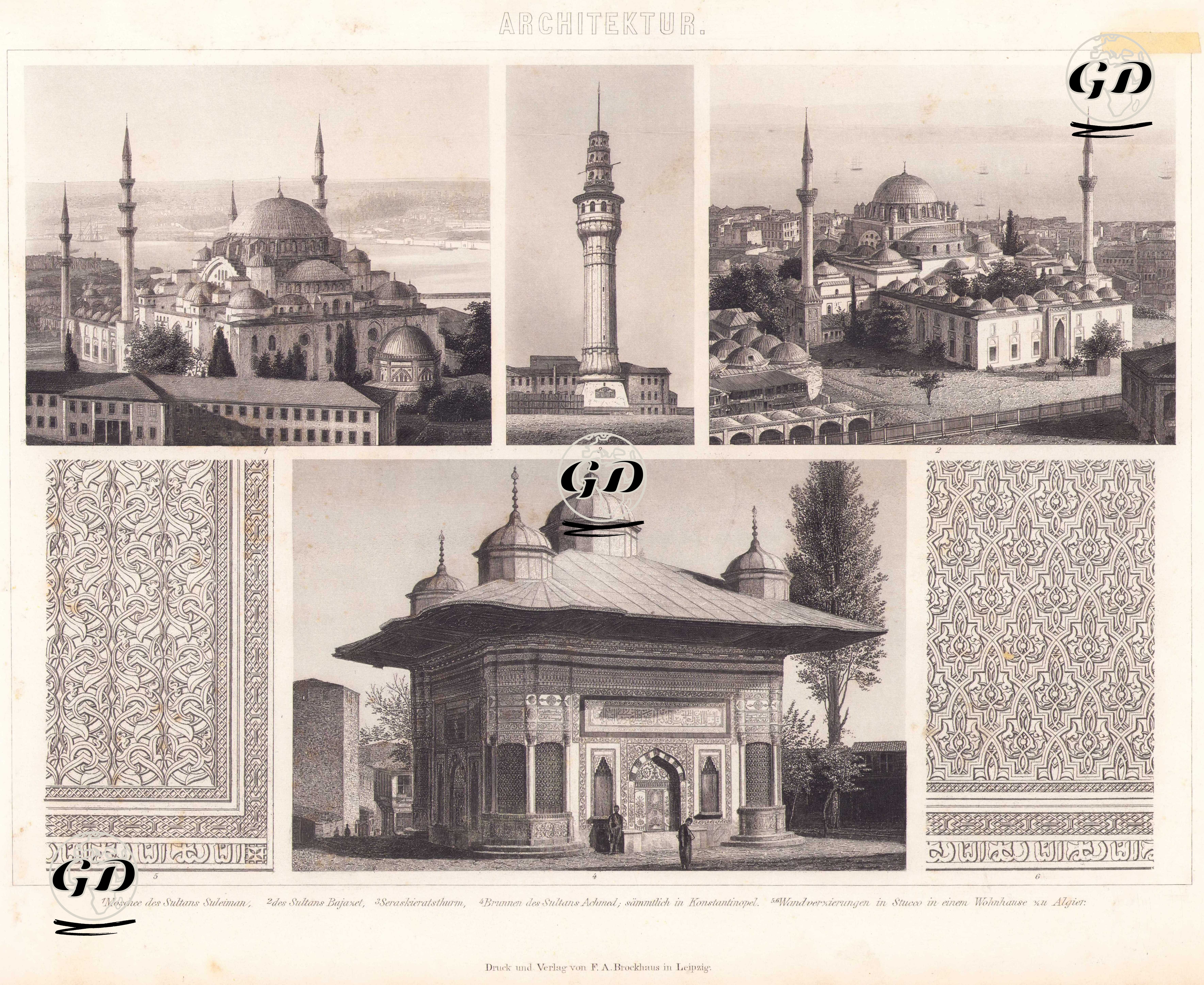
This engraving, dated 1875, demonstrates the aesthetic and structural diversity of Ottoman architecture. The works in the engraving document both the general appearance of important Ottoman buildings in Istanbul and the decorative arts that accompanied them. In the top row, from left to right, the exterior perspective of the Süleymaniye Mosque, one of the most magnificent examples of classical Ottoman architecture, commissioned by Suleiman the Magnificent between 1550 and 1557 by Mimar Sinan. In this view, the mosque's dome, semi-domes, and elegant minarets stand out as monumental within Istanbul's topography. It was built alongside a vast complex (madrasa, hospital, bathhouse, soup kitchen, etc.). The dome is 53 meters high and 27.5 meters in diameter. Its exterior simplicity is balanced by its interior elegance. It is one of the structures that shape Istanbul's skyline, reflecting the power and religious authority of the Ottoman sultans. The Serasker Tower (now known as the Beyazıt Tower), located within the present-day Istanbul University central campus (the Old Ministry of War), is shown in the center. Built in the mid-19th century as both a fire watchtower and for communications, it remained a prominent element of Istanbul's skyline throughout the 19th century. The mosque on the right is the Sultan Bayezid Mosque, a pioneer of early classical Ottoman architecture. Built by Sultan Bayezid II between 1501 and 1506, it is the first classical Ottoman social complex in Istanbul. It features a central dome system inspired by Hagia Sophia and is a prominent example of the tradition of courtyard-plan mosques. The complex is surrounded by a madrasa, soup kitchen, bathhouse, library, and hospital. The two panels on the left and right in the bottom row are of great significance in Islamic decorative art. These decorations likely represent interior decorative details such as glazed tile patterns or plasterwork. Inscriptions and geometric-river motifs are elements frequently encountered in Islamic art and serve both aesthetic and symbolic functions. The structure in the lower center section is the Ahmed III Fountain, commissioned by Sultan Ahmed III in 1728. Located at the entrance to Istanbul's Topkapı Palace, this fountain is a prominent example of Baroque Ottoman architecture, representing the Tulip Era. Its wide-eaved roof, slender columns, and inscription bands reflect the artistic style of the period. The engraving offers an integrated perspective, showcasing not only the iconic architecture of Ottoman Istanbul but also examples of the extensions of Islamic art in North Africa.