GRAVÜR DÜNYASI
Digital Engraving Library
| Date | 1875 |
| Technique | Steel Engraving |
| Category | Ottoman Empire And Turkey |
| Source | Bilder-Atlas: Ikonographische Encyklopädie der Wissenschaften und Künste ; ein Ergänzungswerk zu jedem Conversations-Lexikon ; 500 Taf. in Stahlstich, Holzschnitt u. Lithographie ; in 8 Bd.. 5 by bearb. von Karl Gustav Berneck … - Druck und Verlag von F. A. Brockhaus in Leipzig |
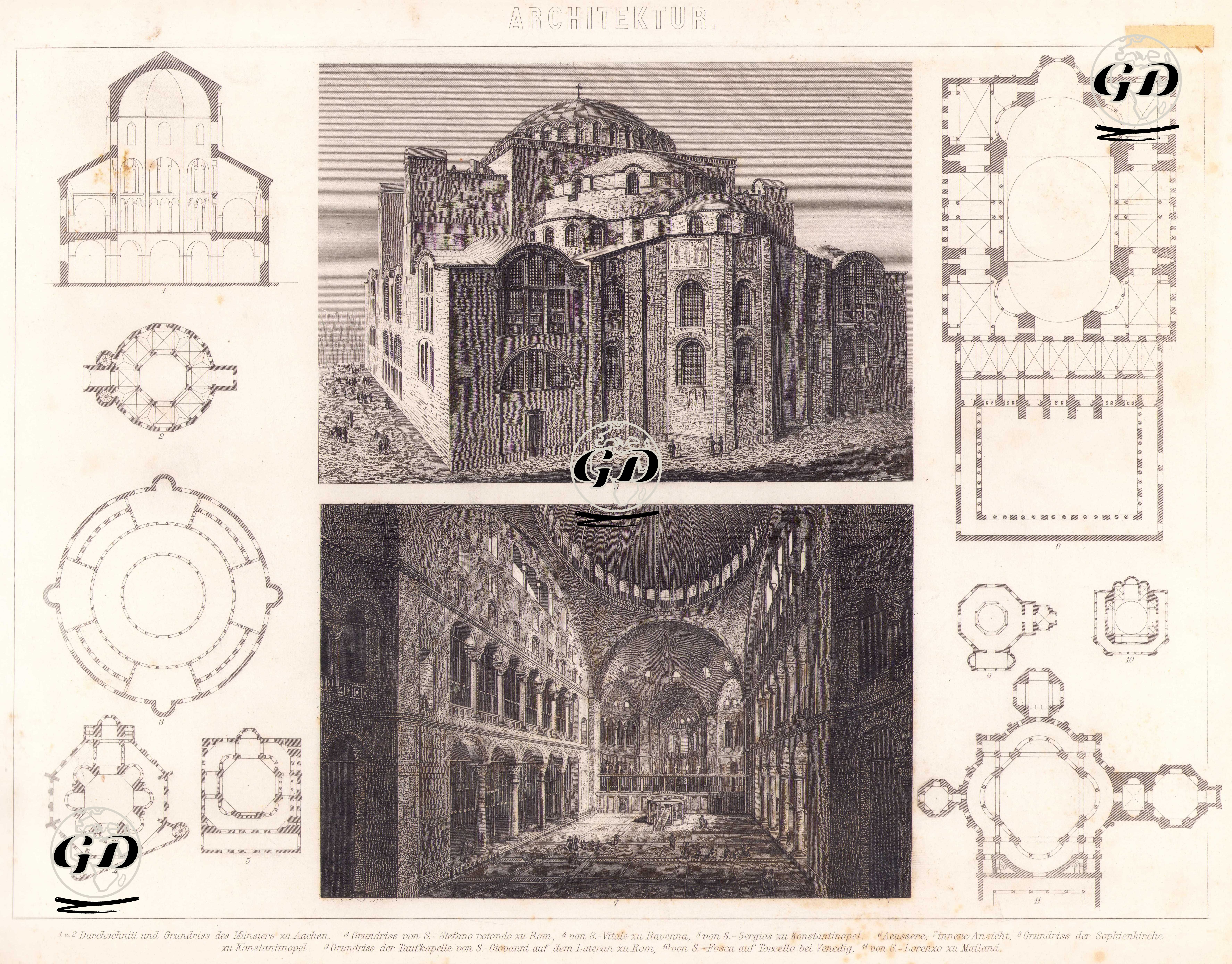
This architectural engraving, dated 1875, documents the architectural heritage of the Byzantine and early Christian periods. Published under the title "Architecture," it systematically presents the development of centrally planned church architecture, in particular, through plan, section, and perspective views. At the center of the engraving is Hagia Sophia, an architectural masterpiece of the Byzantine Empire. Exterior perspective is presented in image 6, interior view in image 7, and architectural plan in detail in image 8. The central dome resting on four massive piers, the main space supported by semi-domes, and the surrounding arcades are clearly visible in the plan. Hagia Sophia's famous galleries, apse, and central dome are depicted with great perspective depth. Built in Istanbul by the Byzantine Emperor Justinian I in 537, this structure stood out not only as a symbol of religious but also of political and cultural power. At the same time, Hagia Sophia's location at both the physical and visual center underlines its decisive role in architectural history and contributes to the meaning of other buildings around this center. In addition to Hagia Sophia, the engraving also features several important examples of early Christian and Byzantine architecture: 1 and 2 show the section and plan of the Cathedral of Aachen (Aix-la-Chapelle); 3 shows the plan of the circular St. Stefano Rotondo in Rome; 4 shows the plan of St. Vitale in Ravenna; and 5 shows the plan of the Church of Sergius and Bacchus (Little Hagia Sophia Mosque), located near Hagia Sophia in Istanbul. 9 also shows the plan of the baptistery of the Basilica of St. Giovanni in Laterano in Rome; 10 shows the plan of the Church of St. Fosca on the Island of Torcello near Venice; and 11 shows the central plan of St. Lorenzo in Milan. A common characteristic of all these structures is their centralized plan, an approach that reflects both liturgical needs and the idea of symbolic centrality. The engraving arranged the plans and sections of these structures in a way that allowed for typological comparison, thus making architectural evolution and diversity visually traceable.