GRAVÜR DÜNYASI
Digital Engraving Library
| Artist | Thomas Allom (1804-1872) |
| Engraver | Edward Goodall (1795-1870) |
| Date | 1839 |
| Technique | Steel Engraving |
| Category | Ottoman Empire And Turkey |
| Source | Constantinople And The Scenery Of the Seven Churches of Asia Minor Illustrated…, With an historical Account of Constantinople, and Descriptions of the Plates… (Fisher, Son & Co. London & Luai De L'Ecole, Paris) |
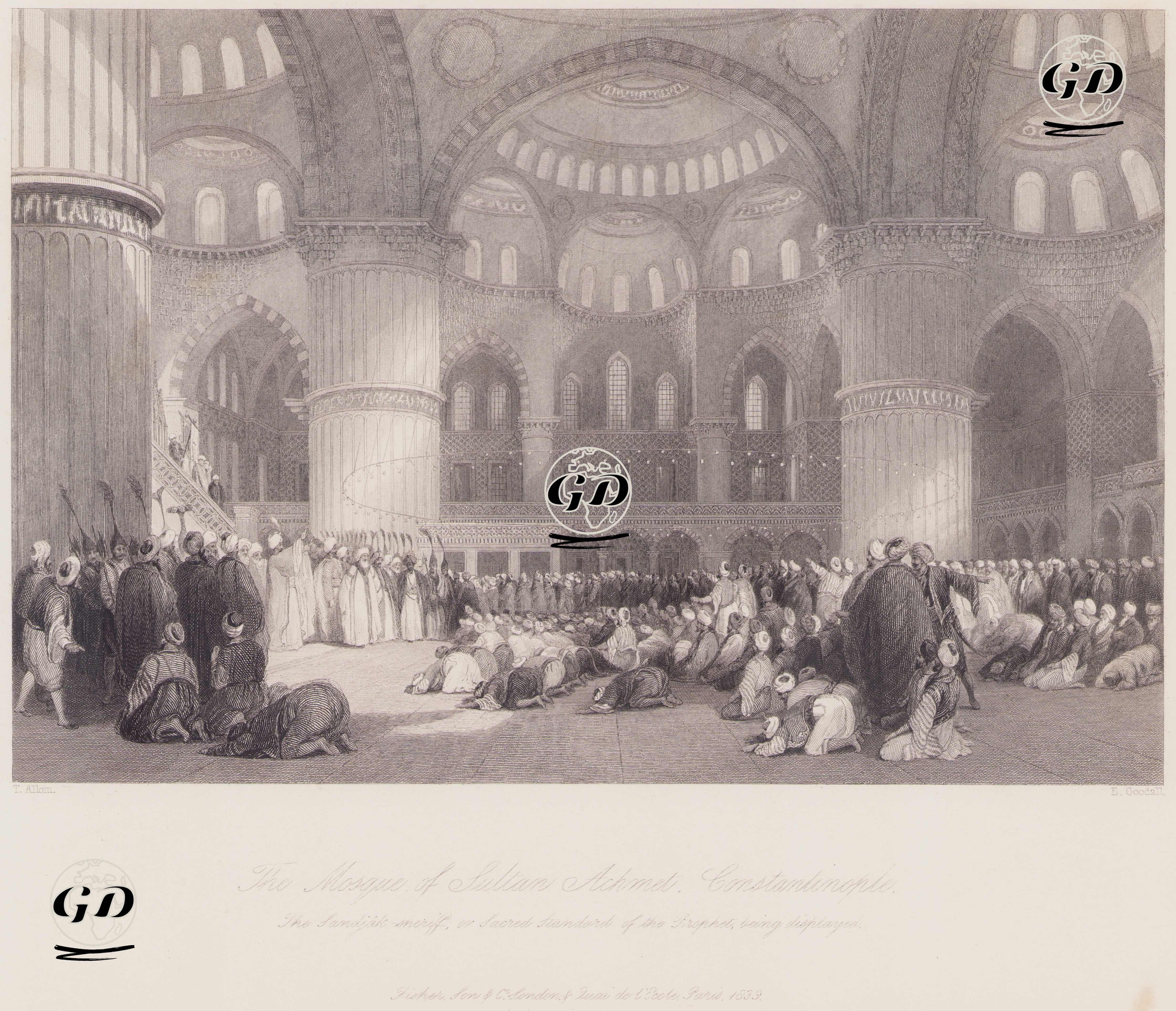
This engraving depicts a crucial ceremonial moment that took place in the interior of the Sultan Ahmet Mosque during the Ottoman period. This scene depicts the raising of the Holy Banner of the Prophet Muhammad (Sancak-ı Şerif), a practice that profoundly impacted the spirit of the Ottoman army and society. This sacred relic was issued when the Ottoman Empire or the Islamic world faced great danger, especially in times of war, to give moral strength to the army and to rally every Muslim able to bear arms under the banner. It also reinforced the religious authority of the Ottoman sultan. The presence of Janissaries and ulema demonstrates the unification of the military and religious elements of the state in the same space, for the same purpose. Therefore, the engraving reflects not only a religious ceremony but also a symbolic expression of the Ottoman political and social order. The engraving conveys impressive depth through the composition of the architecture and human figures. The magnificent domes, sweeping arches, and thick columns of the Sultan Ahmet Mosque, commissioned by Sultan Ahmet I in 1616 by architect Sedefkar Mehmet Ağa opposite Hagia Sophia, are meticulously rendered, powerfully conveying the grandeur of the space to the viewer. The orderly arrangement of the figures, with the congregation kneeling and prostrating in the front, the group lined up behind, and the clergy around the mihrab, creates a ceremonial harmony. The use of light and shadow, particularly highlighting the area where the banner is removed, focuses the viewer on the spiritual gravity of the scene.