GRAVÜR DÜNYASI
Digital Engraving Library
| Artist | Thomas Allom (1804-1872) |
| Engraver | Joseph John Jenkins (1811-1885) |
| Date | 1838-1839 |
| Technique | Steel Engraving |
| Category | Ottoman Empire And Turkey |
| Source | Constantinople And The Scenery Of the Seven Churches of Asia Minor Illustrated…, With an historical Account of Constantinople, and Descriptions of the Plates… (Fisher, Son & Co. London & Paris) |
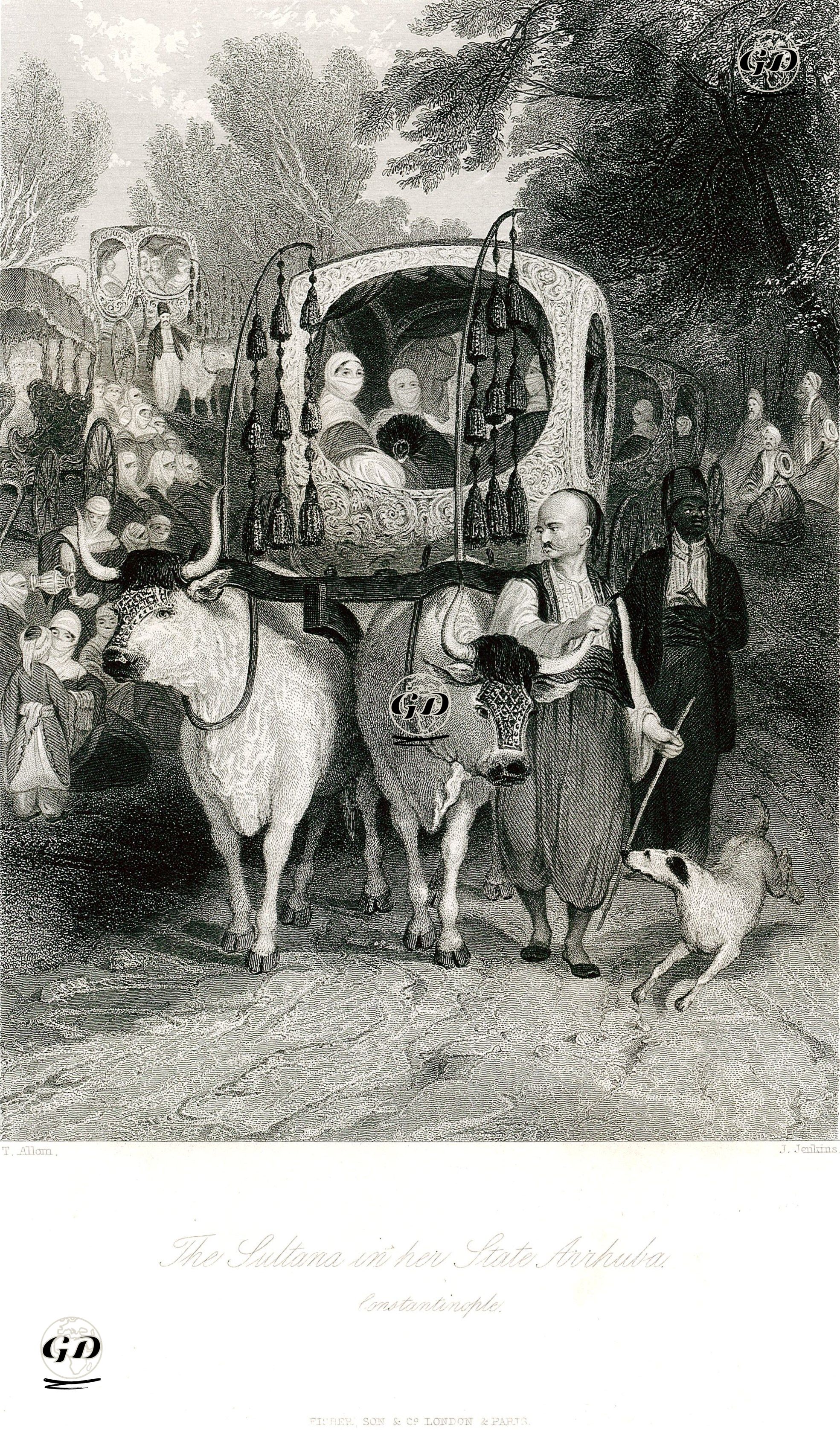
This engraving depicts the recreational journeys undertaken by Ottoman palace women in their imperial carriages. The carriage featured in the engraving was one of the most magnificent means of transport used by the female sultans in Istanbul during the period. The carriage's body is a bulky structure, mounted on unsprung wheels, and is richly decorated with carvings and gilded ornamentation. It is powered by long-horned water buffalo with hennaed forehead hair. The coachman, of Greek origin, directs the animals, while a black eunuch, walking alongside the carriage, protects the privacy of the carriage and the honor of the women inside with his sword. The book "Constantinople And The Scenery Of The Seven Churches of Asia Minor Illustrated...", which includes the engraving, states that these carriages were once completely enclosed by silk curtains, preventing anyone from seeing the faces of the women of the harem or the order within. However, with the introduction of Western customs into Ottoman society in the mid-19th century, these curtains were removed, and the women of the harem became more visible. The open-topped, ornate carriages seen in the engraving are visual documentation of this cultural transformation. The scene depicts Esma Sultan, daughter of Sultan Abdulhamid I, traveling from her palace in Eyüp to the Kağıthane recreation area. The women inside the carriage wear headscarves and face coverings. Along the way, women are lined up on one side and men on the other. Therefore, this engraving demonstrates not only a journey scene but also a cultural structure where privacy and grandeur are intertwined, representing the social life of women in the Ottoman palace.