GRAVÜR DÜNYASI
Digital Engraving Library
| Date | 1867 |
| Technique | Woodblock Engraving (Newspaper-Text on Reverse) |
| Category | Ottoman Empire And Turkey |
| Source | Illustrated Times (June 20 1867-Page 41) |
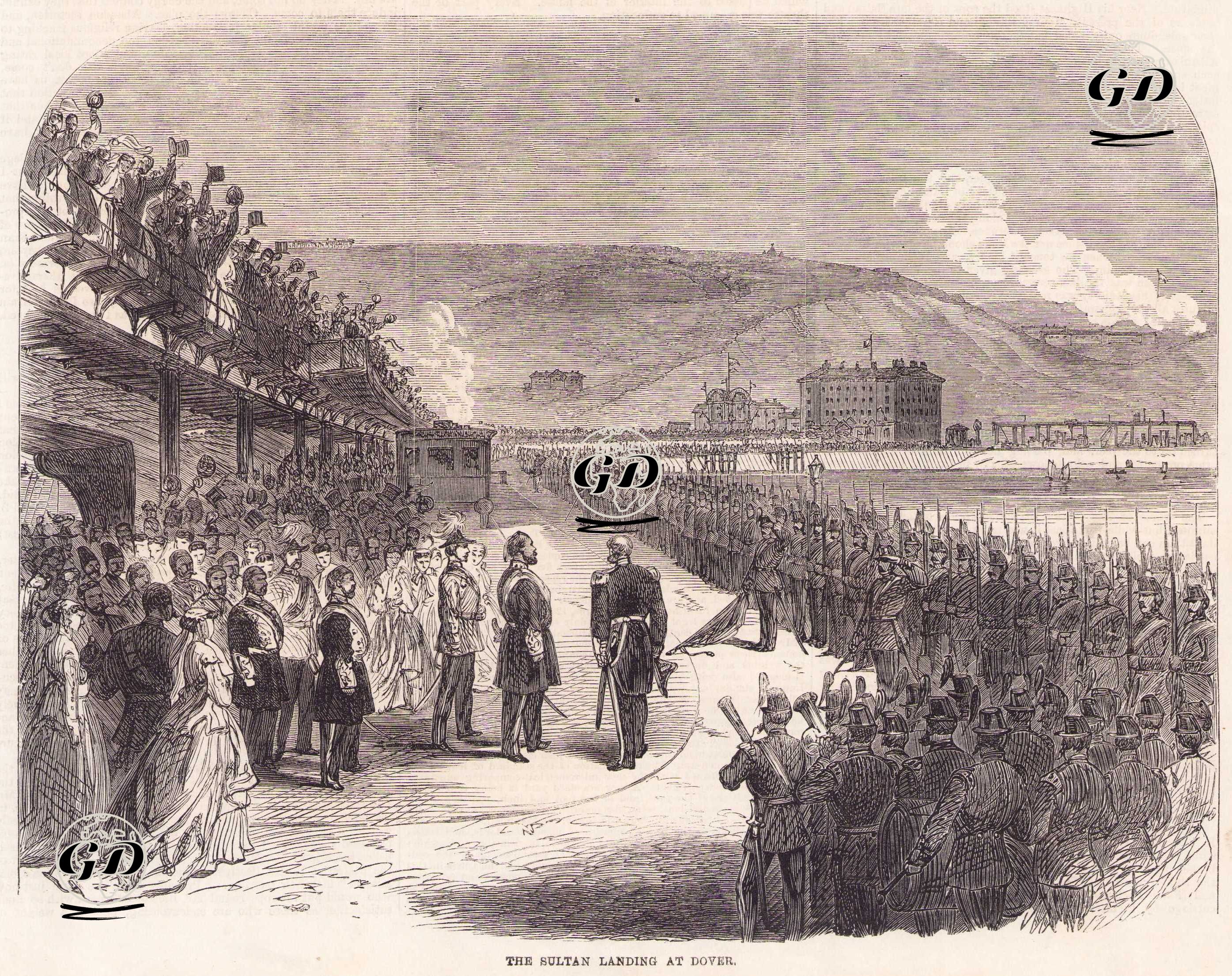
Published in the Illustrated Times on June 20, 1867, this engraving and news text portrays the arrival of Sultan Abdülaziz (reigned 1861-1876), the 32nd Sultan of the Ottoman Empire, on British soil not merely as a visual ceremonial scene, but as a historical narrative reflecting 19th-century European views of the Ottomans, diplomatic symbolism, and perceptions of power. Sultan Abdülaziz was the first Ottoman Sultan to officially visit Europe. The news text summarizes the event as follows: The first-ever arrival of an Ottoman Sultan in British history was considered an extraordinary event by Western European public opinion, and even though the visit was not officially planned with extravagant pomp and circumstance, its enthusiasm and impact were comparable to all previous royal visits in Dover, even to the arrival of the French Emperor and Empress. With expressions such as "the great leader of the Muslim race" and "the representative of the line of Caliphs and Sultans," the Sultan was described not merely as an individual ruler, but as a symbolic figure representing the historical continuity of the Islamic world. The Sultan's arrival in Dover was accompanied by the Prince of Wales, the Duke of Cambridge, the Khedive of Egypt, and other high-ranking British aristocrats. Upon arrival in London, the meticulously decorated Charing Cross Station, the honor guards, diplomatic carriages, military units, and large crowds revealed that this visit was more than a state ceremony; it was a public spectacle. The Sultan's reception in the long-unused Belgian Apartments allocated to him in Buckingham Palace reinforced the importance attributed to this visit, both spatially and symbolically, and the meticulously redesigned aesthetics of the apartments, despite their temporary use, were particularly emphasized. The visit, which included a formal meeting with the Queen at Windsor Castle, an opera visit, military inspections at Woolwich Arsenal, and grand events at Crystal Palace, demonstrates that the Sultan was perceived in England not merely as a diplomatic guest, but also as a figure of military, cultural, and social interest. His particular interest in the Palliser shells and his generous donation to the restoration fund reveal that the visit was conducted on a foundation of mutual respect and prestige. This entire narrative presents a comprehensive picture that clearly reflects the continued recognition of the Ottoman Empire as a powerful, historical, and symbolic actor in 19th-century Europe, as evidenced by the Sultan's visit to England. The engraving visualizes the reception described in the text as "not a grand display of grandeur, but one whose impact and enthusiasm were extremely powerful," with military units lined up in orderly ranks at Dover harbor, crowds gathered on overpasses and piers, harbor architecture, and structures in the background.