GRAVÜR DÜNYASI
Digital Engraving Library
| Artist | Thomas Allom (1804-1872) |
| Engraver | Albert Henry Payne (1812-1902) |
| Date | 1850's |
| Technique | Steel engraving |
| Category | Ottoman Empire And Turkey |
| Source | Leipzig, Engl. Kunst-Anstalt |
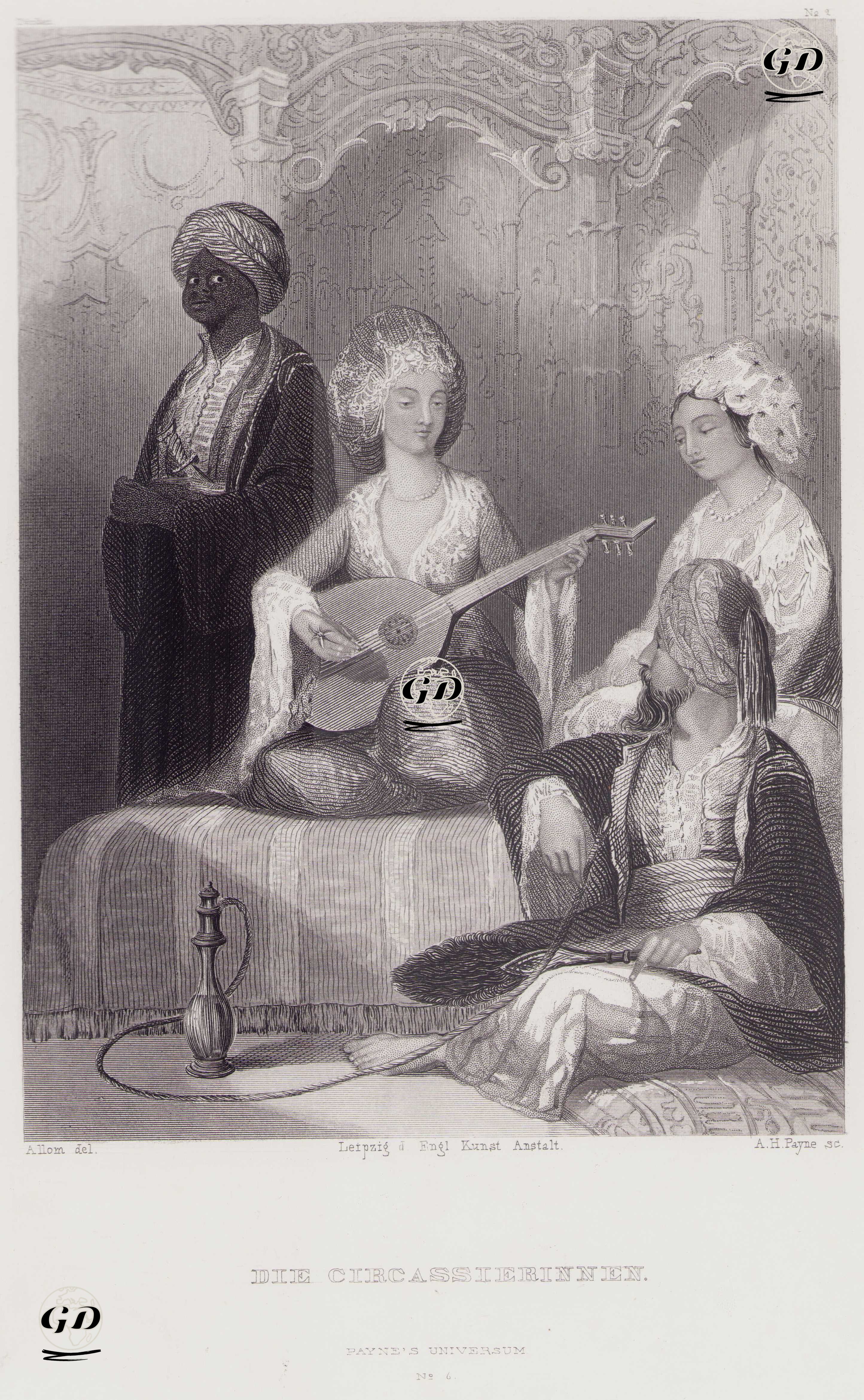
This engraving depicts Circassian women in a harem in Istanbul. The book "Constantinople And The Scenery Of the Seven Churches of Asia Minor Illustrated…", which includes this engraving titled "Circassian Women in the Harem," summarizes the information about this engraving and Circassian female slaves as follows: The book describes the historical and social structure of Circassia from ancient times to the 19th century, particularly the position of Circassian women in the slave trade and the Ottoman harem system. This region, known as Colchis in ancient times, gained value through the female body in Greek mythology and trade, and according to the text, this understanding continued into the modern era. Circassian women are depicted as a group highlighted for their physical beauty and therefore seen as a commercial commodity. The text conveys the tribal-based structure of Circassian society, its chieftainship system, and its governance based on customs and traditions rather than written law. It is claimed that economic activity was limited, with the main trade being conducted through horses and women. The religious structure in the region is described in a superficial and pragmatic manner, and it is stated that families raised their daughters according to religious rules so that they could be more easily sold in Istanbul in the future. The slave trade process is described in detail: the girls were transported to Istanbul on boats arriving at the coast, special care was taken to preserve their physical appearance during the journey, they were kept in inns upon arrival in the capital, and there they were selected by the girls' overseer. The most favored were set aside for the palace harem, while the others were sold in the Women's Market. It is emphasized that Circassian slaves, unlike other slave groups, were kept in more private and separate places. The final section of the text focuses on an engraving scene, depicting daily life within the harem: the master watching the Circassian concubines while smoking a hookah, the concubines attempting to please him with music and entertainment, and the eunuch guarding this private space at the gate. This scene serves as a narrative that visually complements the overall relationship between the harem, concubines, and the master established throughout the text.