GRAVÜR DÜNYASI
Digital Engraving Library
| Artist | Sebastian Munster (1489-1552) |
| Engraver | Georg Scharffenberg (1530-1607) |
| Date | 1628 |
| Technique | Wood Engraving |
| Category | Ottoman Empire And Turkey |
| Source | Cosmographia Universalis, Omnium Orbis Terrarum Regionum et Insularum Veteribus cognitarum descripsit P. Sebastianus Munsterus. This translates to Universal Cosmography, Describing All the Regions and Islands of the World, Known to the Ancients, by P. Sebastian Münster (German Version) |
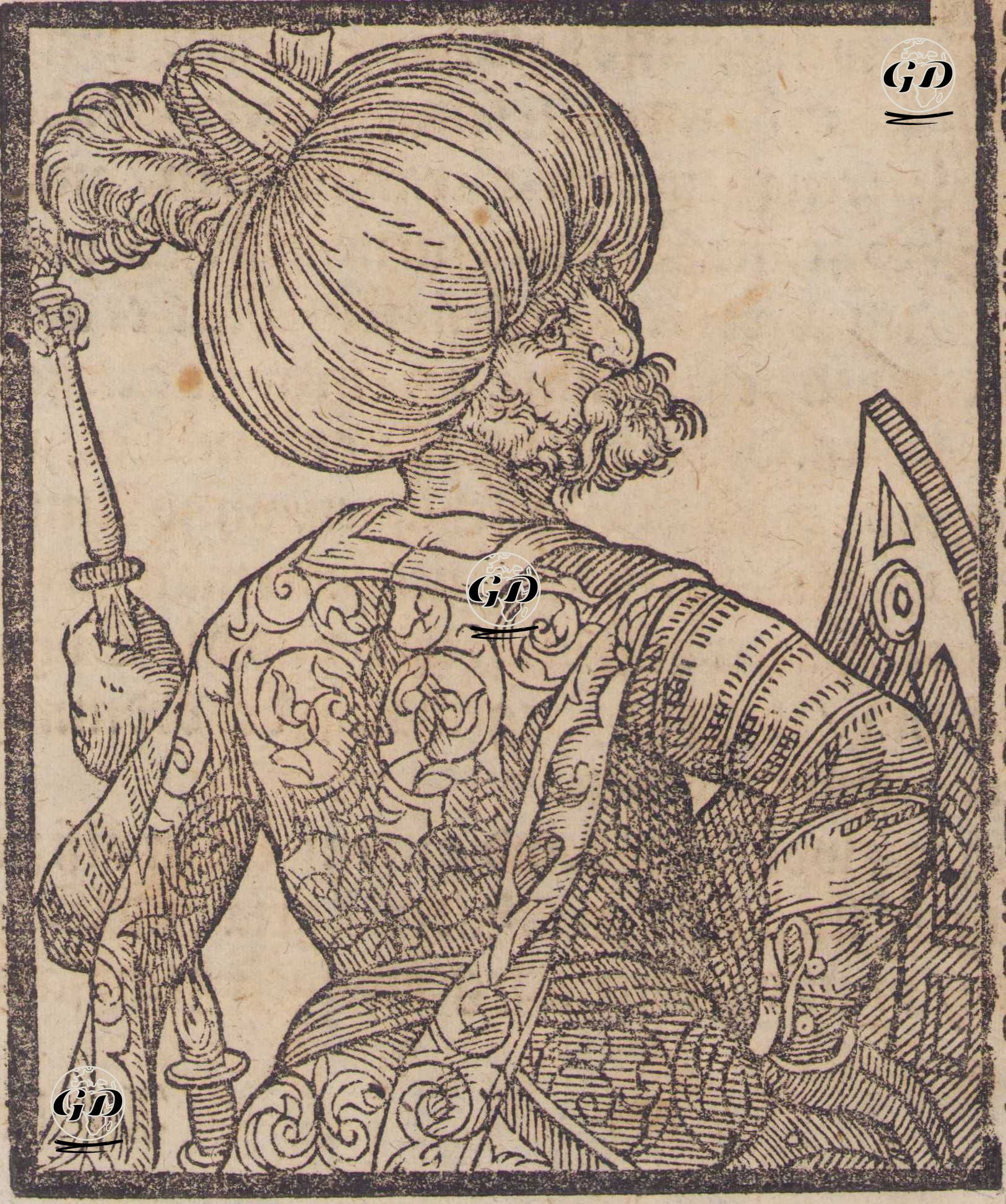
This woodcut portrait, as its title clearly indicates, "Amurath der drit dieses Vammes / und der vierzehende Türkisch Keyser" ("Amurath, Third of This Line and Fourteenth Ruler of the Turkish Empire"), is one of the earliest representations of the Ottoman Sultan Murad III in early modern Europe. The rapid proliferation of Ottoman sultan portraits in Europe between 1520 and 1560 was linked both to the demand by engravers for books on Turkish subjects, known as "Türckenbücher," and to the reflection of the Ottoman Empire's weight in European politics in visual culture. In these works, sultans were often presented in a consecutive dynastic series, indicating their "number of Turkish emperors." While the phrase "third of this line and fourteenth of Turkish emperors" used for Murad III, the twelfth Ottoman Sultan, is chronologically incomplete, it stems from the artists' calculations of the Ottoman dynastic lineage based on Western sources. It is also significant because it demonstrates early modern Europe's limited knowledge of Ottoman history. In the engraving, Murad III is depicted within an idealized and exoticized iconographic mold constructed by Western artists within the framework of the "Eastern ruler" typology. The depiction of the figure from behind (a rare choice among early modern Ottoman ruler portraits) is an aesthetic choice intended both to pique European viewers' curiosity and to reinforce the ruler's dignified and inaccessible character. The wide, layered, and exaggerated turban, the caftan adorned with dense spiral and sinuous floral motifs cascading from the shoulders, the stylized floral ornamentation resembling peonies, and the scepter held in the ruler's right hand are all iconographic elements that reflect Western artists' interpretation of the Ottoman palace through the lens of "magnificence, sumptuous fabrics, and ceremonial symbols." The sharp contours, dense hatching on flat surfaces, the tight placement of the figure within a square frame, and traces of surface engraving indicate that the engraving was produced using a typical Renaissance German wood engraving technique (Holzschnitt). This engraving was first published in Sebastian Munster's Cosmographia Universalis … in 1544. Over the years, the book has gone through numerous editions and revisions, becoming one of the most important works of geography and history of the 16th century. Containing a wealth of information in geography, cartography, natural history, and anthropology, the book has been widely used as a reference source by scientists, explorers, and cartographers for centuries. This engraving in our library was published in the 1628 edition of Sebastian Munster's Cosmographia Universalis ….