GRAVÜR DÜNYASI
Digital Engraving Library
| Artist | Sebastian Munster (1489-1552) |
| Engraver | Georg Scharffenberg (1530-1607) |
| Date | 1628 |
| Technique | Wood Engraving |
| Category | Ottoman Empire And Turkey |
| Source | Cosmographia Universalis, Omnium Orbis Terrarum Regionum et Insularum Veteribus cognitarum descripsit P. Sebastianus Munsterus. This translates to Universal Cosmography, Describing All the Regions and Islands of the World, Known to the Ancients, by P. Sebastian Münster (German Version) |
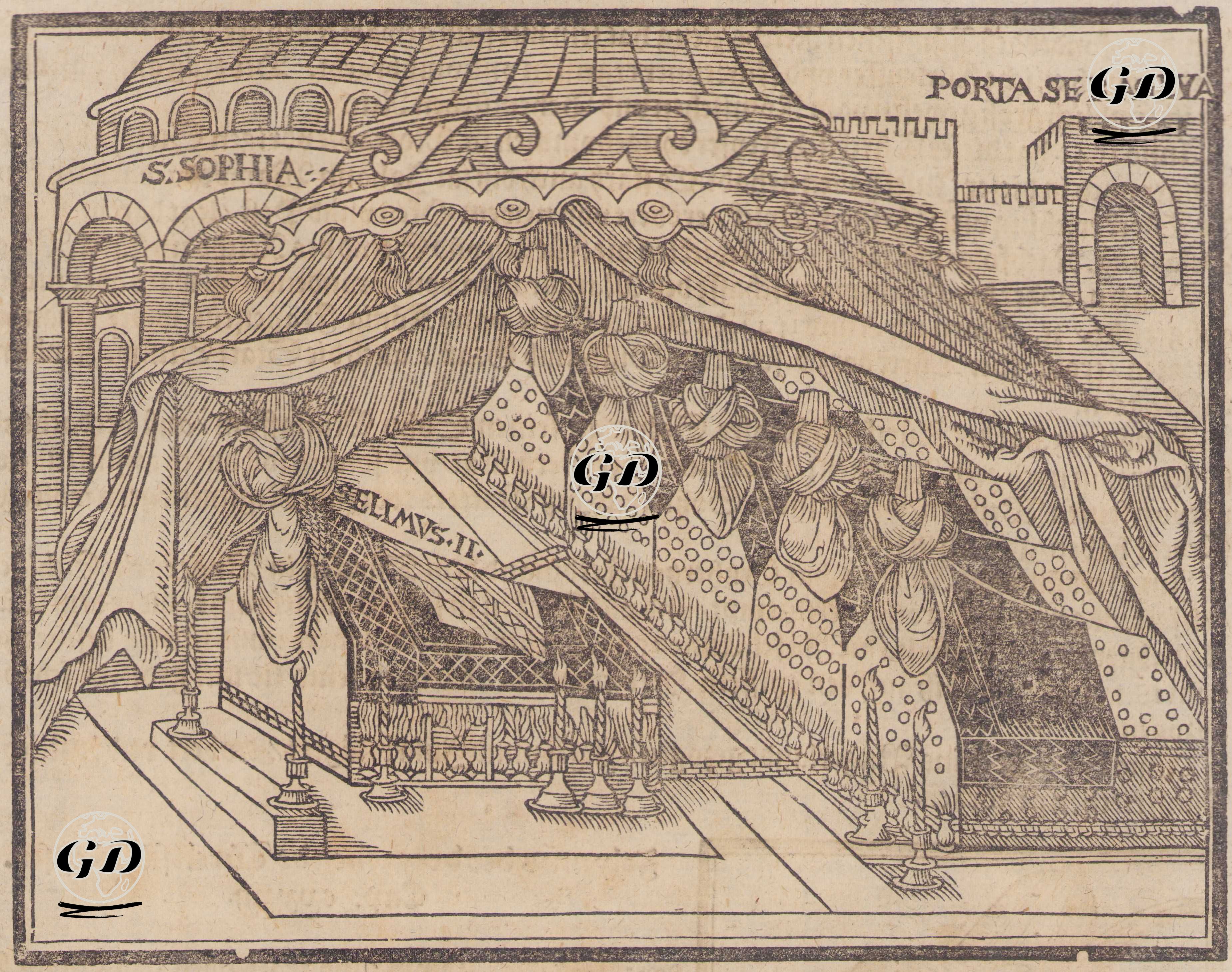
This woodcut, as the title "SELIMVS II" suggests, features a Western artist's imaginative representation of the tomb of the Ottoman Sultan Selim II and some of Istanbul's key structures. The engraving is part of an iconographic tradition frequently encountered in Turkish-themed books, cosmographies, and travelogues known as "Türckenbücher," which enjoyed considerable popularity in Europe from the 16th century onward and were published in a textual-visual integration designed to depict the Ottoman world. In these works, the palace life of the Ottoman sultans, their tombs, and the important sites of Istanbul were often shaped not by actual observations but according to European images of the "East." In the engraving, Selim II's tomb is depicted with a distinctly European symbolic setting, quite different from the hexagonal tomb designed by Mimar Sinan in 1577, located southwest of Hagia Sophia. For the European artist, the goal was not architectural accuracy but a theatrical scene that emphasized the theme of "the eternal resting place of the glorious ruler of the East." The ornate, tent-like coverings covering the mausoleum, the vertically stretched ropes, the tasseled curtains, and the lamps placed throughout the space represent a Western interpretation of Ottoman palace ceremonial aesthetics, generalized and exoticized. The covered sarcophagus above the tomb, while drawing on the traditional use of coverings seen in Ottoman sultans' mausoleums, serves as an exaggerated staged composition. In the background, Hagia Sophia, marked with the inscription "S. Sophia," is rendered within a semicircular vaulted and arched scheme frequently employed by Western artists. This depiction, rather than reflecting the structure's actual architecture, perpetuates the clichéd Hagia Sophia iconography recurring in European printed sources. Similarly, the Sarayburnu–Topkapı Palace gate, designated "PORTA SERAGLYA," is a typified architectural form used to introduce the Ottoman palace complex to European audiences. Instead of the palace's actual topography and architecture, a schematic entrance form reminiscent of castle walls was chosen. This scene is significant for demonstrating how early modern Europeans perceived the Ottoman dynasty and the spatiality of Istanbul. The power, majesty, and sacred authority of the Ottoman sultans were often transformed into a visual narrative through symbolic structures such as the palace, mausoleum, and Hagia Sophia. This engraving was first published in Sebastian Munster's Cosmographia Universalis … in 1544. Over the years, the book went through numerous editions and revisions, becoming one of the most important works of geography and history of the 16th century. Containing rich information in the fields of geography, cartography, natural history, and anthropology, the book was widely used as a reference source by scientists, explorers, and cartographers for centuries. This engraving, which is in our library, was published in the 1628 edition of Sebastian Munster's Cosmographia Universalis ….