GRAVÜR DÜNYASI
Digital Engraving Library
| Artist | Sebastian Munster (1489-1552) |
| Engraver | Georg Scharffenberg (1530-1607) |
| Date | 1628 |
| Technique | Wood Engraving |
| Category | Ottoman Empire And Turkey |
| Source | Cosmographia Universalis, Omnium Orbis Terrarum Regionum et Insularum Veteribus cognitarum descripsit P. Sebastianus Munsterus. This translates to Universal Cosmography, Describing All the Regions and Islands of the World, Known to the Ancients, by P. Sebastian Münster (German Version) |
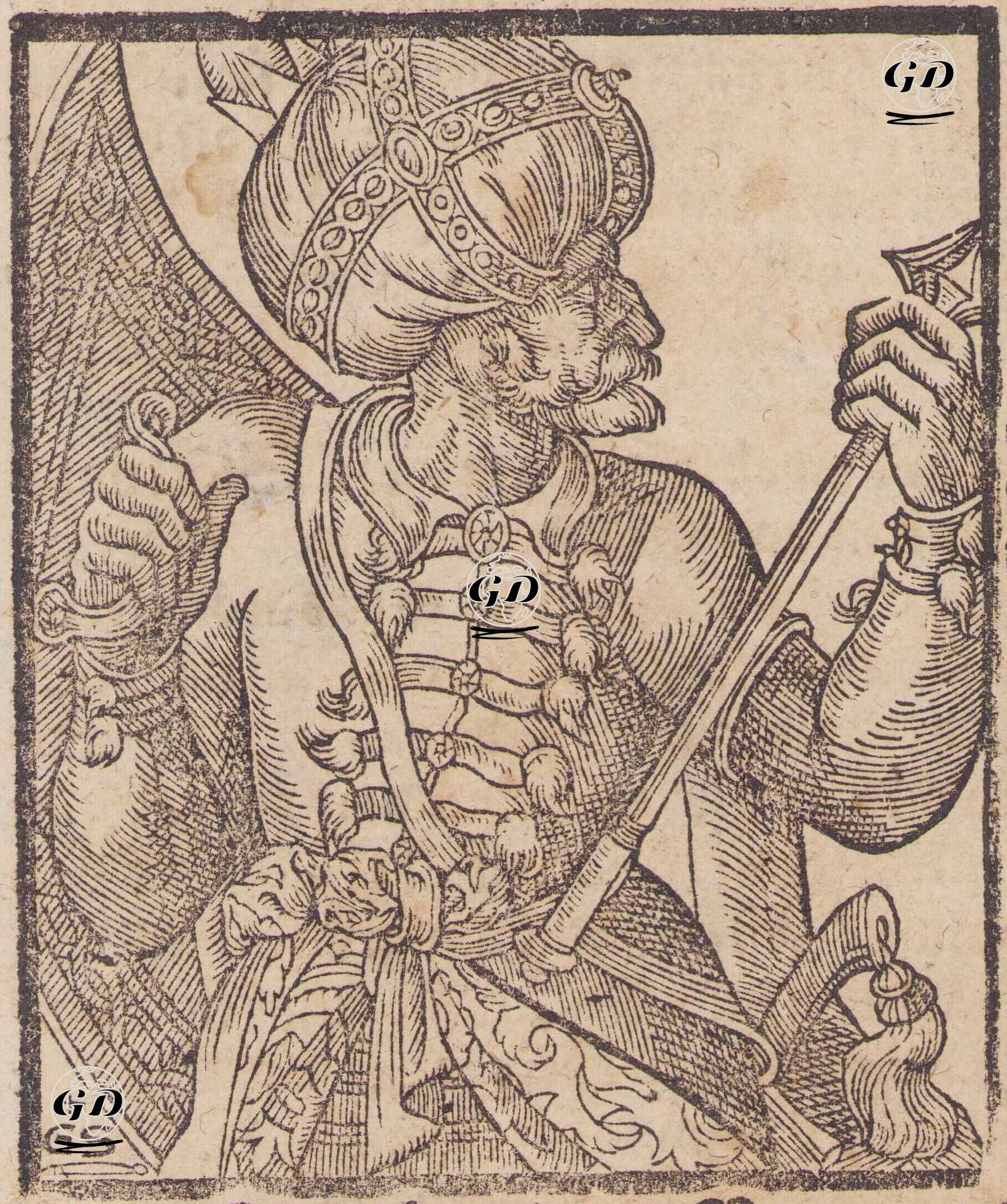
This woodcut engraving, as its title clearly indicates, is one of the earliest representations of the Ottoman sultan Suleiman the Magnificent in early modern Europe. The proliferation of Ottoman sultan portraits in Europe between 1520 and 1560 is linked both to the demand by engravers for books on Turkish subjects, known as "Türckenbücher," and to the reflection of the Ottoman Empire's influence in European politics in visual culture. In this engraving, Suleiman the Magnificent is depicted in an exoticizing, typified conception of the Eastern ruler, a concept frequently seen in Western iconography. His large-scale, bejeweled, crowned turban reflects Western artists' tendency to associate Ottoman sultans with both political and sacred authority. The jawshan-like breastplate, gold-embroidered caftan, tassels hanging from the shoulders, and the staff in his hand symbolically express the sultan's military and ceremonial power. These details, not actually used in the Ottoman palace, are the product of the iconographic tradition that framed Ottoman rulers in 16th-century Europe around images of Eastern despotism, grandeur, and military might. The sharply defined contour lines, densely hatched textures, and the square composition that encompasses the figure in close-up, in particular, are characteristic of the Renaissance German wood engraving technique (Holzschnitt) prepared by Georg Scharffenberg. This technique was frequently used in brochures, chronicles, and royal gallery books of the period, and Ottoman sultans were generally included in a series of numbered rulers in Europe. The fact that Suleiman the Magnificent, the tenth Ottoman sultan, is listed as the "twelfth sultan" in the engraving stems from the artists' calculations of the Ottoman dynastic lineage based on Western sources. While this number is not chronologically accurate, it is significant in demonstrating the limited knowledge of Ottoman history in early modern Europe. This engraving is a valuable example of how early modern Europeans perceived and represented the Ottoman sultan. Suleiman the Magnificent was recognized as a great emperor in Western culture for his diplomatic prowess, military victories, and the title "Magnus Suleimanus" (Suleiman the Magnificent). However, this recognition was often conveyed through a symbolic aesthetic shaped by the imagination of Western artists rather than actual palace iconography. This engraving is from Sebastian Munster's book, Cosmographia Universalis …, first published in 1544. Over the years, the book has undergone numerous editions and revisions, becoming one of the most important works of geography and history of the 16th century. Containing a wealth of information in geography, cartography, natural history, and anthropology, the book has been widely used as a reference source by scientists, explorers, and cartographers for centuries. This engraving in our library was published in the 1628 edition of Sebastian Munster’s Cosmographia Universalis …