GRAVÜR DÜNYASI
Digital Engraving Library
| Artist | Sebastian Munster (1489-1552) |
| Engraver | Georg Scharffenberg (1530-1607) |
| Date | 1628 |
| Technique | Wood Engraving |
| Category | Ottoman Empire And Turkey |
| Source | Cosmographia Universalis, Omnium Orbis Terrarum Regionum et Insularum Veteribus cognitarum descripsit P. Sebastianus Munsterus. This translates to Universal Cosmography, Describing All the Regions and Islands of the World, Known to the Ancients, by P. Sebastian Münster (German Version) |
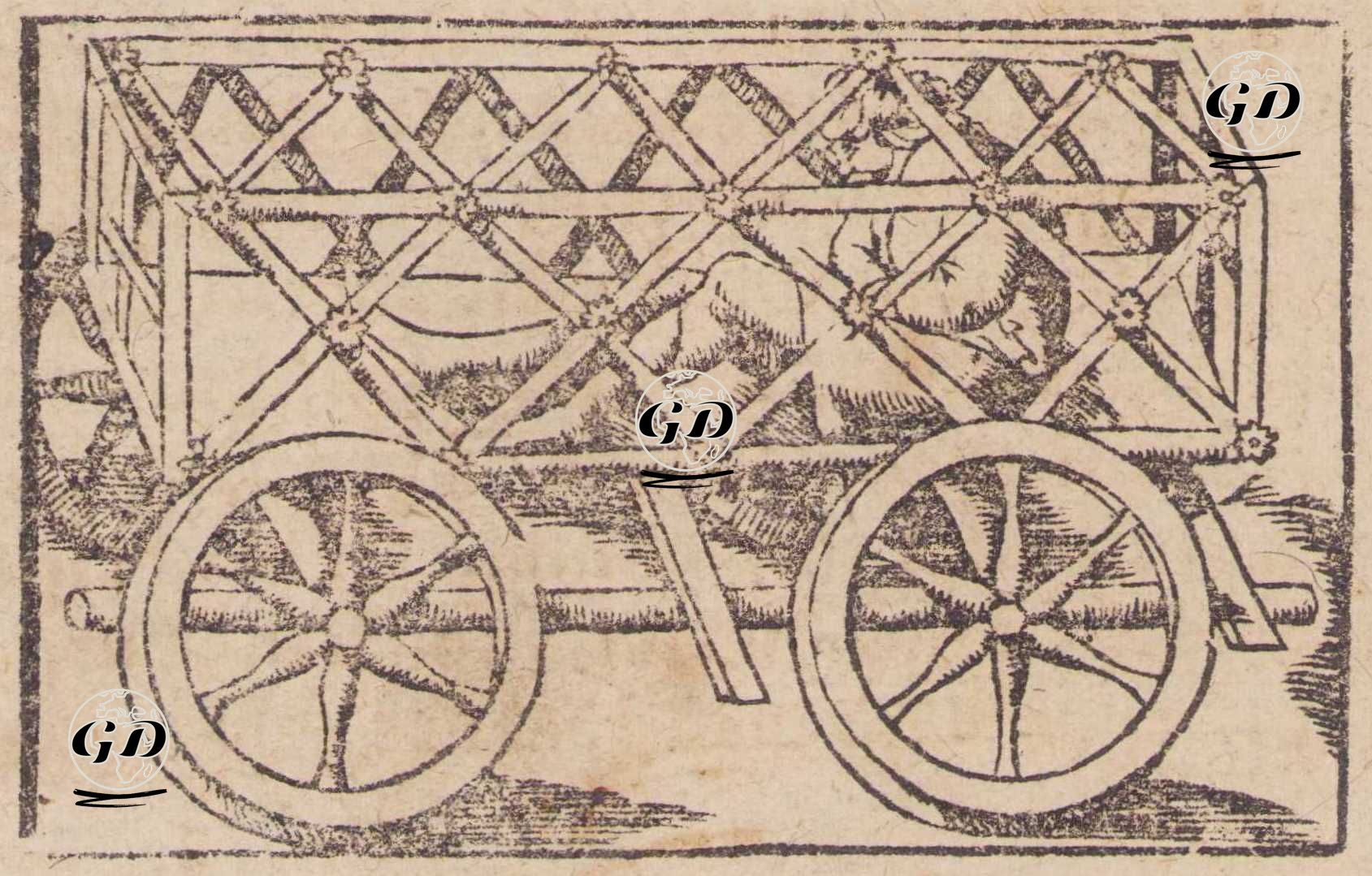
This small woodcut engraving is one of the most familiar symbolic depictions used in 16th-century European history texts to describe Bayezid's predicament after his defeat by Timur. The caged carriage seen in the engraving is a fictional symbol designed to illustrate European narratives of Timur's humiliating captivity of Bayezid. By depicting Bayezid in a wheeled "cage wagon," the artist renders both Timur's power and the Ottoman defeat a striking image for European readers. The engraving's origins lie in the legends that rapidly spread throughout Europe about Bayezid's fate after the Battle of Ankara in 1402. However, Ottoman and Islamic sources contain no mention of Bayezid being chained and paraded in public. This narrative emerged entirely in Western literature, particularly in anti-Ottoman propaganda, and has been reinforced over time. To more effectively portray Timur's cruelty and the "breakdown of the Turkish threat," 15th- and 16th-century European historians transformed Bayezid's captivity into a symbolic story of his downfall. The cage in the engraving therefore represents not a historical reality but an image of the "humiliation of the enemy emperor." The composition in the engraving is quite simple: a cage structure constructed with geometric lines, within which is placed an undefined, half-reclining figure, whose face and details are deliberately left obscure. The viewer is expected to recognize it as Bayezid, but no actual portrait is presented. This approach is typical of the early modern European tradition of representing Ottoman rulers not through literal depictions but rather through "cautionary events" and "political stories." The wheeled cage, on the other hand, conveys a sense of movement and display, serving as a visualization of the legend of Bayezid being paraded through Timur's camp. In this respect, the engraving, while not offering historical accuracy, is crucial for demonstrating how Europe dramatized the story of Bayezid and Timur, transforming the Ottoman defeat into a symbol of "shame and collapse." This engraving was first published in Sebastian Munster's Cosmographia Universalis … in 1544. Over the years, the book has gone through numerous editions and revisions, becoming one of the most important works of geography and history of the 16th century. Containing rich information in geography, cartography, natural history, and anthropology, the book has been widely used as a reference source by scientists, explorers, and cartographers for centuries. This engraving, which is in our library, was published in the 1628 edition of Sebastian Munster's Cosmographia Universalis ….