GRAVÜR DÜNYASI
Digital Engraving Library
| Artist | Sebastian Munster (1489-1552) |
| Engraver | Georg Scharffenberg (1530-1607) |
| Date | 1628 |
| Technique | Wood Engraving |
| Category | Ottoman Empire And Turkey |
| Source | Cosmographia Universalis, Omnium Orbis Terrarum Regionum et Insularum Veteribus cognitarum descripsit P. Sebastianus Munsterus. This translates to Universal Cosmography, Describing All the Regions and Islands of the World, Known to the Ancients, by P. Sebastian Münster (German Version) |
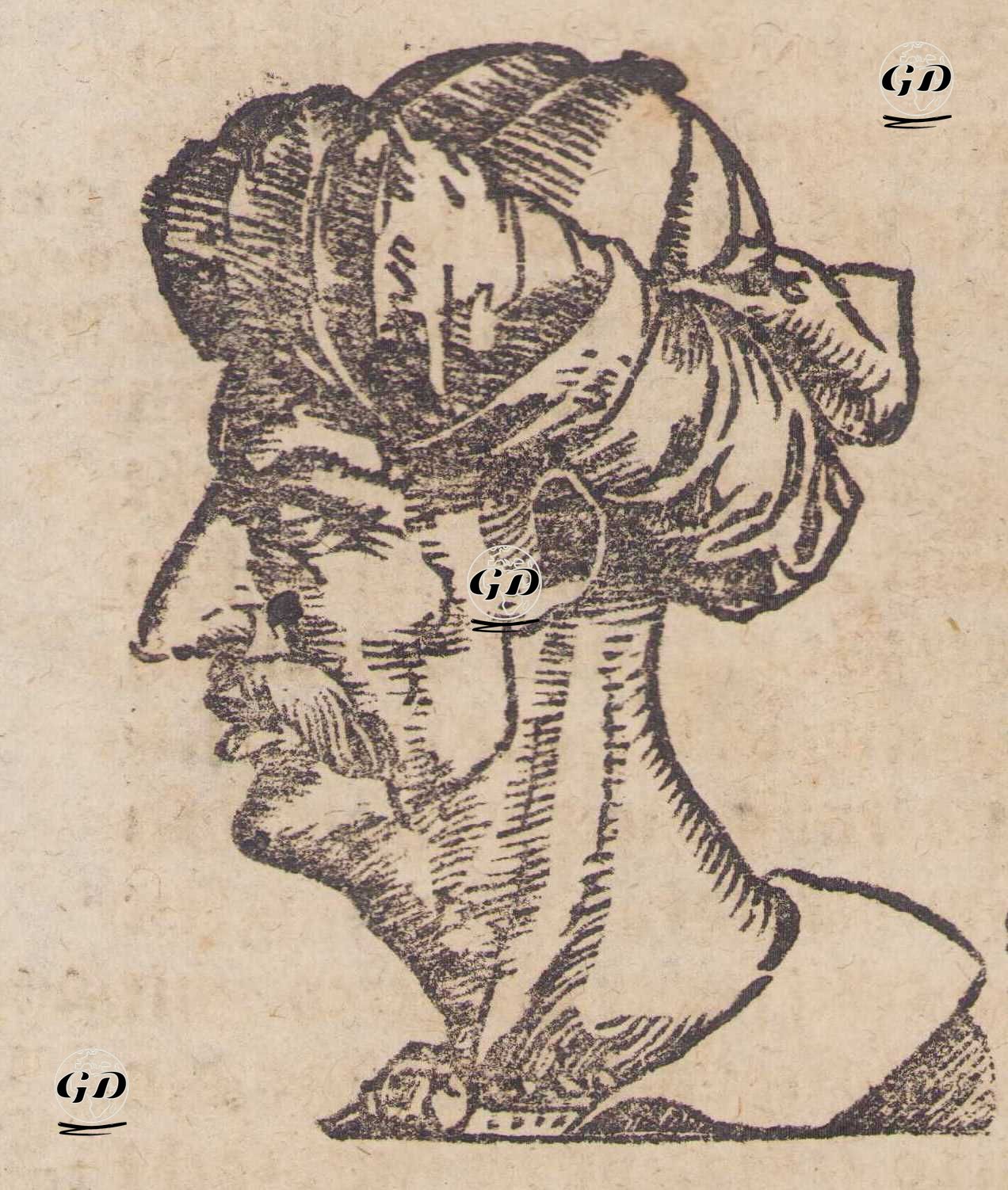
This woodcut, with its caption "Bajazet der vierdt Türkisch Keyser," belongs to the tradition in which early modern European historians classified Bayezid the Thunderbolt as the "fourth emperor" of the Ottoman Empire. The engraving is typical of the sultanic portraits in the 16th-century German-Swiss Türckenbücher (Turkish books) literature, representing Bayezid through European mental imagery rather than historical reality. The portrait form here—long-necked, rigidly profiled, loosely turbaned, sharply contoured face—derives not from an actual portrait tradition of Ottoman sultans, but from the schematic "Eastern ruler" mold of Renaissance iconography, which typified foreign rulers. This portrait tradition encompasses a style that primarily depicts Ottoman sultans in profile, emphasizing the "type of the Turkish ruler" rather than individual physiognomy. This depiction of Bayezid with a long beard and a stern look does not correspond to the actual miniature portraits of Yıldırım Bayezid. In this context, the engraving demonstrates how Ottoman sultans were transformed for European readers into political symbols rather than historical figures. While this engraving and its accompanying text are limited in terms of historical accuracy, they are crucial for understanding sixteenth-century European perceptions of the Ottoman Empire, political fears, polemics, and the cultural formation of the "Turkish image" (Turkenbild). While Bayezid's reign is remembered in Ottoman history for its institutionalization, expansion, and major battles, European sources often present this period as the "peak of the Turkish threat." This woodcut is also valuable for illustrating the divergence between two distinct historical memories: the Ottomans' own chronicle tradition and the externally produced European representation. This engraving appears in Sebastian Munster's book, Cosmographia Universalis …, first published in 1544. Over the years, the book has gone through numerous editions and revisions, becoming one of the most important works of geography and history of the 16th century. Containing a wealth of information on geography, cartography, natural history, and anthropology, the book has been widely used as a reference source by scientists, explorers, and cartographers for centuries. This engraving in our library was published in the 1628 edition of Sebastian Munster's Cosmographia Universalis...