GRAVÜR DÜNYASI
Digital Engraving Library
| Date | 1877 |
| Technique | Woodblock Engraving (Newspaper-Text on Reverse) |
| Category | Ottoman Empire And Turkey |
| Source | The Illustrated London News (June 2 1877- Page 517) |
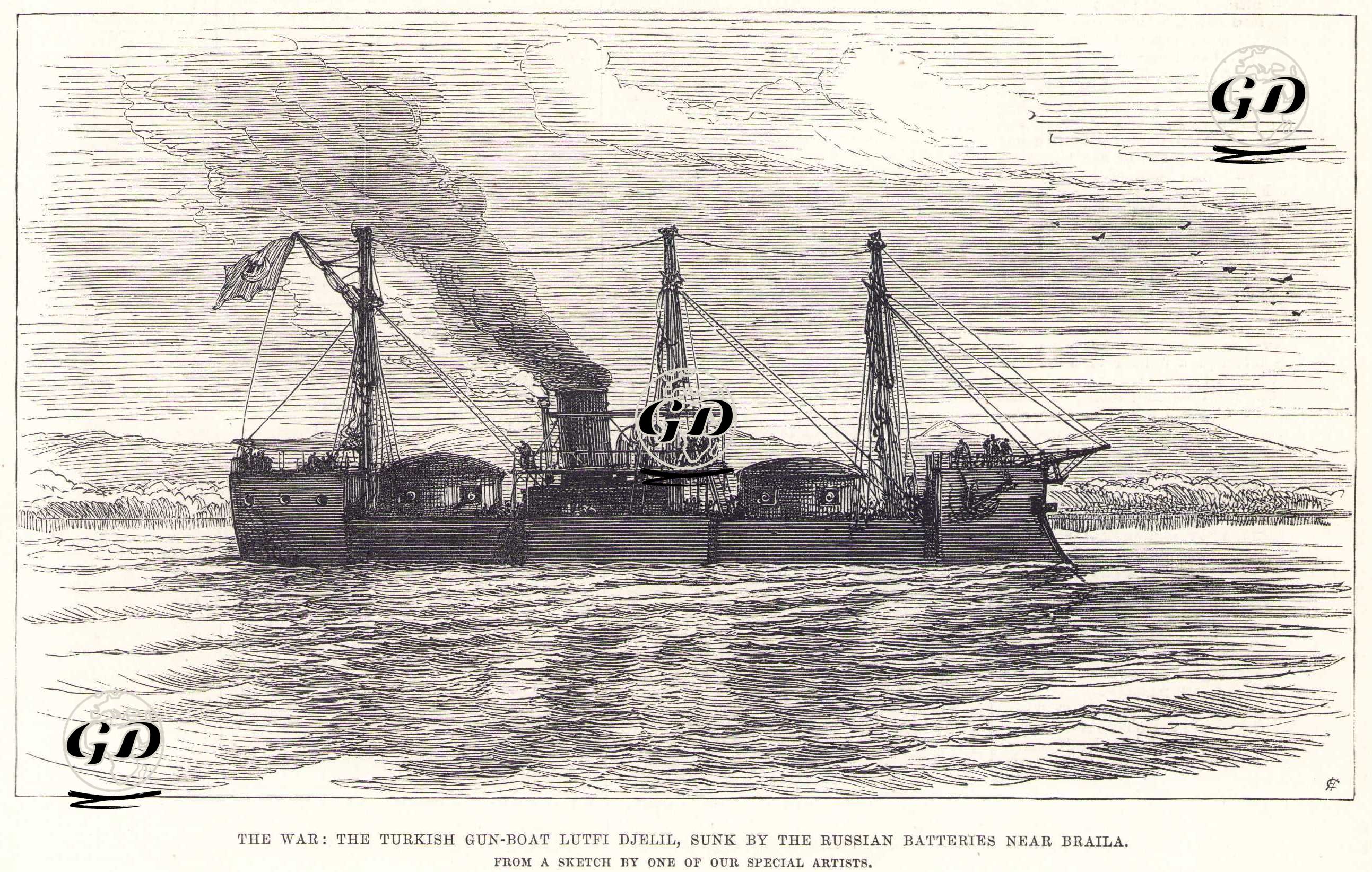
This engraving, published in the June 2, 1877, issue of The Illustrated London News, depicts Lütf-i Celil, one of the Ottoman Navy's most advanced river monitors commissioned as part of its modernization program in the second half of the 19th century. One of four turreted artillery ships built for the Ottoman government at the Chantier de la Gironde shipyard in Bordeaux, Lütf-i Celil, with its low side and strong armor belt, was designed to withstand the intense artillery fire of the Danube River. Her hull armor protection, reaching 140 mm, and her twin rotating turrets, each carrying two heavy guns, made her the most effective firepower on the Ottoman Danube line. Armed with Armstrong 229 mm and 178 mm guns, the ship is notable for its high destructive power against both coastal batteries and Russian crossing points. Although the 2,000 horsepower steam engine provided Lütf-i Celil with a speed of 12 knots under ideal conditions, this speed decreased due to lack of maintenance in 1877, the year of war. With the outbreak of the '93 War, Lütf-i Celil was assigned to the Danube Division and tasked with preventing the Russians from crossing the Galatz-İzmail-Braila river. However, on May 11, 1877, off the coast of İzmail, she came under intense fire from Russian batteries, and after a shell hit her boiler room, the ship sank in just ten minutes with a massive explosion. Most of the approximately 160 crew lost their lives. The incident was witnessed on-site by war correspondents of the time, and the moment of the sinking was published in a dramatic newspaper engraving.