GRAVÜR DÜNYASI
Digital Engraving Library
| Artist | Thomas Allom (1804-1872) |
| Engraver | Henry Bryan Hall (1808-1884) |
| Date | 1838-1839 |
| Technique | Steel Engraving |
| Category | Ottoman Empire And Turkey |
| Source | Constantinople And The Scenery Of the Seven Churches of Asia Minor Illustrated…, With an historical Account of Constantinople, and Descriptions of the Plates… (Fisher, Son & Co. London & Rue St. Honore, Paris) |
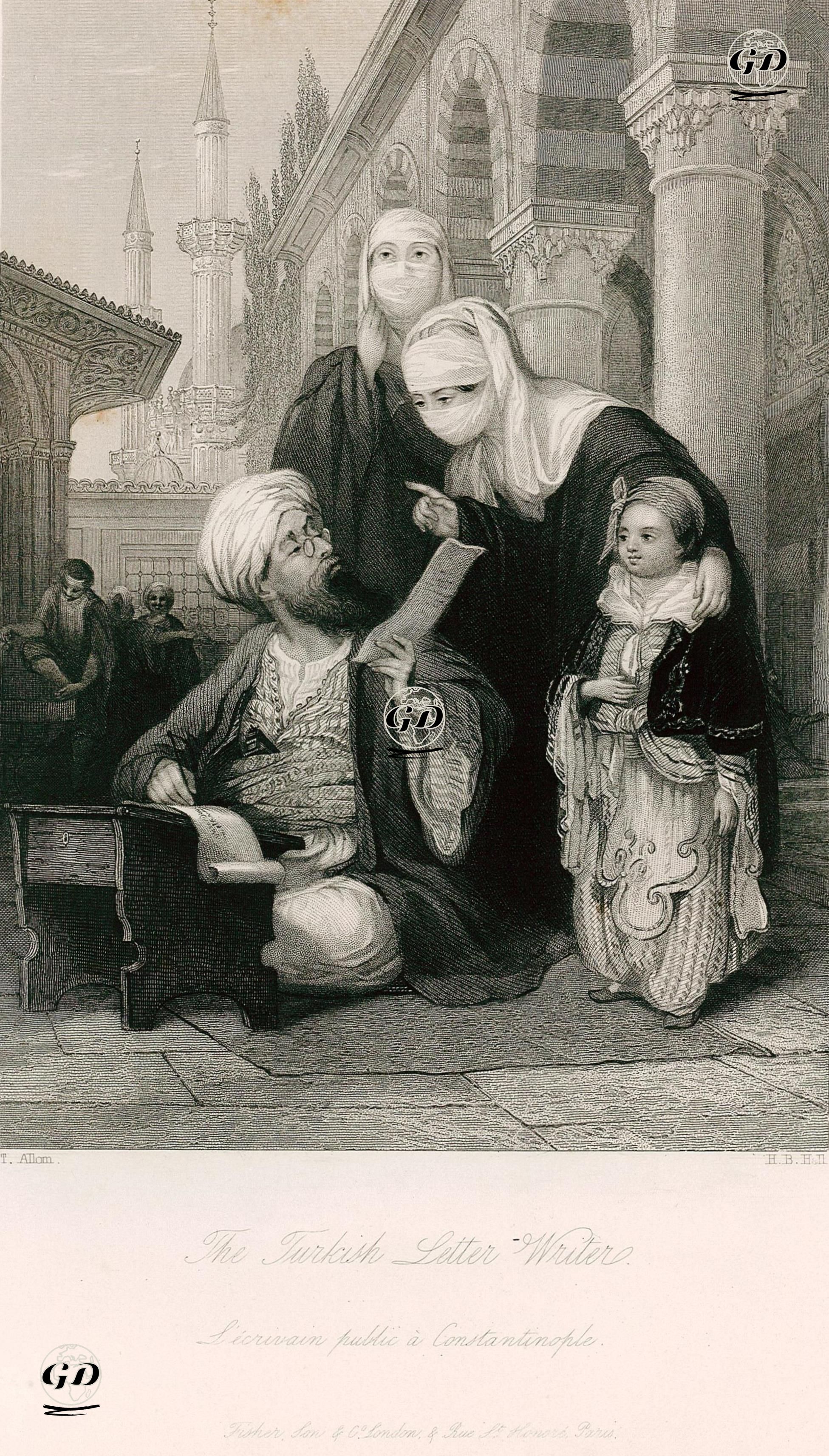
This engraving reveals the figure of the "Turkish scribe," one of the most striking professions of daily life in Ottoman Istanbul. Scribes (Arzuhalciler) were important intermediaries who prepared letters, petitions (arzuhal) to state institutions, and amulets for the largely illiterate public, thus ensuring the public's connection to written culture. In this respect, scribes served as intermediaries between the public and the state, acting as "public clerks." Scribes, in particular, were an indispensable professional group, preparing petitions to be submitted to the courts and the Imperial Council, thus conveying the voices of ordinary individuals to official institutions. These individuals, who earned their living through writing, could easily be seen in marketplaces, mosque courtyards, and on street corners. Instead of tucking swords or guns into their belts, they carried brass inkwells and inkwells, symbolizing their mastery of the pen. While their desks were often simple pieces of wood, their pens, like those of the Romans, were made of reed. Despite their modest appearance, they were respected in society as individuals capable of "putting every subject into writing." The engraving depicts a scribe sitting on his knees in a mosque courtyard, holding a small easel and papers in front of him. Surrounded by women and a child, he is approached by women and a child. The woman's gestures to the scribe clearly demonstrate that the scribe functioned not only as a scribe, conveying the text but also as a translator, translating the people's feelings, wishes, and daily concerns. As noted in the book "Constantinople And The Scenery Of The Seven Churches of Asia Minor Illustrated...", which includes the engraving, the engraving depicts a mother having a petitioner write an amulet for her daughter. In Ottoman society, amulets were believed to protect against illness, magic, evil spirits, the wrath of enemies, and thieves. Scribes would create these amulets by adding various symbolic signs alongside selected verses from the Quran, thus providing their customers not only with written documents but also with a means of spiritual security. The amulet known as "Kef Meryem" (Virgin Mary's hand), prepared for a child in the engraving, was one of the most common talismans believed to protect children from evil and the evil eye. Such amulets were usually written on paper or blue glass and worn on the head or chest of children. Furthermore, the same book, while providing information about this engraving, notes that Ottoman society communicated not only through letters but also through symbolic communication methods. Communication through flowers was paramount. Flower bouquets served as an allegorical language, replacing written letters. For example, the rose represented happiness and beauty; the orange blossom hope; the marigold despair; the cockscomb loyalty; and the tulip reproach in the face of disloyalty. This symbolic language was of great importance, especially for illiterate lovers to convey their feelings to their beloveds.