GRAVÜR DÜNYASI
Digital Engraving Library
| Artist | C.Robinson |
| Date | 1877 |
| Technique | Woodblock Engraving (Newspaper-Text on Reverse) |
| Category | Ottoman Empire And Turkey |
| Source | The Illustrated London News (March 17, 1877-Page 245) |
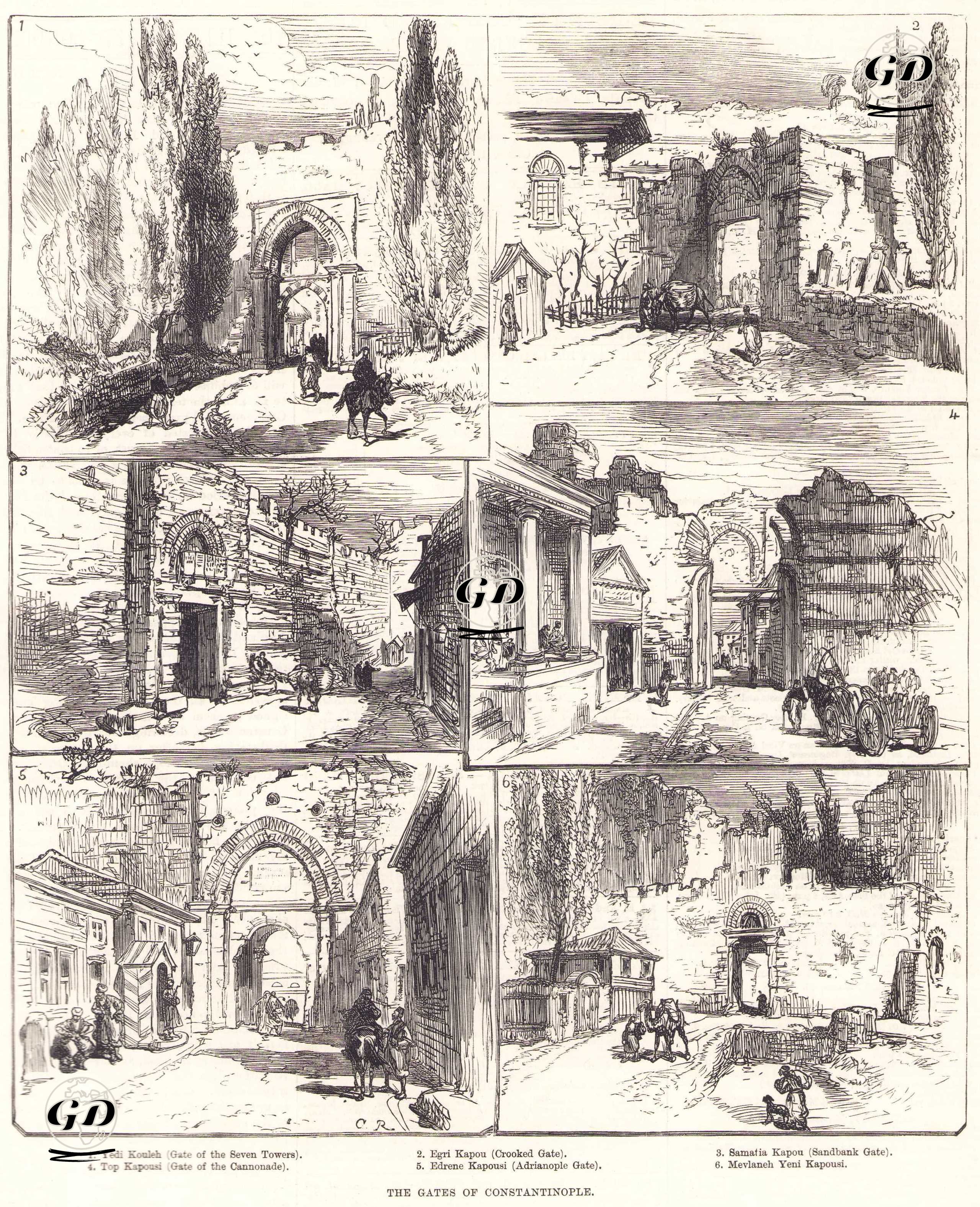
This engraving was published in The Illustrated London News on March 17, 1877, and is titled "The Gates of Constantinople." The engraving depicts in detail six of the important gates leading to the land and sea walls of Ottoman-era Istanbul. Below is a summary of the Turkish translation of the news text related to this engraving, preserving its original meaning. Constantine's imperial city continues to bear his name throughout the Christian world. However, the Turks, who ruled the city for 423 years, call it "Stamboul" or "Istambol." Some believe this name is a corruption of three Greek words meaning "towards the city." During the Byzantine Empire, this expression was frequently heard among provincials, referring to the capital. Ancient Byzantium was founded by a Megarian Greek colony in the 7th century BC. The city was the scene of many fierce battles between the Greeks and the Persians. It later changed hands between the Spartans, Athenians, and Macedonians. However, before the dawn of our era, it succumbed to the conquering power of Rome. In 330 AD, Rome's first Christian emperor founded this magnificent city, and for over 1,000 years it remained the Christian capital of the East. It has now been the center of Ottoman rule for over four centuries. In the 13th century, the city was captured by Western Crusaders and came under the rule of a Flemish dynasty based on a confederation of princes. However, Byzantine Emperor Michael VIII defended the city against Muslim enemies for another two centuries. Even in the 15th century, had it not been for the civil wars in France and England, it might have been recaptured by Christian Europe. The location of this famous city—situated on a promontory at the southern end of the Bosphorus, overlooking the Sea of Marmara, and overlooking the Golden Horn, a natural harbor—has always attracted attention. The Bosphorus is sometimes called the "Golden Horn" and has two Christian neighborhoods, Pera and Galata. The first of these is where European visitors live, while the second is inhabited by the Sultan's Greek subjects. Across the Bosphorus from the Asian side lies Üsküdar, a city comprised entirely of Turks. The drawings presented in this issue are taken from the sketches of our dedicated artist and depict the gates of Istanbul. The city is surrounded by walls constructed entirely of brick and stone. These walls, built by the Eastern Roman Emperors, are approximately 13 miles long. Two-thirds of the walls extend along the Marmara coast, from Yedikule to Sarayburnu, the Bosphorus, and the Golden Horn. The remaining section extends on land, consisting of a triple wall extending along the promontory where Stamboul is located. These walls are adorned with moats and numerous towers. These walls offer several examples of medieval castle architecture, but today they are a series of ruins and ruins. Today, these structures appear as picturesque ruins. The city has seven gates on the land side, twelve on the Golden Horn and Bosphorus sides, and seven on the Sea of Marmara side. However, some are walled off. The Turkish word for "gate" is "Kapou" or "Kapouh," and this word appears in the names of many of the gates depicted in our engravings. One of the first gates visible in the general view of Istanbul is the Yedikule (Seven Towers). It is located near the southern city walls, the promontory between the Sea of Marmara and the Golden Horn. Near this gate are various structures dating from the Byzantine and early Ottoman periods. These include hospitals, Greek and Armenian churches, and mausoleums. The next gate is the Edirne Gate. The "Eğri Kapı" (Curved Gate) is also known as the "Charsian Gate" after the Greek architect Charsis. It is sometimes referred to as the Bulgarian Gate. This gate is also on the western side of the city. It was also the gate through which Emperor Justinian made his triumphal entry into Constantinople. Just north of it is the Edirne Gate. This gate opens onto the road to Edirne, which was the political center of Edirne before the Ottomans conquered Istanbul in 1453. The Mevlevi Yeni Gate is not particularly striking. These are all landward gates. The other two gates depicted in engravings are the Samatya Gate and the Top Gate. Top Gate is also known as the "Aziz Roman Gate." It is where the Turkish army launched its fiercest attacks before 1453, ultimately breaching the city walls. The Turkish flag was also first raised here. Since the collapse of Greek rule and the transformation of the Ottoman government, many of the gates in Istanbul are no longer in use. Unlike European armies, the Turks did not use large numbers of carts or wheeled vehicles, forcing them to move all their logistical supplies through several breaches simultaneously. Some gates not covered in this article include: The Garden Gate (Baghtche Kapousi), the Jewish Gate (Chifoot Kapousi), the Fish Market Gate (Baluk-Bazar), the Dungeon Gate (Lindoou), the Wood Barn (Odoun), the Glaziers' Gate (Jubali), the Palace Gate (Balat), the Animal Farm (Haivan Serai), the Butchers' Gate (Chiflik), the Stable Gate (Akhur), the Pomegranate Garden (Narli), the Lighthouse Gate (Fanar), the Sand Gate (Koum Kapousi), the Davud Pasha Gate, and several other gates, all of which open onto the sea. We haven't mentioned the famous and magnificent structures within the city here: Hagia Sophia, built by Justinian in the 6th century, has now been converted into a mosque. The Ahmediye, Süleymaniye, and Fatih Mosques, the Hippodrome (Atmeydanı), the Babıali, the Saray-ı Atik (Old Palace), and the Sultan Tombs are also among these structures.