GRAVÜR DÜNYASI
Digital Engraving Library
| Artist | Melton Prier (1845-1910) |
| Date | 1877 |
| Technique | Woodblock Engraving (Newspaper-Text on Reverse) |
| Category | Ottoman Empire And Turkey |
| Source | The Illustrated London News (January 6 1877-Front Page) |
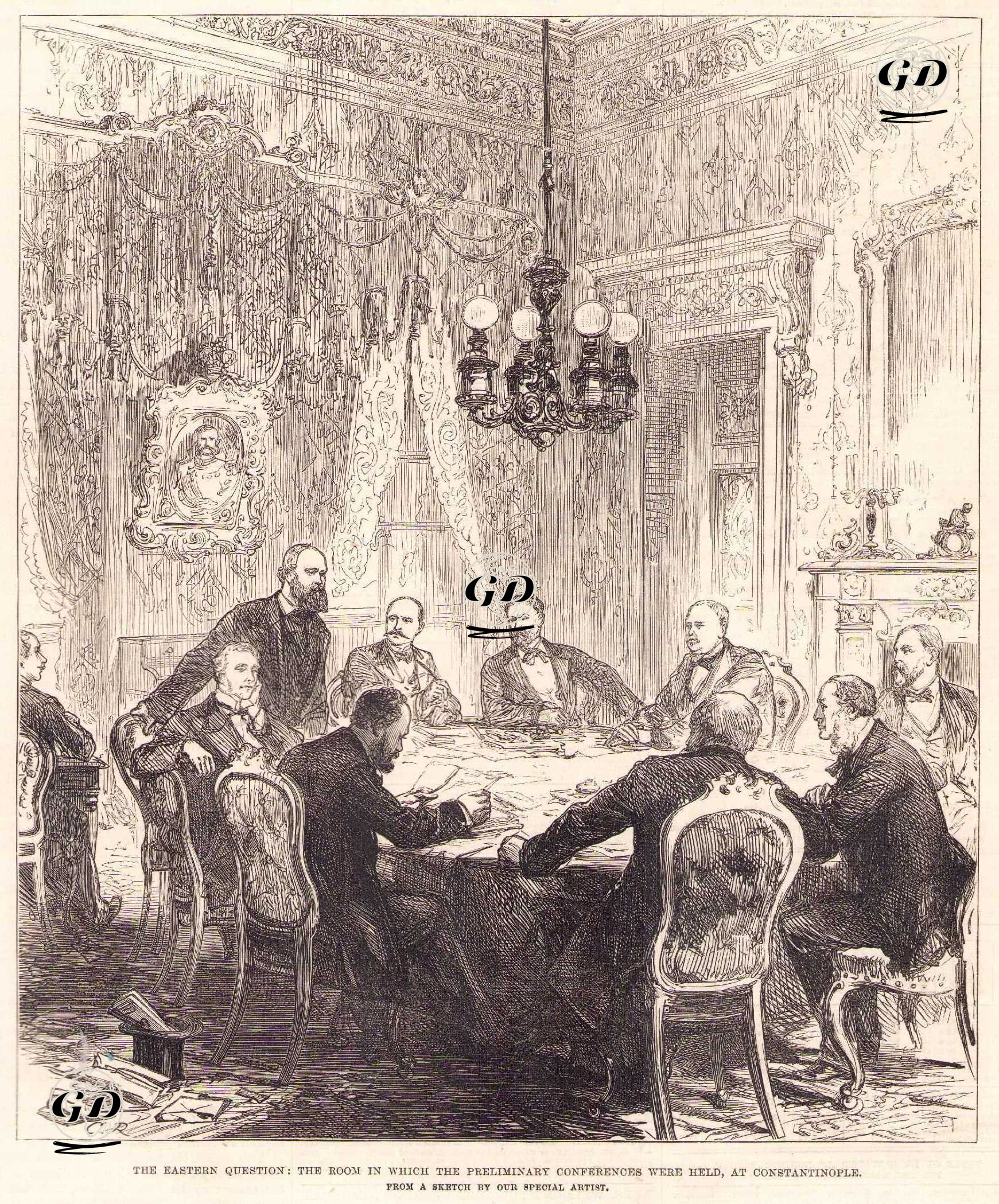
This engraving documents the diplomatic atmosphere of the Plenary Shipyard Conference held in Istanbul between December 23, 1876, and January 1, 1877, and the international negotiations that prevailed during the final years of the Ottoman Empire. The meetings took place in the magnificent hall of the Ottoman Navy Ministry (Tersane-i Amire). The hall depicted in the engraving is an elegant structure overlooking the Golden Horn, with its ceiling decorations, colorful chandeliers, and gold-embroidered curtains on the walls, reflecting the aesthetic and ceremonial aspects of Ottoman diplomatic culture. The European press described the venue as "a synthesis between the grandeur of the East and the formality of Western diplomacy." Foreign Minister Safvet Pasha presided over the conference, representing the Ottoman Empire; Edhem Pasha also participated in the Ottoman delegation. From European states, Lord Salisbury (England), Count Zichy (Austria), Baron Werther (Germany), Count de Chaudordy (France), General Ignatieff (Russia), Marquis de Boutenieff, Prince Corti (Italy) and other ambassadors attended. The conference's purpose was to assess the Ottoman Empire's reform promises in the face of events that shook European public opinion, particularly following the uprisings in the Balkans and Bulgaria. In his opening speech, Safvet Pasha stated that the Ottoman Empire had a liberal understanding of reform, and that Sultan Abdulhamid II had declared the new 1876 Constitution (Kanun-ı Esasi) granting equal rights to all subjects. However, the European delegates demanded that these reforms be implemented under international supervision. At the second session on December 28, 1876, it was decided to extend the armistice for two months. The Ottoman delegation agreed to examine the proposals of the European powers but reserved the right to submit its own counterproposals. At the third session on December 30, 1876, the Ottoman side presented its own reform proposals, but they were deemed inadequate by the European powers. The Ottoman government rejected foreign intervention in its internal affairs, stating that "reforms would be carried out under the authority of the Sublime Porte." At the fourth session, held on January 1, 1877, Lord Salisbury considered Ottoman counter-offers on behalf of the European delegates, and negotiations ended without a compromise. This marked a period of exhaustion for diplomatic efforts and laid the groundwork for the Russo-Turkish War of 1877–1878 (the '93 War) that would erupt a few months later. This engraving documents not only a diplomatic meeting but also one of the last major international conferences of the age of empires, with the Ottoman Empire striving for reform.