GRAVÜR DÜNYASI
Digital Engraving Library
| Artist | William Henry Bartlett (1809-1854) |
| Engraver | Robert Wallis (1794-1878) |
| Date | 1854 |
| Technique | Steel Engraving |
| Category | Ottoman Empire And Turkey |
| Source | The Beauties Of The Bosphorus |
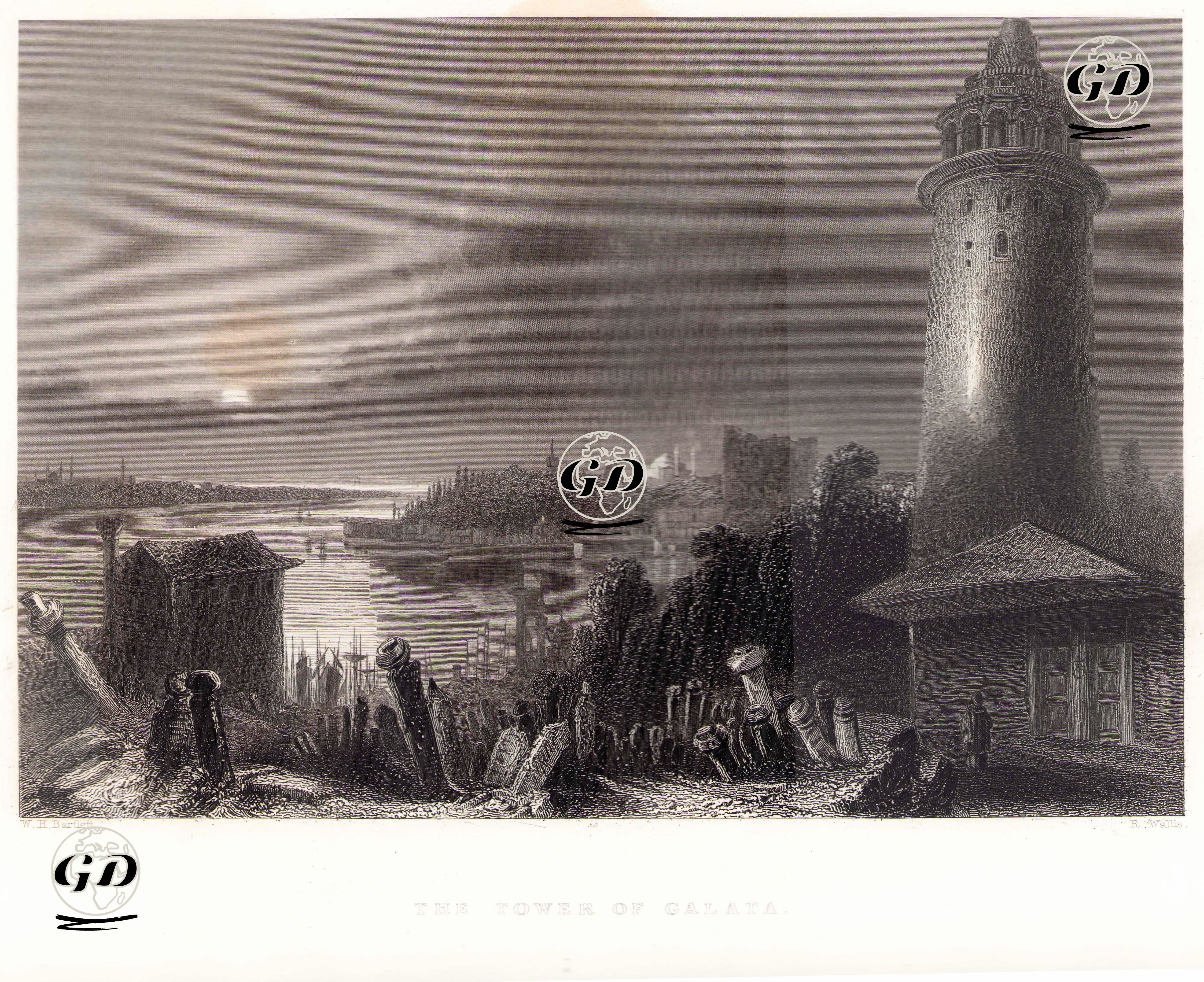
The book "The Beauties of the Bosphorus," which includes this engraving titled "Galata Tower," summarizes the information about Galata Tower and its surroundings as follows: Galata, located on the outskirts of Pera, is described as one of the most important ports and trade centers connecting Istanbul to Europe. The name Galata originates from the Byzantine word "gala," meaning "milk market." The district was developed as a trading center by the Genoese during the Crusades, and thanks to its strategic location between the Bosphorus and the Golden Horn, it possessed a vast trade network. However, its increasing prosperity aroused the envy of the Venetians, and as a result of Venetian attacks, Galata was largely destroyed. The Genoese, defeated and homeless, sought refuge in Emperor Kantakouzenos, who was on the opposite bank of the Golden Horn. The emperor allowed the Genoese to rebuild their houses and surround their town with a wall, which he then protected with a wide moat. Galata Tower is located on this wall line, which had fallen into ruin and lost its defensive function by the time the book was written. It was built for defensive purposes and in memory of the Genoese settlers who died defending their lives and property. However, over time, the tower partially fell into disrepair, becoming both useless and dangerous. The book notes that an elegant garden surrounded the tower, offering a particularly impressive view, especially to those approaching the Golden Horn from the Marmara Sea. It also notes that despite the dilapidated state of the Galata walls, the gates separating Galata and Pera were still closed every night by Turkish watchmen. As emphasized in the book, the tower was conceived not only as a military and strategic structure but also as a monumental element shaping the city's skyline. In the eyes of travelers, the tower served as both a part of the walls separating Pera and Galata and as a "sentinel" monitoring Istanbul's maritime trade. Galata Tower served various functions throughout the Ottoman and Republican periods, serving as a lighthouse, dungeon, observatory, and fire lookout. Severely damaged in the "Little Apocalypse" earthquake of 1509, the tower was repaired during the reign of Bayezid II. During the reign of Suleiman the Magnificent, the tower briefly served as an observatory during the reign of Murad III. During the reign of Murad IV, it witnessed Hezarfen Ahmed Çelebi's historic flight to Üsküdar. The tower, which became a communications hub for fires in the 18th century, lost its spire in the fire of 1794 and was renovated on the orders of Sultan Selim III. During the reign of Mahmud II, it was renovated in the Empire style, with the upper floors arranged as arched cihannüma (housing area) and a wooden spire added. The spire was blown away in the storm of 1875, and octagonal floors were built in its place, preserving this appearance until 1964. Its structure was strengthened with the restorations carried out between 1964 and 1967, and with the last restoration carried out in 2020, it gained the function of a museum. Today, Galata Tower continues to exist both as one of the landmarks of Istanbul and as an architectural witness to the multi-layered historical processes of the past.