GRAVÜR DÜNYASI
Digital Engraving Library
| Artist | William Henry Bartlett (1809-1854) |
| Engraver | Joseph Clayton Bentley (1809-1851) |
| Date | 1838 |
| Technique | Steel Engraving-Original Hand Colored |
| Category | Ottoman Empire And Turkey |
| Source | The Beauties Of The Bosphorus (London Published For Proprietors By Geo. Virtue 26 Ivy Lane, 1838) |
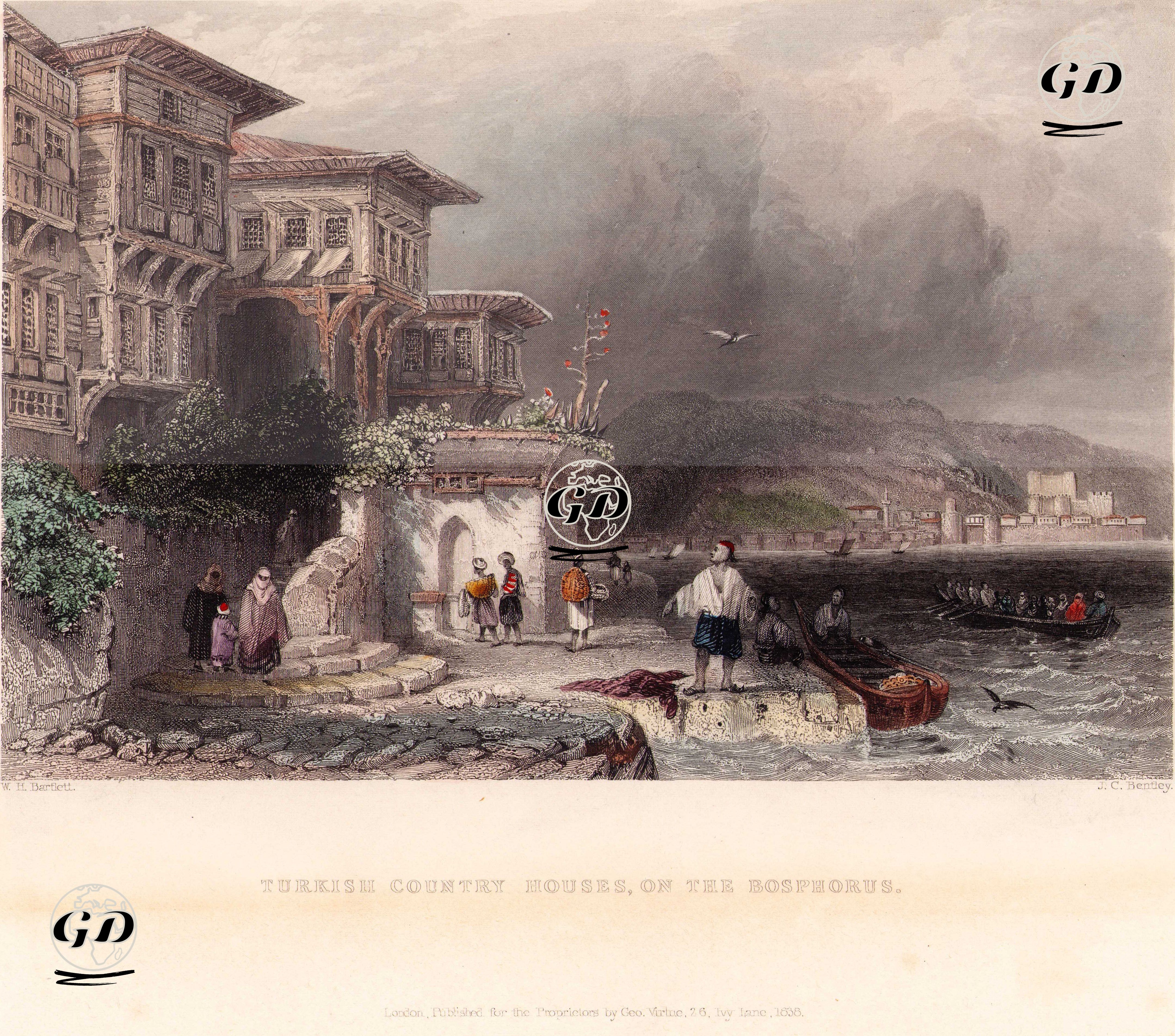
The Turkish houses and waterside residences that adorned the shores of the Bosphorus were perceived by 19th-century Western travelers not only as architectural structures but also as scenes reflecting the aesthetic and social order of Ottoman life. The written information about this engraving, titled "Turkish Houses on the Bosphorus," in the work The Beauties of the Bosphorus, is summarized as follows: "These houses, lined along the shore, were mostly built on terraces extending directly into the sea, sometimes notable for their overhangs. The exteriors of these houses were painted in a variety of colors. Armenian and Greek houses were generally adorned with dull red, gray, and black tones. More vibrant colors were reserved for Turkish houses. Wealthier mansions were painted in two different colors, making them appear as separate structures. While their construction styles were irregular and fragmented, this irregularity created an architectural style integrated with nature, enriching the distinctive landscape of the Bosphorus. One of the most distinctive features of waterside residences are their gardens and terraces. Surrounded by cypress, plane, and maple trees, these structures, used as summer residences, are practically summer resorts, integrated with nature. Trellis-covered terraces in front of the windows, gardens filled with the scent of flowers, and boats docking at the shore are integral parts of daily life. The trellis-covered terraces of the harem sections, in particular, both preserved privacy and added aesthetic refinement. The interiors, however, are even more ornate and imaginative than their exteriors. The walls are decorated with frescoes of landscapes, fruits, and flowers, and the ceilings are intricately decorated. These interiors were designed with the idea of joy and spaciousness, and were described by Western observers as "spaces as elegant as fairy palaces, yet almost as fragile." This narrative in the book demonstrates that Turkish houses along the Bosphorus are not merely an architectural typology, but a concrete manifestation of Ottoman society's connection with nature, the intricacies of daily life, and its aesthetic sensibility. With both magnificent mansions and simple structures, these houses transformed the Bosphorus into a stage for Western travelers, and the waterside residences became decorative and poetic elements within this stage. Finally, the house in the center of the engraving is the Yılanlı Yalı (Snake Mansion). Located between Rumelihisarı and the Bebek districts, Yılanlı Yalı was built in the late 17th century. The mansion was severely damaged in a fire in 1964. The harem section of the mansion burned down, and it was not rebuilt. Various sources state that the name Yılanlı Yalı remained, as it was claimed to contain a snake to prevent its sale.