GRAVÜR DÜNYASI
Digital Engraving Library
| Date | 1840`s |
| Technique | Copper Engraving |
| Category | Architecture And Design |
| Source | Stahlstich (Direction v. Kleinknecht) aus der Schweinfurter Graviranstalt des Bibliographisches Institut, Hildburghausen, Amsterdam, Paris & Philadelphia |
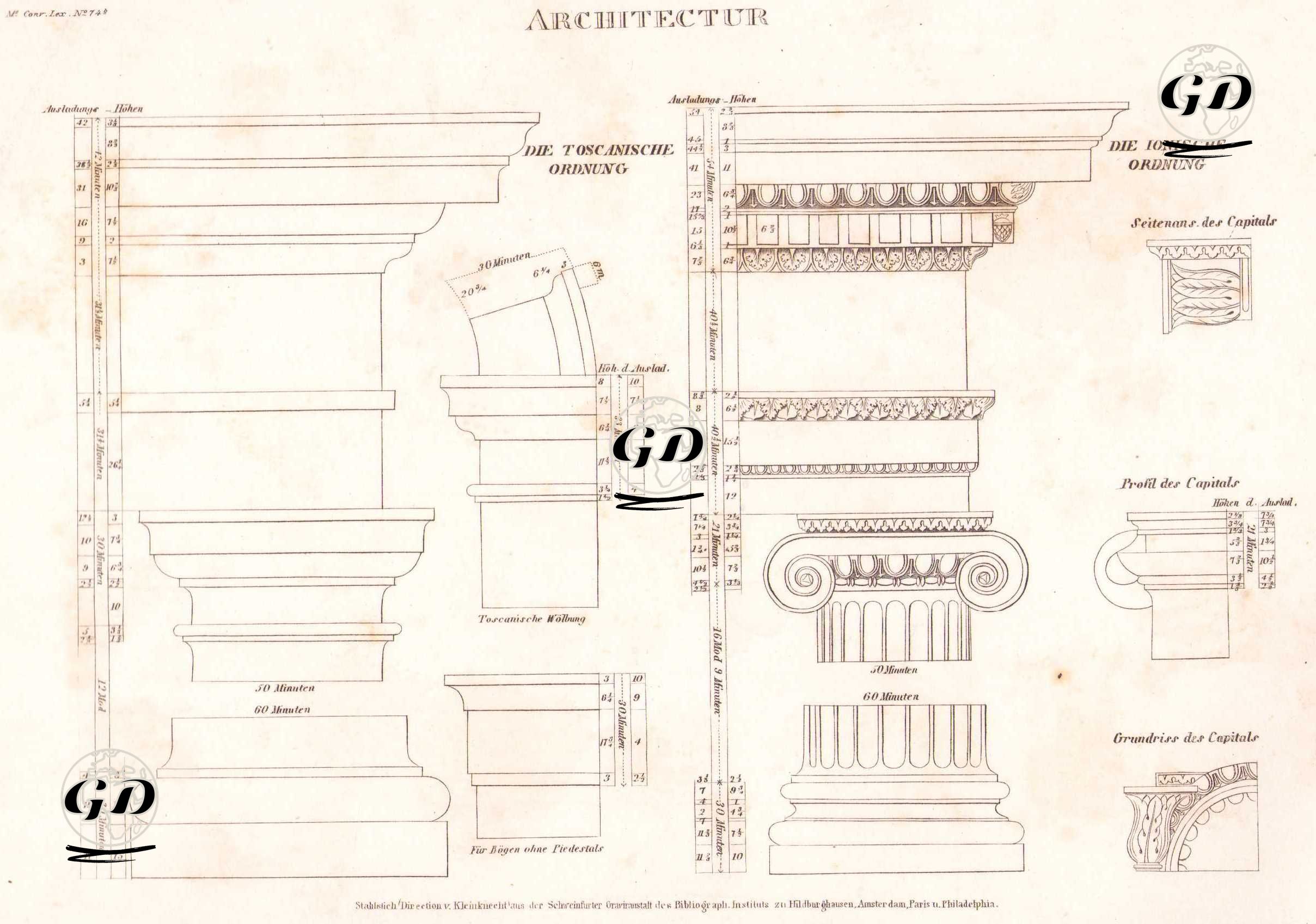
This engraving is a typical example of how the Vitruvian tradition, which systematically defined column orders in Classical Antiquity, was represented in 19th-century academic architectural education. The Tuscan order is shown on the left, and the Ionic order on the right, accompanied by scaled tables of proportions. These two orders represent a line of formal evolution within the classical architectural hierarchy, from the "simplest" (Tuscan) to the "more refined" (Ionic). This change was seen not only as an increase in ornamental forms but also, in the academic understanding of the 18th-19th centuries, as a reflection of civilizational and cultural development on architectural forms. The engraving depicts, with millimetric precision, the calculations of proportions and dimensions for the column base, shaft, capital, and superstructure (entablature). This is a typical manifestation of the understanding of architecture as a "mathematical language" in 19th-century academies. The spiraling curves and curvilinear profile transitions of the Ionic capital, while appearing as ornamentation on the surface, are actually presented as a calculable system, reduced to geometric modules. The Tuscan's simple bands and undecorated surfaces, on the other hand, recall the "simplicity of the first order," its rustic and solemn presence. Such drawings were practically a mandatory language of instruction for architecture students in the 19th century. All proportions within a project, such as the height of the superstructure (entablature), the diameter of the columns, or the radius of the spiral volutes (volutes), were calculated according to the modular system illustrated here. Therefore, this engraving is not only a stylistic comparison but also demonstrates how the Classical Proportion System became the "norm" in 19th-century pedagogy.