GRAVÜR DÜNYASI
Digital Engraving Library
| Date | 1875 |
| Technique | Steel Engraving |
| Category | Architecture And Design |
| Source | Bilder-Atlas: Ikonographische Encyklopädie der Wissenschaften und Künste ; ein Ergänzungswerk zu jedem Conversations-Lexikon ; 500 Taf. in Stahlstich, Holzschnitt u. Lithographie ; in 8 Bd.. 5 by bearb. von Karl Gustav Berneck … - Druck und Verlag von F. A. Brockhaus in Leipzig |
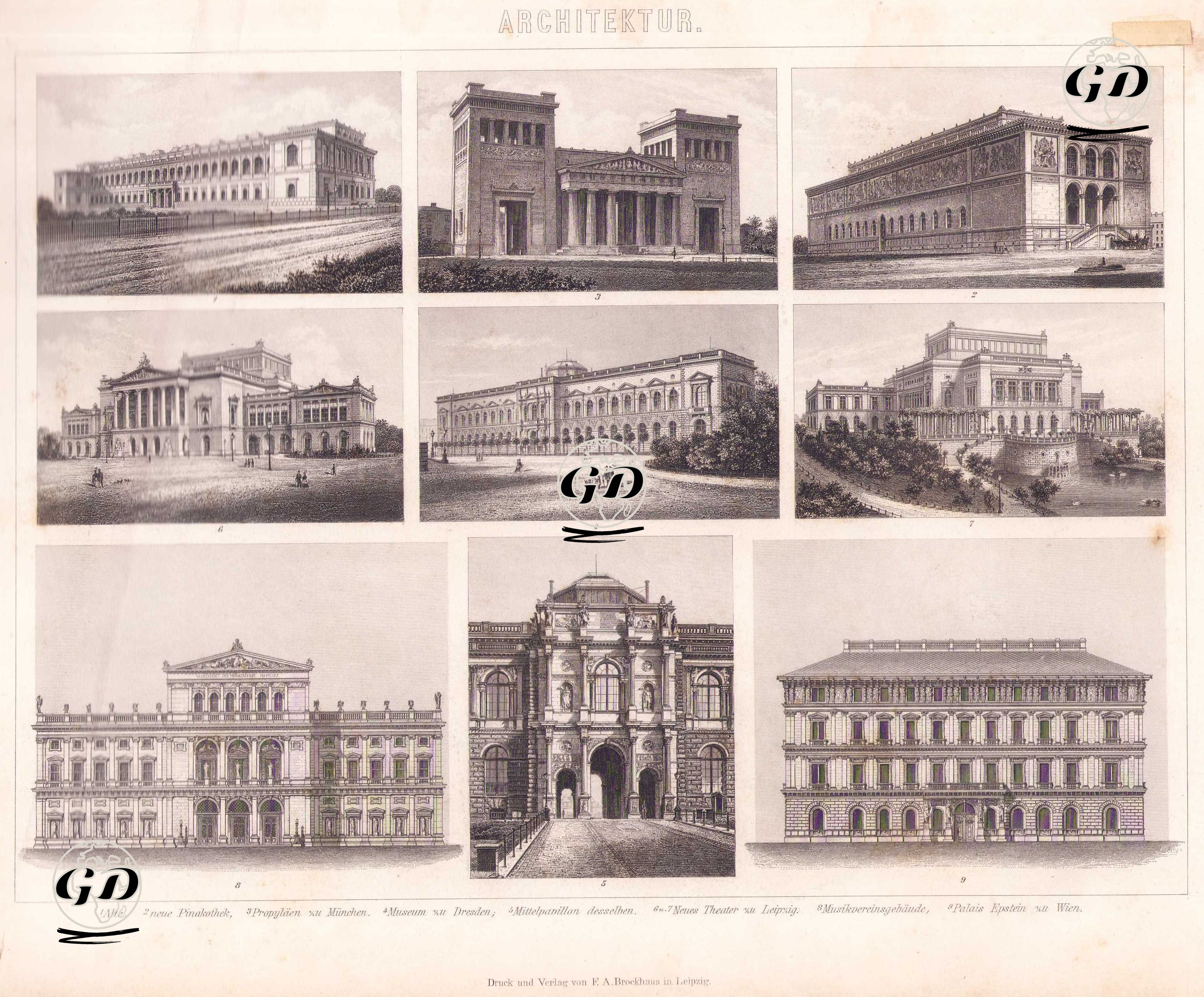
This engraving demonstrates that the modernization of 19th-century European architecture was shaped by an architectural approach inspired by past periods and combining diverse styles. The buildings seen in the engraving can be interpreted along two main lines that transformed the cultural policies of Central Europe, particularly in Germany and Austria: (1) the rise of museums and scientific institutions, and (2) the transformation of public and representative state architecture into a more flamboyant, theatrical style. The Alte and Neue Pinakothek in Munich are among the earliest examples of the art collection becoming a national asset and prestige. The interior and exterior architecture of these buildings, inspired by antiquity and the Italian Renaissance, establish an academic sense of proportion and order. The examples of the Dresden Museum and the New Theatre in Leipzig demonstrate how the museum and opera/theater building became symbols of metropolitanism. The Palais Epstein and the Musikverein building in Vienna represent one of the most prestigious urban stagings undertaken by the Habsburg capital along the Ringstrasse in the second half of the 19th century. Here, architecture not only produced a functional structure but also represented the cultural hierarchy and intellectual identity of the imperial center. This engraving brings these examples together, demonstrating in a clear and scholarly manner how 19th-century European modernity, while forging its post-industrial identity, simultaneously coexisted with a "return to ancient forms" and "the nation-state's desire for self-representation."