GRAVÜR DÜNYASI
Digital Engraving Library
| Date | 1875 |
| Technique | Steel Engraving |
| Category | Architecture And Design |
| Source | Bilder-Atlas: Ikonographische Encyklopädie der Wissenschaften und Künste ; ein Ergänzungswerk zu jedem Conversations-Lexikon ; 500 Taf. in Stahlstich, Holzschnitt u. Lithographie ; in 8 Bd.. 5 by bearb. von Karl Gustav Berneck … - Druck und Verlag von F. A. Brockhaus in Leipzig |
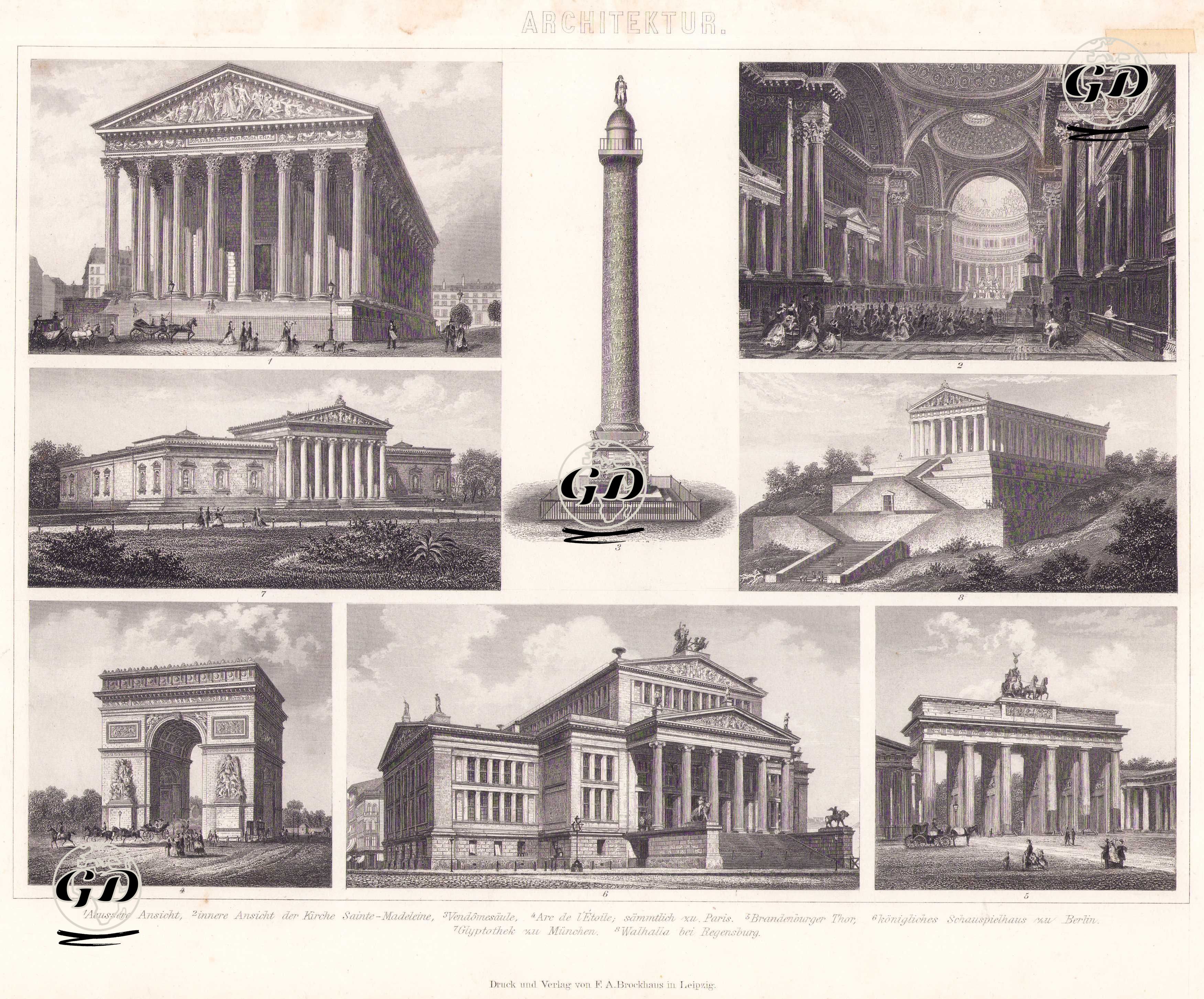
This engraving brings together the most powerful representations of Classicism and its successor, the Neo-Renaissance, in 19th-century European architecture. In four important cultural centers—Paris, Berlin, Munich, and Regensburg—the reinterpretation of the ancient Greco-Roman heritage became a tool both for reflecting state ideology and for constructing national identity. The construction of the Sainte-Madeleine (La Madeleine) Church in Paris, built on a peripteral plan (a temple surrounded by columns) reminiscent of a Roman temple, symbolizes Napoleon's effort to combine imperial ideology with the grandeur of ancient Rome. The Vendome Column and the Arc de l'Étoile (today's Arc de Triomphe), erected to commemorate Napoleon's victories, transformed classical iconography into the language of 19th-century propaganda. The Brandenburger Tor in Berlin exemplifies how the Prussian monarchy used classical humanism for its own political legitimacy and is one of the most symbolic examples of the race of European empires to appropriate the "Roman heritage" in the late 18th and early 19th centuries. The Glyptothek in Munich is more than just a museum showcasing ancient sculptures. With this structure, Ludwig I pursued a project to demonstrate Bavaria's cultural superiority through art. The Walhalla in Regensburg is the site of a German national monument and a re-sanctification of the ancient temple typology for German identity. Taken together, these structures reveal that 19th-century nation-states leveraged the heritage of the classical period beyond a mere aesthetic resource to produce legitimacy and narratives of origin. This engraving thus allows us to understand the process of modernizing Europe's ancient Greco-Roman tradition and instrumentalizing it in the construction of national identity.