GRAVÜR DÜNYASI
Digital Engraving Library
| Date | 1875 |
| Technique | Steel Engraving |
| Category | Architecture And Design |
| Source | Bilder-Atlas: Ikonographische Encyklopädie der Wissenschaften und Künste ; ein Ergänzungswerk zu jedem Conversations-Lexikon ; 500 Taf. in Stahlstich, Holzschnitt u. Lithographie ; in 8 Bd.. 5 by bearb. von Karl Gustav Berneck … - Druck und Verlag von F. A. Brockhaus in Leipzig |
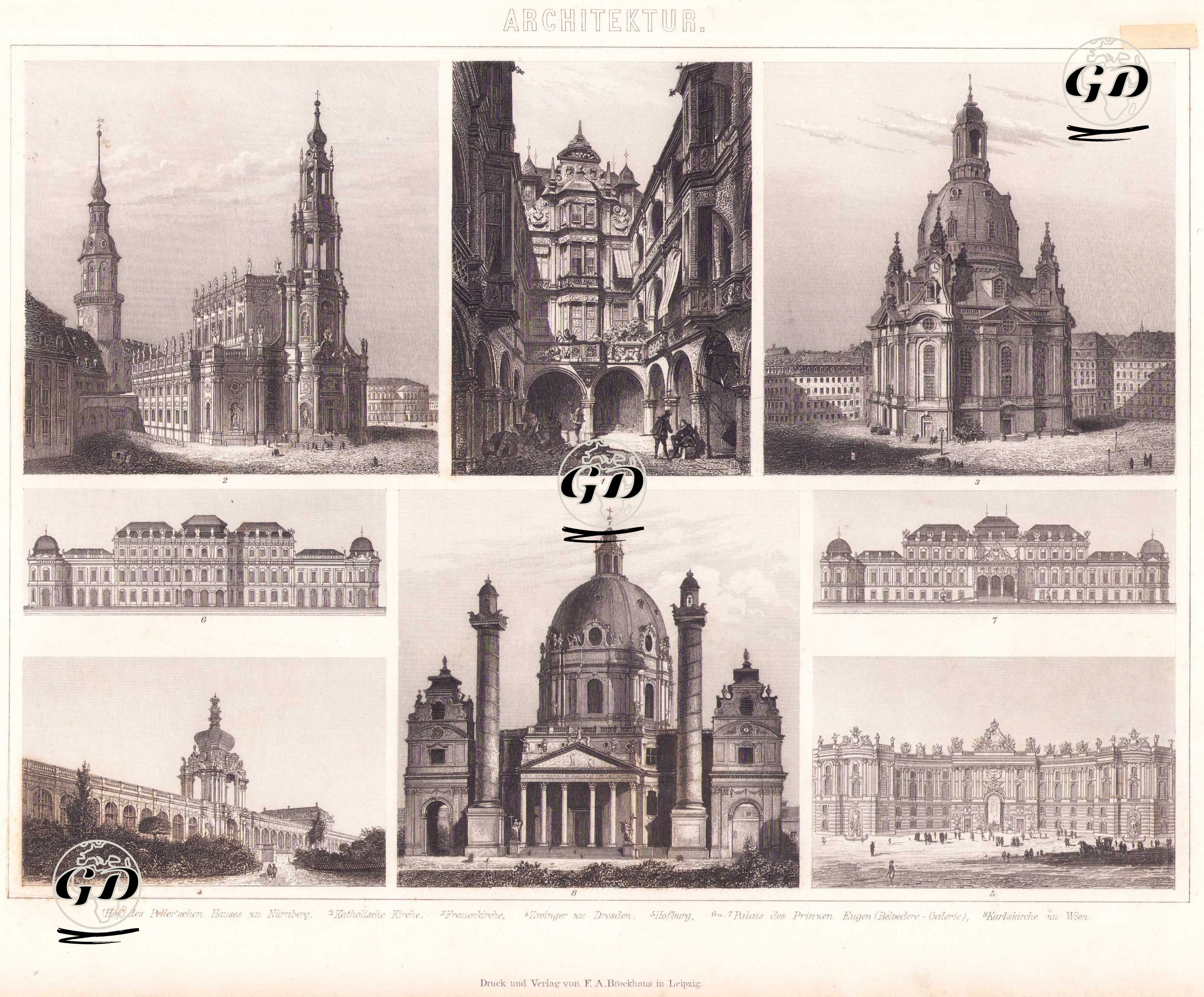
This engraving brings together the most characteristic examples of Baroque architecture in Germany and Austria during the 17th and 18th centuries. Following the Catholic Reformation (Counter-Reformation), Baroque was a style in which religious and secular power, particularly in the Habsburg world, was transformed into "visual persuasion" through the language of architecture. Iconic domed structures such as the Dresden Frauenkirche (1743-1747) represent a trans-Alpine adaptation of Italian Baroque, not only through its engineering and plastic volumes but also through its emphasis on spatial "centeredness." The Dresden Zwinger complex (from the 1710s) was designed as a spatial stage for courtly entertainment, scientific collecting, and ceremonial occasions. These palace and church structures, seen on the axis of Nuremberg, Vienna, Dresden and Prague, with their high-profile cornices, giant colonnades, curvilinear facades, elliptical plan motifs, dense plastic ornaments, sculptural programs and mythological or allegorical iconography, represent not only a stylistic change but also a turning point in which the empires inscribed their own “understanding of truth” into architectural space. Buildings such as the Belvedere (Prinz Eugen Palace) and the Hofburg reflect the Habsburg dynasty's polycentric administrative structure and diplomatic representation through their interior layouts and theatrical façade compositions. Conversely, the Karlskirche in Vienna, combining the influences of the Roman Baroque (especially Bernini and Borromini) with ancient architectural elements, is considered one of the most mature and academic examples of the late Baroque period in continental Europe. Therefore, this engraving typologically and compositionally demonstrates how the Baroque of the Northern Alps created its own "visual theology" and "state stage" through the most exquisite examples.