GRAVÜR DÜNYASI
Digital Engraving Library
| Date | 1875 |
| Technique | Steel Engraving |
| Category | Architecture And Design |
| Source | Bilder-Atlas: Ikonographische Encyklopädie der Wissenschaften und Künste ; ein Ergänzungswerk zu jedem Conversations-Lexikon ; 500 Taf. in Stahlstich, Holzschnitt u. Lithographie ; in 8 Bd.. 5 by bearb. von Karl Gustav Berneck … - Druck und Verlag von F. A. Brockhaus in Leipzig |
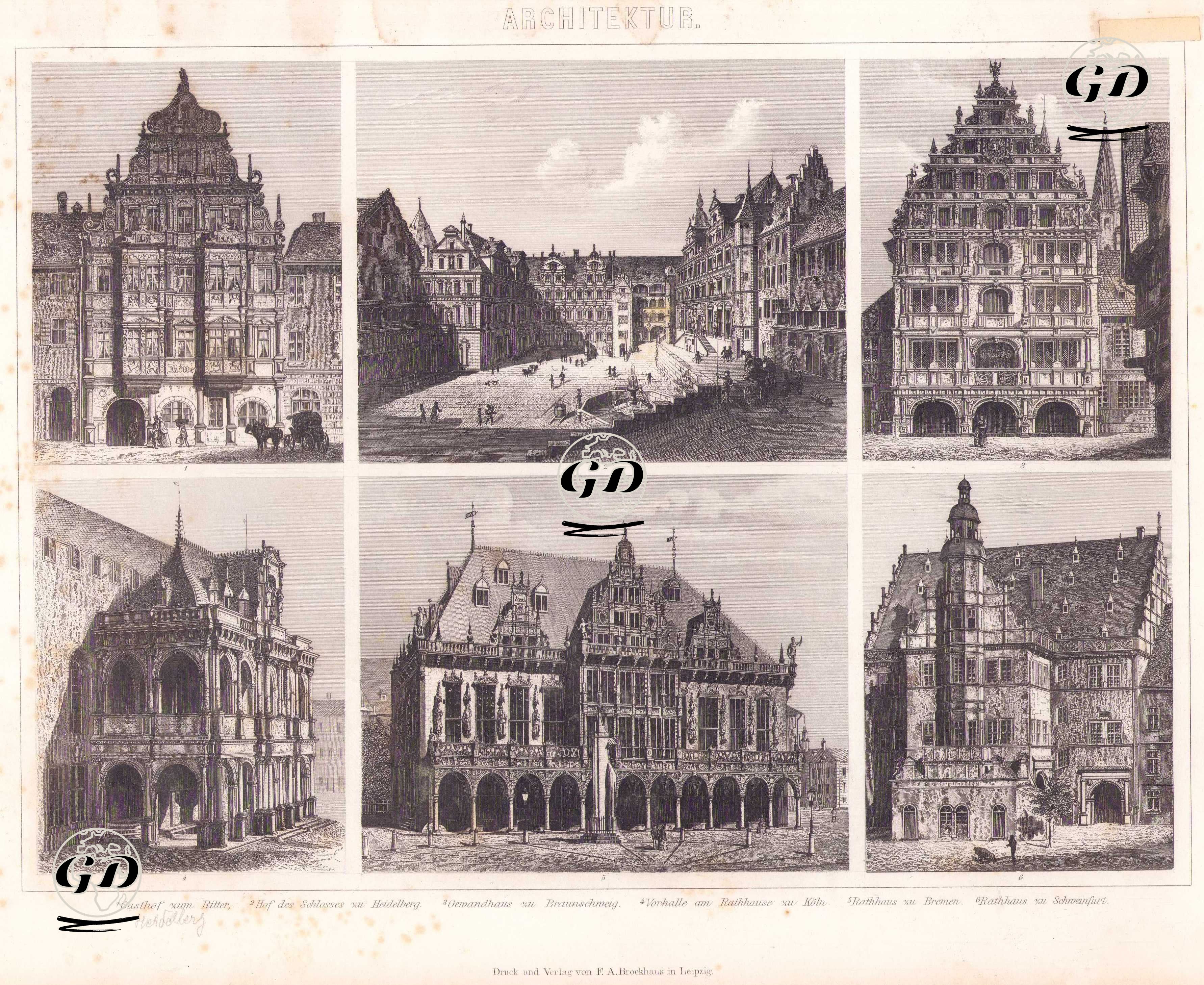
This engraving demonstrates the character of the German Renaissance, particularly reflected in urban architecture in the 16th century, through town halls and urban representative structures. The German Renaissance is not a mechanical copy of the classical language originating in Italy, but rather a unique synthesis blended with Northern European stonemasonry, late Gothic ornamentation, and the timber-frame tradition. The public buildings of cities like Cologne, Bremen, Braunschweig, and Schweinfurt seen in the engraving reflect the period when city government emerged as representative spaces for the "urban bourgeoisie," independent of aristocratic palaces. The façade configurations of town halls, with their dense pediment layers, triple- and double-paned window rows, the vertical emphasis on the roof, and richly carved stone frames, symbolize "visual power" and "public prestige." This building typology signifies a rupture in Northern European trade networks (including the Hanseatic tradition), when cities created a new language of public representation, and urban culture staged its own political and economic existence through architectural form. The examples in the engraving can be read as both the late-Gothic legacy and the early-modern municipal symbols of this historical process, and they perfectly demonstrate the "visibility" of the urban nobility class becoming independent from the imperial political structure.