GRAVÜR DÜNYASI
Digital Engraving Library
| Date | 1875 |
| Technique | Steel Engraving |
| Category | Architecture And Design |
| Source | Bilder-Atlas: Ikonographische Encyklopädie der Wissenschaften und Künste ; ein Ergänzungswerk zu jedem Conversations-Lexikon ; 500 Taf. in Stahlstich, Holzschnitt u. Lithographie ; in 8 Bd.. 5 by bearb. von Karl Gustav Berneck … - Druck und Verlag von F. A. Brockhaus in Leipzig |
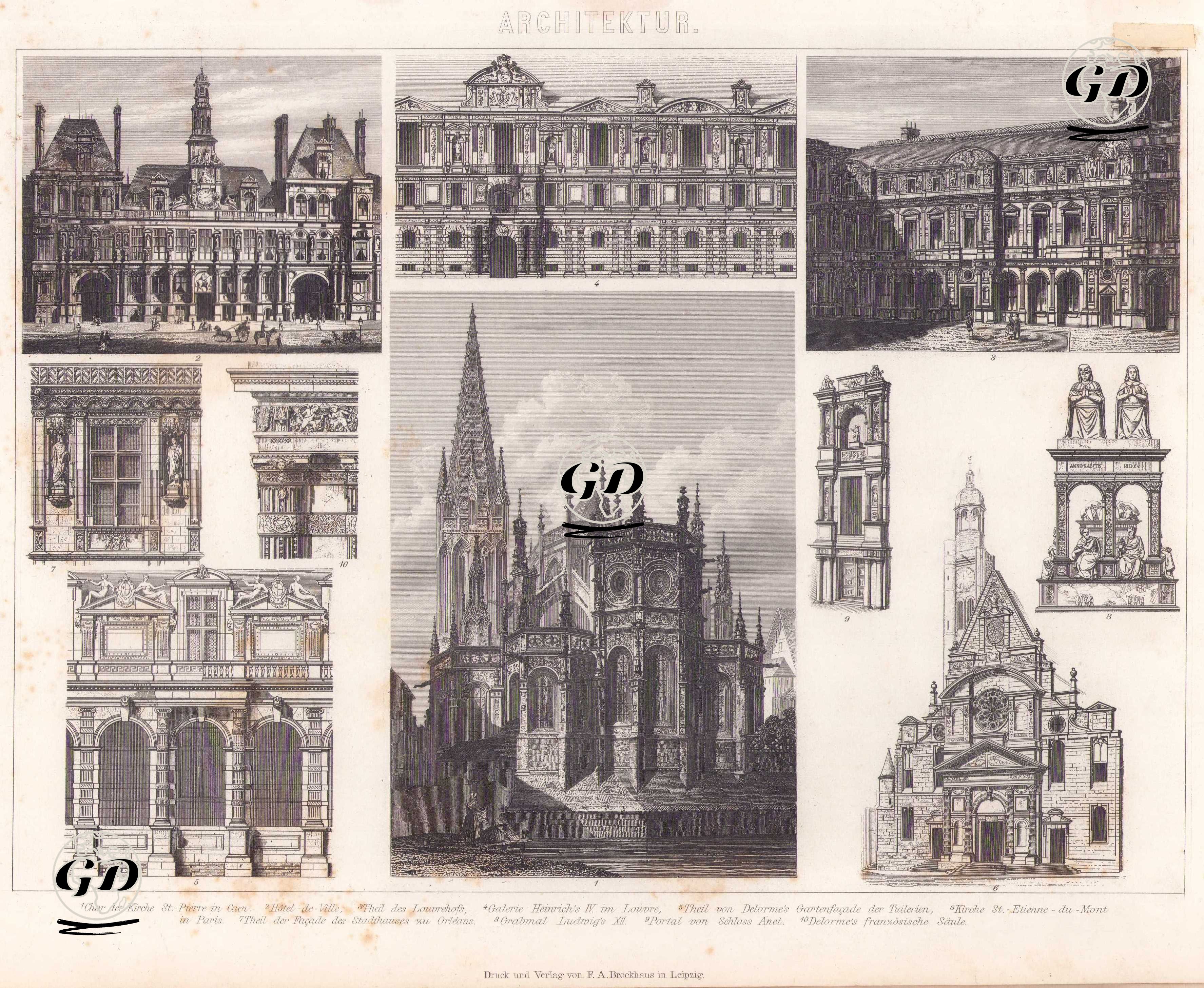
This engraving reveals the transition from the Late Renaissance to the Early Baroque in French architecture, both aesthetically and structurally. The late 16th-early 17th-century France was a period when royal power redefined urban space. The Louvre and Tuileries area became a spatial testing ground for these new representational approaches. While traces of this tradition are still visible in the choir of Saint-Étienne-du-Mont, one of the last great examples of medieval Gothic architecture, the engraving also presents the first coherent examples of the "French classical façade language" developed by innovative architects such as Pierre Lescot and Philibert de l'Orme. This new language is characterized by cordon lines, pilaster arrangements, an emphasis on continuity, and the rational organization of mass-proportion geometry. Many of the architectural examples shown here are central structures that shaped the visual policies of French court and state programs. While the Hotel de Ville (Paris City Hall) embodies the ideology of modern urban governance, the Louvre courtyard and the Henri IV Gallery encode the palace's cultural role as a "royal museum-library." Delorme's designs for the garden façade of the Tuileries Palace and the theoretical detail known as the "French column" are crucial for representing the turning point in French architecture where the relationship between support and ornament began to diverge from the Italian classical tradition. The portal of the Chateau Anet and the tomb of Louis XII in the engraving embody the iconographic aspect of monarchical monumentality (death, eternity, legitimacy) with symbolic intensity. Within this framework, the engraving does not merely present select facades. It directly reveals how the "High Renaissance" style, originating in Italy, became distinctive in France, how Gothic continuity dissolved, and the motifs with which local royal-palace culture constructed a "new national architecture."