GRAVÜR DÜNYASI
Digital Engraving Library
| Date | 1875 |
| Technique | Steel Engraving |
| Category | Architecture And Design |
| Source | Bilder-Atlas: Ikonographische Encyklopädie der Wissenschaften und Künste ; ein Ergänzungswerk zu jedem Conversations-Lexikon ; 500 Taf. in Stahlstich, Holzschnitt u. Lithographie ; in 8 Bd.. 5 by bearb. von Karl Gustav Berneck … - Druck und Verlag von F. A. Brockhaus in Leipzig |
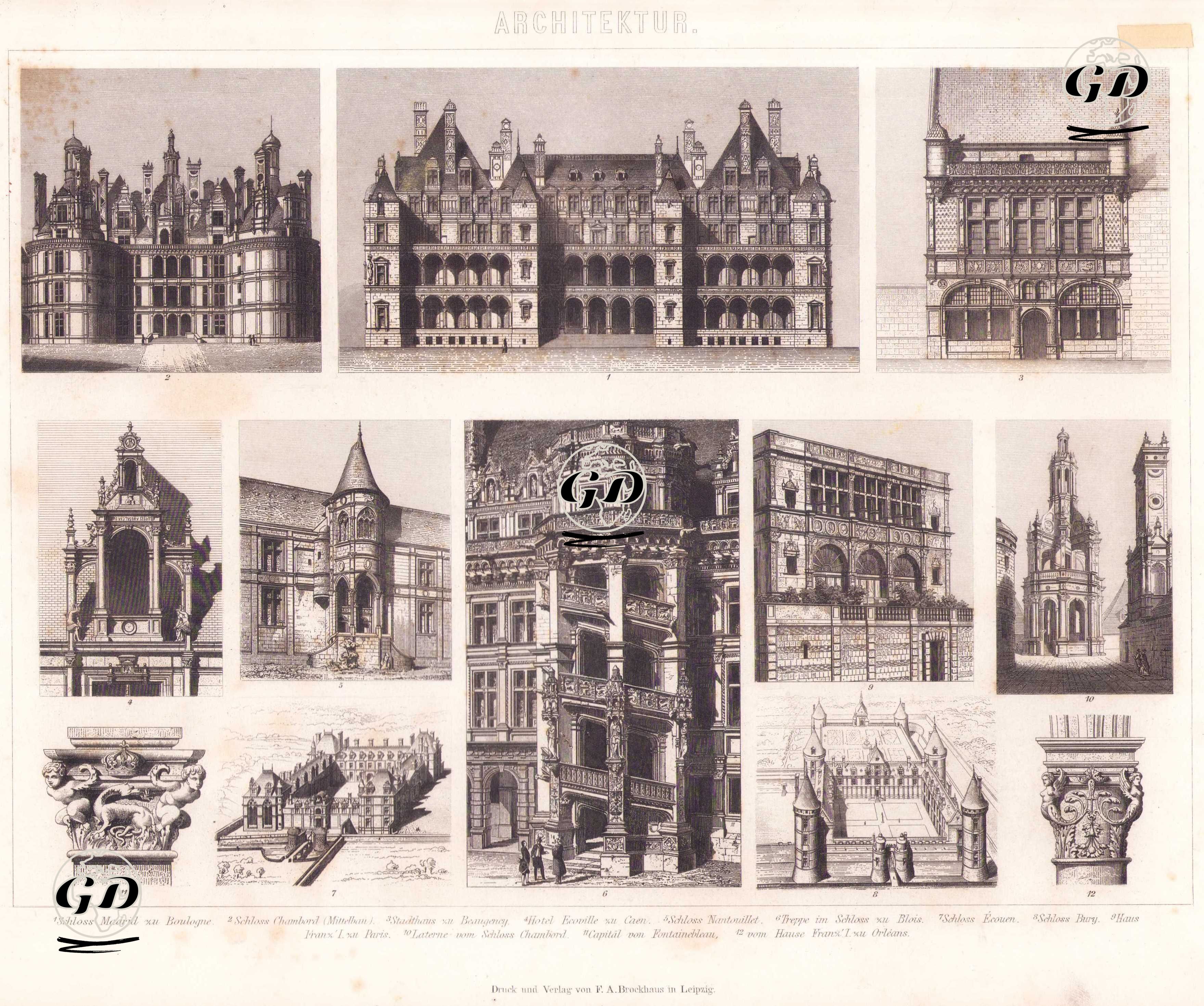
This engraving demonstrates the new aesthetic language adopted by the French Renaissance, particularly in the aristocratic residential architecture of the Loire Valley and Normandy in the 16th century. The examples depicted in the engraving include chateaux such as Chateau Madrid, Chambord, Blois, Ecouen, and Bury, all associated with the reign of King Francis I, as well as city mansions in Paris and Orleans. These structures, moving away from the defensive, mass-based language of medieval castle architecture, adopted a rational composition influenced by the Italian Quattrocento, with rich reliefs, sculptural stair towers, grotesque motifs, rhythmic floor divisions, and organized façade schemes. Renaissance architecture in France was shaped by artists brought from Italy (especially to construction sites in the Loire Valley) and also by the circulation of Italian Renaissance albums through engraving. Therefore, chateaux like Chambord both maintained the French Gothic tradition's emphasis on verticality and towers while also embracing the New Renaissance's classical proportions, capitals, friezes, and representational culture of palace interiors. In interior spaces, staircases, in particular, became the primary architectural element that generated the idea of a "ceremonial transition." Exteriorly, the façade became a heraldic display (heraldic display area) where aristocratic power was symbolically expressed. Thus, the building became a direct manifestation of its owner's social status and ancestry. This iconographic transformation was decisive in establishing a characteristic and unique identity for the French Renaissance in Europe.