GRAVÜR DÜNYASI
Digital Engraving Library
| Date | 1875 |
| Technique | Steel Engraving |
| Category | Architecture And Design |
| Source | Bilder-Atlas: Ikonographische Encyklopädie der Wissenschaften und Künste ; ein Ergänzungswerk zu jedem Conversations-Lexikon ; 500 Taf. in Stahlstich, Holzschnitt u. Lithographie ; in 8 Bd.. 5 by bearb. von Karl Gustav Berneck … - Druck und Verlag von F. A. Brockhaus in Leipzig |
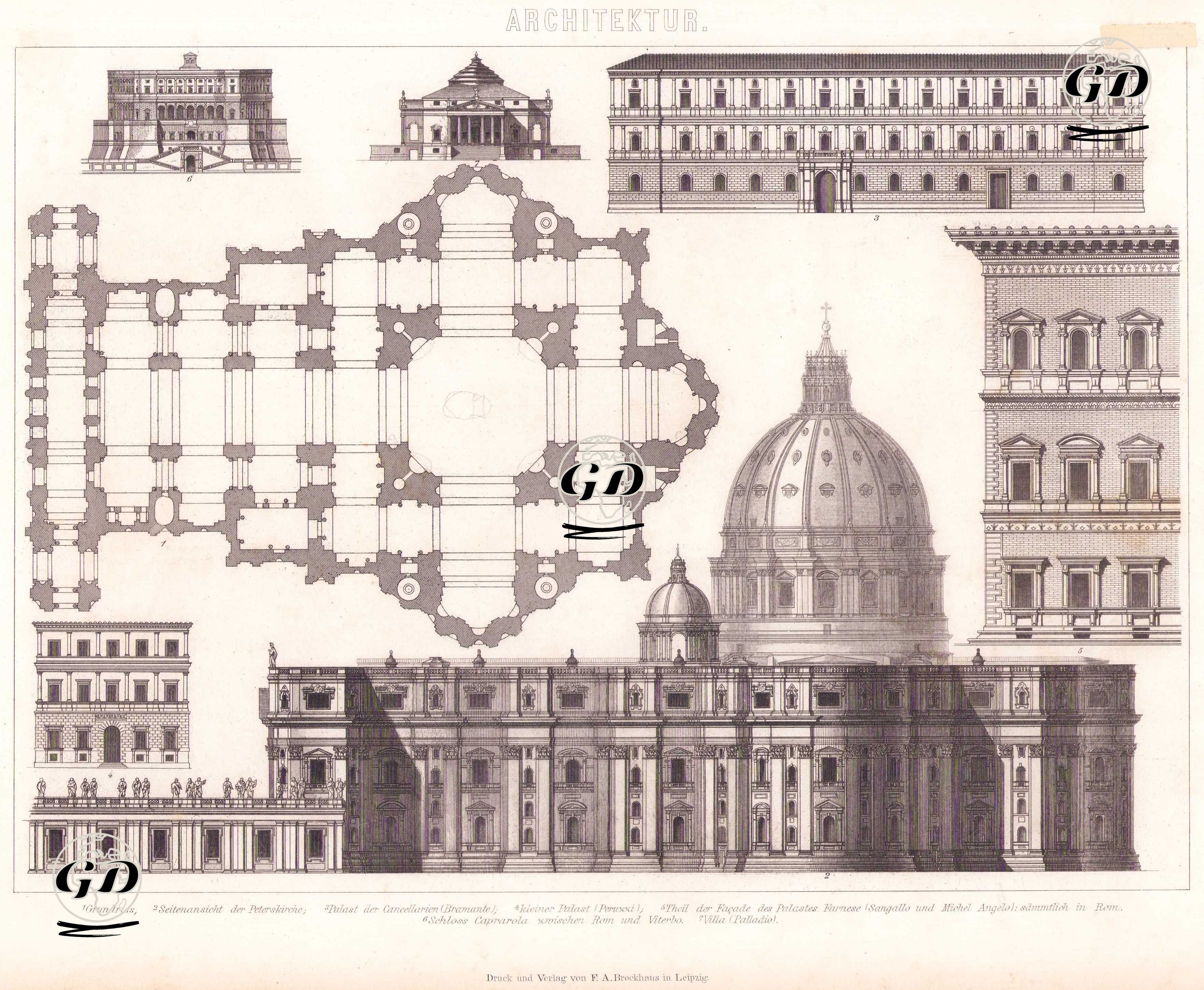
This engraving shows two main axes representing the highest level reached by both religious and civil architecture in post-Renaissance Rome: the palazzo culture shaped by St. Peter's Basilica and Rome's Papal palaces. The central plan and sectional drawing reveal the multilayered construction process of New St. Peter's Basilica, beginning with Bramante and extending to Michelangelo, Madera, and Bernini. The central plan demonstrates the ideal scheme of a central dome, the rhythmic proliferation of side naves, and the ultimate expression of the Renaissance ideal of a "return to the ancient plan." Michelangelo's colossal dome is a reinterpretation of the Roman heritage inherited from the Pantheon within a Christian universal framework. The palazzo facades (similar to the Farnese Palace), seen at the top and right of the page, are prime examples of Rome's ancient orderly principles adapted to the modern city palace typology. The modular layout of these palaces, with a ground floor featuring rusticated stonework, a piano nobile (first floor) accented by a composite column layout, and upper floors finished with balanced cornices, established a common architectural "standard language" for the European urban aristocracy. This style spread throughout Europe between the 16th and 18th centuries. Chateau de Caprarola is a pioneering transitional example, transforming the Renaissance tradition of defensive construction into a villa-fortezza (castle-villa) model outside the city.