GRAVÜR DÜNYASI
Digital Engraving Library
| Date | 1875 |
| Technique | Steel Engraving |
| Category | Architecture And Design |
| Source | Bilder-Atlas: Ikonographische Encyklopädie der Wissenschaften und Künste ; ein Ergänzungswerk zu jedem Conversations-Lexikon ; 500 Taf. in Stahlstich, Holzschnitt u. Lithographie ; in 8 Bd.. 5 by bearb. von Karl Gustav Berneck … - Druck und Verlag von F. A. Brockhaus in Leipzig |
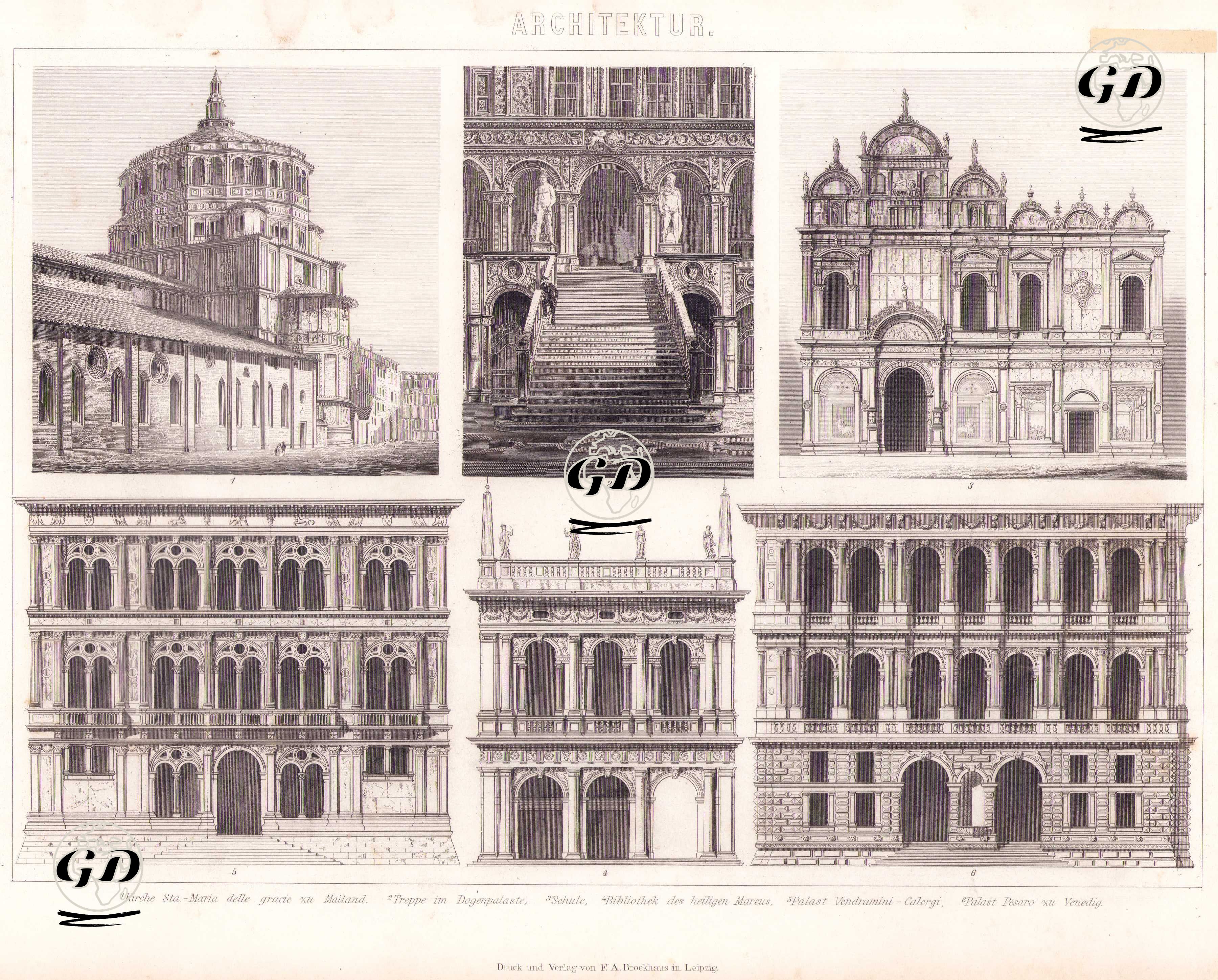
This engraving brings together structures from Italy's High Renaissance (late 15th-mid 16th centuries), when architectural language reached its zenith. Following the early classical pursuits of the Renaissance, the concepts of proportion, rhythm, perspective, and geometric order achieved a more sophisticated synthesis in architecture during this period. Many of the examples seen in the plate are characteristic of the developing architectural schools centered in Lombardy and Venice. Santa Maria delle Grazie in Milan (the monastery complex where Leonardo's Last Supper was located) is a key example of the Renaissance's simple yet powerful idea of spatial order. The famous Scala dei Giganti (Giants' Staircase) in the Doge's Palace of Venice is considered one of the most magnificent examples of the interweaving of ceremonial processions and monarchical representation within architecture. Similarly, the tomb of Doge Vendramini and the facades of Venetian palaces such as the Palazzo Vendramin-Calergi and Palazzo Pesaro are exemplary structures that combine the classical ordering principles of the Renaissance with the aristocratic urban opulence of Italian city-states. These structures are notable for their rhythmic columnar rows, distinct horizontal floor arrangement, elegant stonework, and the balanced and harmonious design of the façade, resembling a musical piece. These examples also represent the model of Italian Renaissance architecture that spread to European architecture. The palace and residential architectural styles seen in France, Germany, and England in the 16th century, particularly in Venetian residential facades, transferred this understanding of proportion and symmetry to other geographies, transforming the typology of aristocratic housing in Europe.