GRAVÜR DÜNYASI
Digital Engraving Library
| Date | 1875 |
| Technique | Steel Engraving |
| Category | Architecture And Design |
| Source | Bilder-Atlas: Ikonographische Encyklopädie der Wissenschaften und Künste ; ein Ergänzungswerk zu jedem Conversations-Lexikon ; 500 Taf. in Stahlstich, Holzschnitt u. Lithographie ; in 8 Bd.. 5 by bearb. von Karl Gustav Berneck … - Druck und Verlag von F. A. Brockhaus in Leipzig |
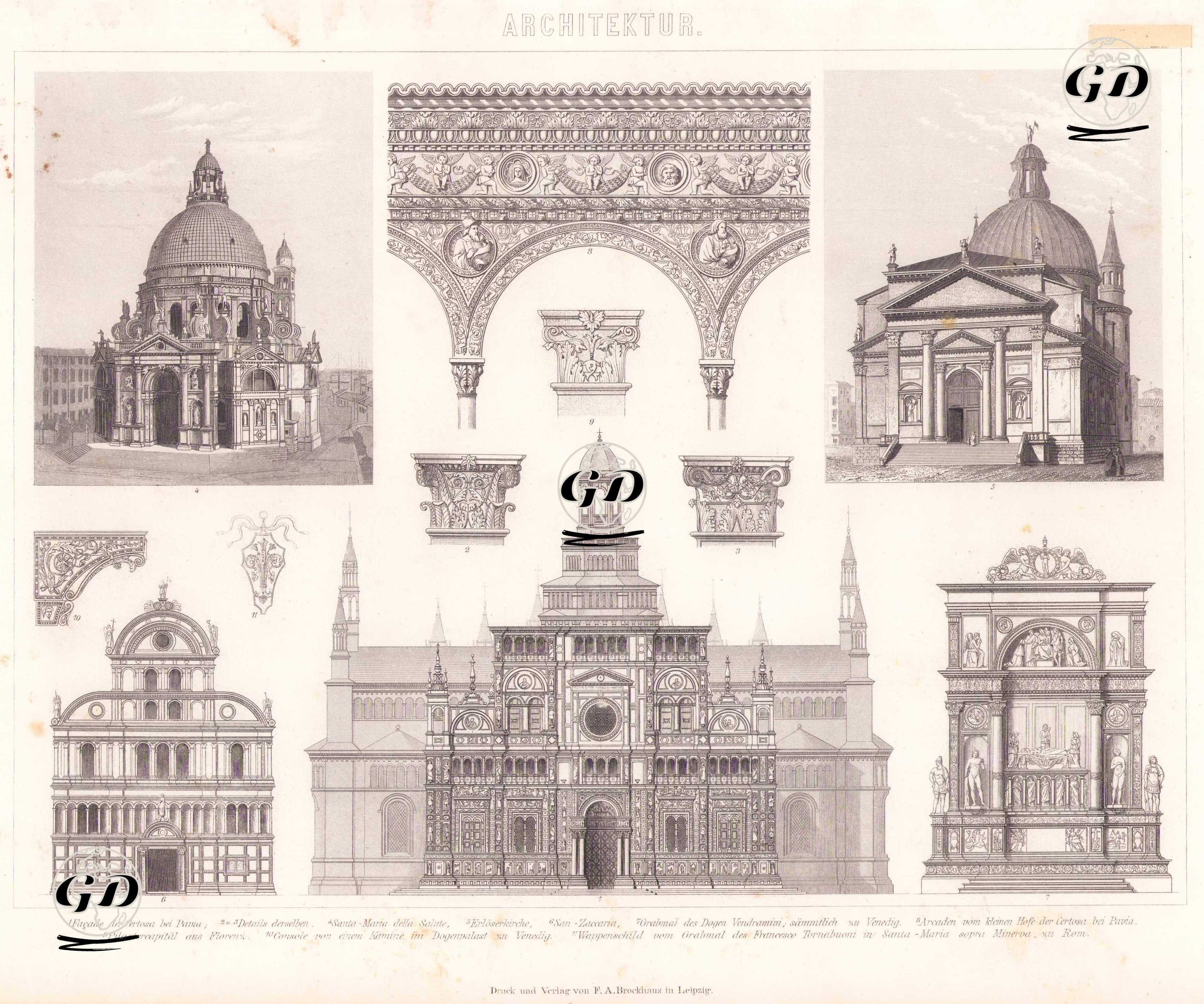
This engraving demonstrates the aesthetic finesse, mastery of proportion, and rich diversity of symbolic (iconographic) expression achieved by Italian Renaissance architecture between the 15th and 16th centuries. The composition juxtaposes mature Renaissance central buildings such as Santa Maria della Salute and Il Redentore in Venice with the marble façade program of the Certosa in Pavia. Thus, the engraving reveals that the Renaissance was not a single style, but a "language of weight and proportion" interpreted in diverse ways under the influence of cities, noble families, artisan guilds, and local stoneworking traditions. Classical pilaster capitals originating in Florence are small examples of how the style of Antonio da Sangallo and Michelozzo transformed the marble carving tradition in Venice. The grotesque, acanthus, and heraldic motifs featured in these capitals reveal how the Renaissance concept of the "rediscovery of antiquity" came to life in Italy on both an intellectual (humanitas) and a material (polychrome marble work) level. The tomb monument of the Scaliger family in Verona, in addition to being a vertical structure referencing medieval tradition, transformed into a monumental stone expression symbolizing the ruling families' quest for "eternal legitimacy" during the early Renaissance. Therefore, this engraving demonstrates how the triangle of "church, city, and dynasty" formed a programmatic unity in Renaissance architecture.