GRAVÜR DÜNYASI
Digital Engraving Library
| Date | 1875 |
| Technique | Steel Engraving |
| Category | Architecture And Design |
| Source | Bilder-Atlas: Ikonographische Encyklopädie der Wissenschaften und Künste ; ein Ergänzungswerk zu jedem Conversations-Lexikon ; 500 Taf. in Stahlstich, Holzschnitt u. Lithographie ; in 8 Bd.. 5 by bearb. von Karl Gustav Berneck … - Druck und Verlag von F. A. Brockhaus in Leipzig |
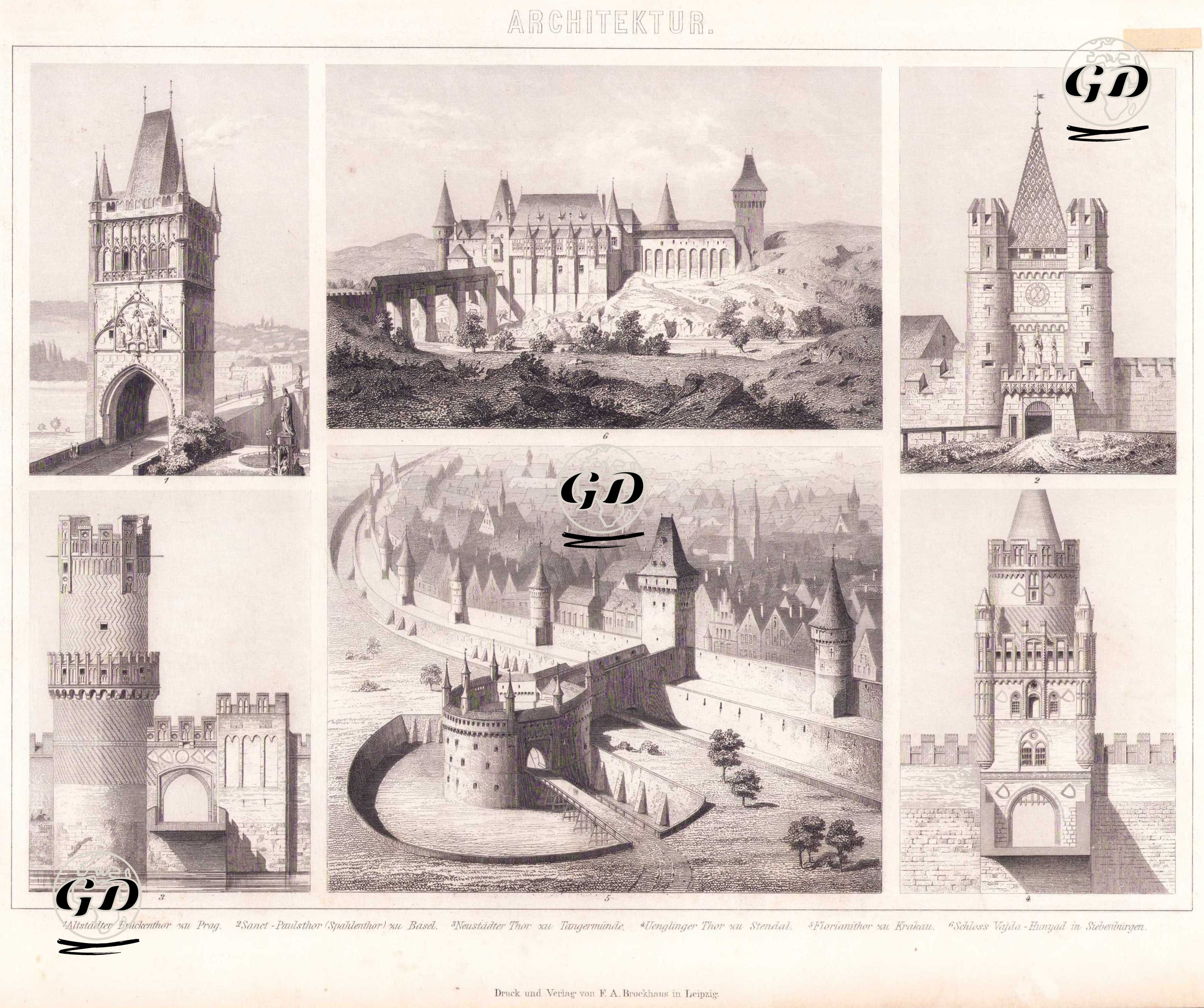
This engraving presents city gates and castle complexes, some of the most characteristic examples of medieval defensive architecture in Central Europe. Selected structures from diverse locations, such as Prague, Basel, Tangermünde, Stendal, Kraków, and the Vajda-Hunyad Castle in Transylvania, illustrate both the developmental stages of city defense systems and how the display of political power through these structures was reflected in the architectural language. Beyond simply being mere transit points, these gates are political symbols of monumental scale, representing city identity. They provide both a deterrent force against enemies and a "representative stage" at the entrance to the city. Anyone entering the city through these gates would immediately recognize the symbolic power of the ruler or the city's autonomy through the reliefs, coats of arms, and ornamentation above the gates. These gates, with their high towers, rows of battlements, entrance corridors connected by bridges, and often surrounded by moats, brought the techniques developed by castle architecture to the urban scale. In particular, the battlemented walkways, arrow/cartridge embrasures, and bridge-cane connections made these gates a direct reflection of military technology. Furthermore, each city gate became an iconographic element associated with its own city. For example, in Central Europe, Gothic towered gates were an integral part of the city skyline, while the Transylvanian example (Vajda-Hunyad) presents a feudal aristocracy structure enriched by early Renaissance influences. This engraving, through its architectural morphology, presents a historical panorama where political, military, and aesthetic forms intersect, visualizing the multilayered role the concept of the "gate" has assumed in European urban memory as a space of both defense and representation.