GRAVÜR DÜNYASI
Digital Engraving Library
| Date | 1875 |
| Technique | Steel Engraving |
| Category | Architecture And Design |
| Source | Bilder-Atlas: Ikonographische Encyklopädie der Wissenschaften und Künste ; ein Ergänzungswerk zu jedem Conversations-Lexikon ; 500 Taf. in Stahlstich, Holzschnitt u. Lithographie ; in 8 Bd.. 5 by bearb. von Karl Gustav Berneck … - Druck und Verlag von F. A. Brockhaus in Leipzig |
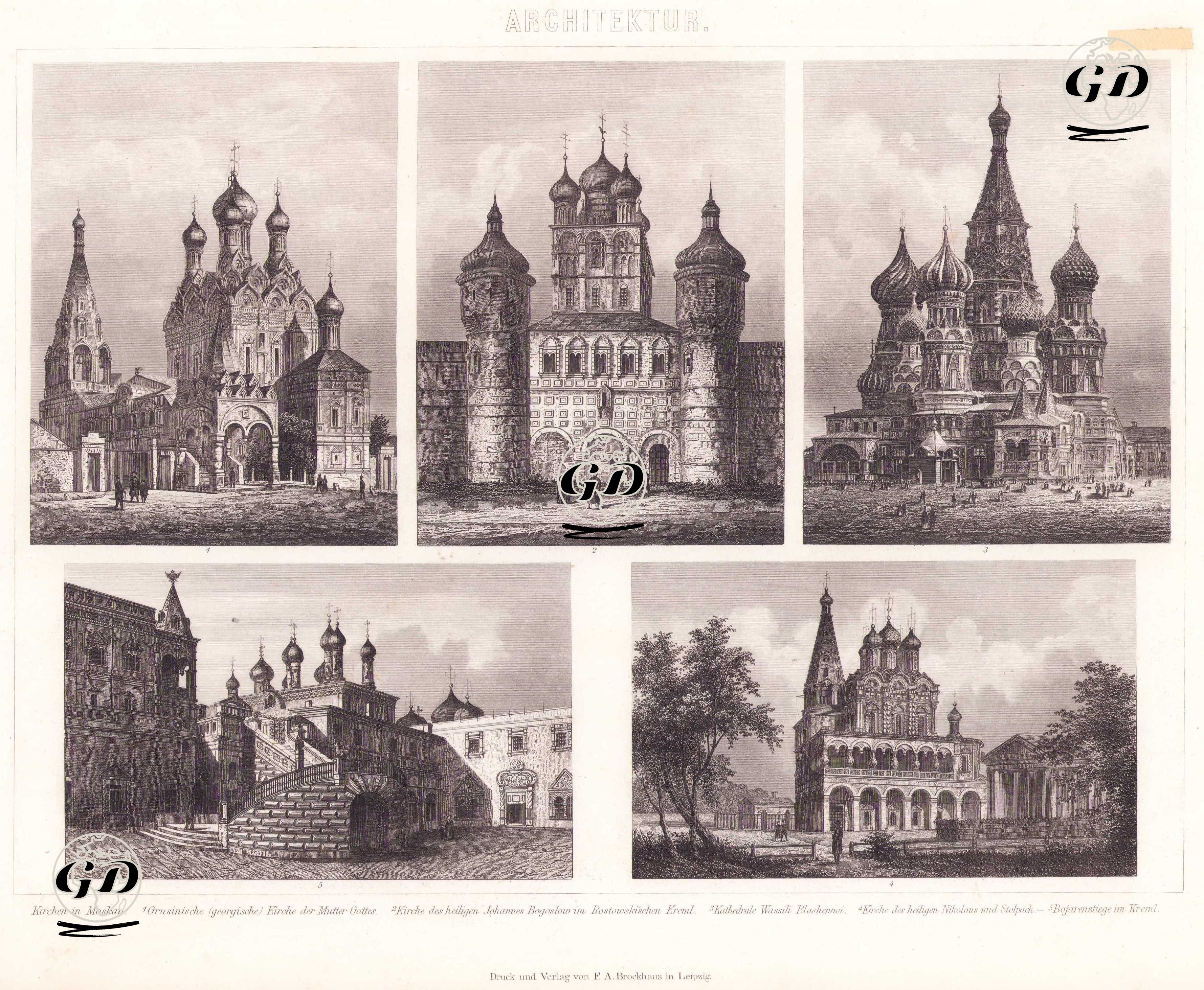
This engraving depicts Orthodox churches in Moscow and examples of religious and civil architecture within the Kremlin. The engraving demonstrates the unique aesthetic language created by the fusion of Byzantine traditions with local wooden construction techniques in Russian architecture between the 15th and 17th centuries. The structure in the center of the upper row is the Archangel Michael Cathedral (Arkhangelsky Sobor) within the Moscow Kremlin. Built between 1505 and 1508 by the Italian architect Aloisio Lamberti da Montagnana (Aleviz Novi), it is the tomb church where the grand dukes and tsars of Moscow were buried. This cathedral is considered one of the first examples of combining the formal understanding of the Italian Renaissance with the Byzantine-Russian iconographic tradition. In the upper right is St. Basil's Cathedral (Sobor Vasiliya Blazhennogo), one of the most recognizable structures of Russian architecture. It was built by Tsar Ivan IV from 1555 to 1561. Built by Ivan the Terrible to commemorate the conquest of Kazan, the cathedral's multi-domed composition forms a star plan with eight smaller chapels surrounding a central dome. Onion-shaped domes created a unique silhouette in Renaissance Europe, becoming a symbol of Russian identity. The building seen at the top left is the Church of the Intercession of the Virgin Mary (Pokrovskaya Tserkov) in Moscow, or one of the smaller churches of a similar style. The red brick body, white stone ornamentation, and soaring spire reflect the "tent-roofed" architectural style of the 17th-century pre-Russian Baroque era. This form is a reinterpretation of timber-based architecture in stone. The scene at the bottom left depicts the staircase passages within the Kremlin Palace Complex and the surrounding small churches. Such ramped passages served both as ceremonial passages and as connections between structures at different elevations. The building at the bottom right belongs to the Novodevichy Convent or one of the similar women's monasteries around Moscow. These structures reflect the religious patronage of the Moscow aristocracy in the 16th and 17th centuries and are indicative of the period when women's monasteries became cultural and educational centers. All the structures in the engraving exhibit the multi-domed composition, vertical emphasis, colorful surface decoration, and iconographic façade layout that are hallmarks of Russian Orthodox architecture. This style, an expression of both religious and national identity, was described in 19th-century Europe as "Russian exotic architecture."