GRAVÜR DÜNYASI
Digital Engraving Library
| Date | 1875 |
| Technique | Steel Engraving |
| Category | Architecture And Design |
| Source | Bilder-Atlas: Ikonographische Encyklopädie der Wissenschaften und Künste ; ein Ergänzungswerk zu jedem Conversations-Lexikon ; 500 Taf. in Stahlstich, Holzschnitt u. Lithographie ; in 8 Bd.. 5 by bearb. von Karl Gustav Berneck … - Druck und Verlag von F. A. Brockhaus in Leipzig |
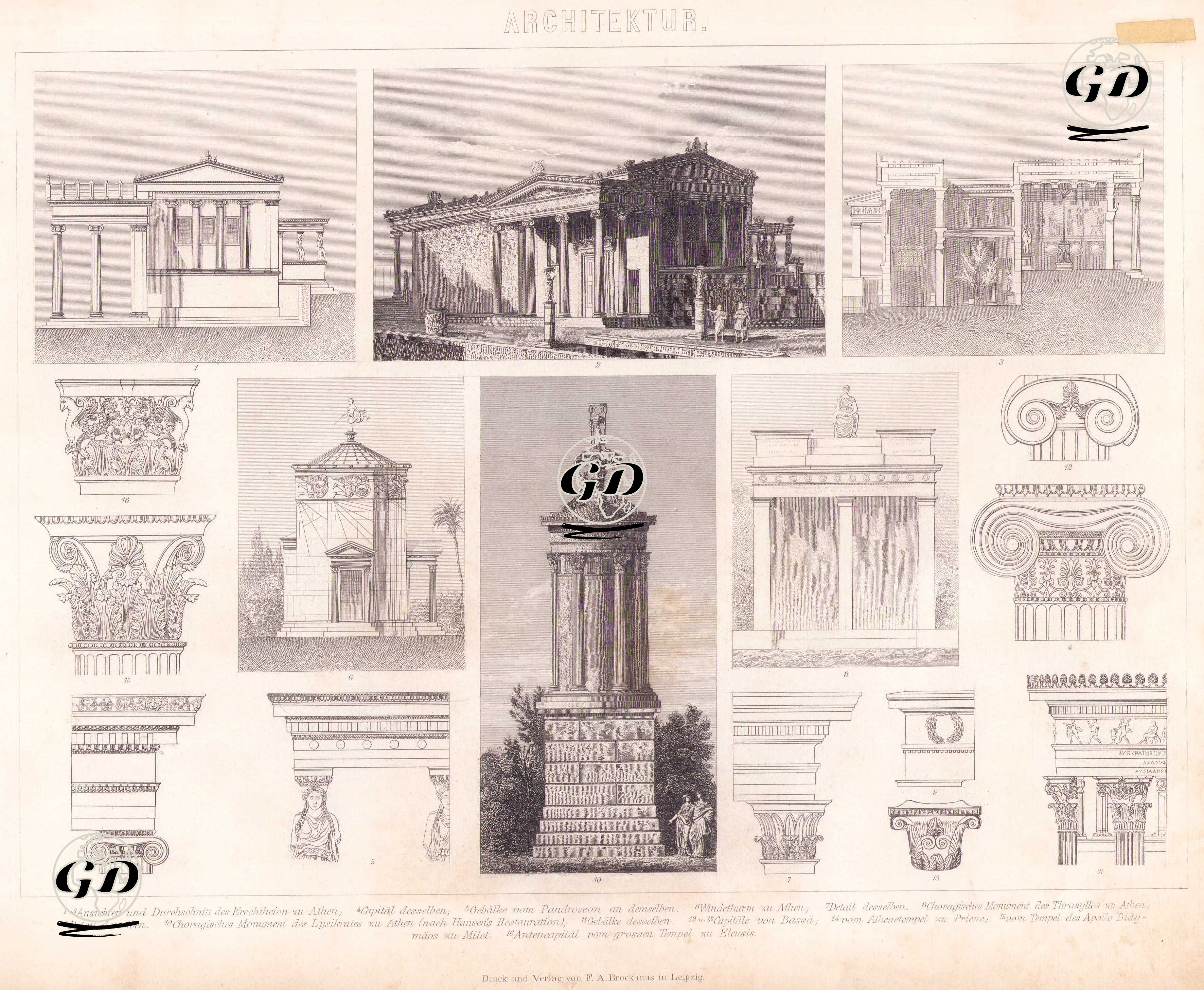
This engraving presents a comparative analysis of the most important Greek monuments on and around the Acropolis of Athens, particularly the Erechtheion, Parthenon, Lysikrates Monument, and the Temple of Nike, in both plan and façade detail. The three main scenes in the top row are taken from various structures on the Acropolis. The drawing on the left shows the north facade of the Erechtheion. This structure reflects both the elegant proportions of the Ionic order and the religious identity of Athens through its mythological background (a sanctuary dedicated to Poseidon and Athena). The central scene depicts the Parthenon (447-432 BC). Built by the architects Iktinos and Callicrates, this structure is considered the most perfect example of the Doric order. The reliefs depicting the Panathenaic procession on the friezes symbolize the fusion of religious ritual and civic consciousness. The scene on the right shows a section of the Temple of Nike Apteros (the Temple of Athena Nike, the Wingless Goddess of Victory). This small but elegant structure displays the refined proportions of the Ionic order of columns and represents the sacred space where victories in battle were commemorated with divine gratitude. The central composition in the middle row depicts the Lysikrates Monument (334 BC). This circular structure is one of the earliest examples of the early Corinthian order, and with its acanthus leaves on its capitals, it pioneered the decorative style that would later develop in Roman architecture. Details of the Beule Gate, the Propylaia, and other monumental entrance structures in Athens can also be seen in the engraving. The details in the lower section instructively illustrate the formal differences between the three classical column orders. The Doric order, with its volute (spiral) capitals, embodies elegance and balance. The Corinthian order, with its capitals decorated with acanthus leaves, offers an aesthetically pleasing appearance. These orders represent not only structural systems but also three different philosophical interpretations of the idea of "perfection" in Greek aesthetics.