GRAVÜR DÜNYASI
Digital Engraving Library
| Date | 1875 |
| Technique | Steel Engraving |
| Category | Architecture And Design |
| Source | Bilder-Atlas: Ikonographische Encyklopädie der Wissenschaften und Künste ; ein Ergänzungswerk zu jedem Conversations-Lexikon ; 500 Taf. in Stahlstich, Holzschnitt u. Lithographie ; in 8 Bd.. 5 by bearb. von Karl Gustav Berneck … - Druck und Verlag von F. A. Brockhaus in Leipzig |
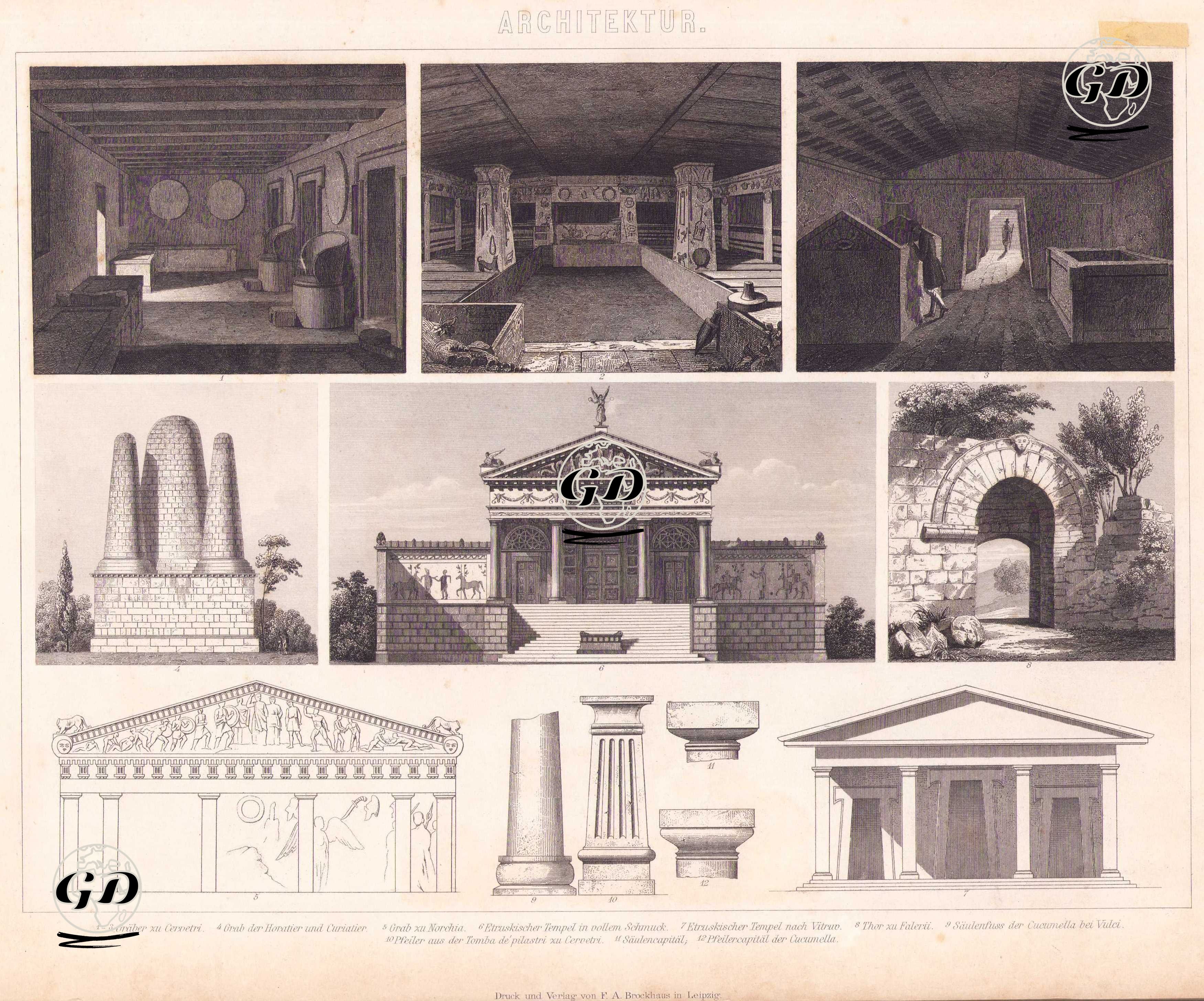
This engraving systematically illustrates the evolution of religious and architectural forms from the Mycenaean, Corinthian, and Archaic Greek periods. The three images in the top row depict the interiors of tholos (circular royal burial chambers) from the Mycenaean civilization (16th-12th centuries BC). These structures represent the earliest examples of masonry dome systems and pioneered the spatial organization of later Greek temples. The middle scene shows a cross-section of the Mycenaean tholos, probably known as the Treasury of Atreus. The stonework on the interior walls of these chambers reflects early geometric decoration. The middle row of images depicts temple forms from the Late Archaic and Early Classical periods. The structure on the left represents the sacred center known as the Omphalos (Delphi Stone). According to ancient Greek cosmology, the Omphalos stone represents the center of the world, the axis between gods and humans. The temple in the middle was inspired by the Temple of Aphaia (Aegina) or similar early Doric structures. The scenes on the relief friezes depict heroic narratives from Greek mythology. The arched passage on the right is an example of Etruscan gateway architecture near Faleri (Civita Castellana) and demonstrates early formal uses of the stone arch. The drawings in the lower section document the early evolutionary forms of the Doric order. The proportions of the frieze, triglyphs, metopes, and columns are the starting point for the aesthetics of proportion in classical Greek architecture. The temple pediment and façade drawing in the lower left, in particular, offer an early example of the integration of sculpture and architecture. The temple reconstruction on the right points to the origin of the three-aisled basilica plan, which evolved from the simple naos (cella). This sequence, extending from Mycenaean stone tombs to Doric temples, serves as a visual summary of both the structural and symbolic evolution of sacred architecture.