GRAVÜR DÜNYASI
Digital Engraving Library
| Date | 1875 |
| Technique | Steel Engraving |
| Category | Architecture And Design |
| Source | Bilder-Atlas: Ikonographische Encyklopädie der Wissenschaften und Künste ; ein Ergänzungswerk zu jedem Conversations-Lexikon ; 500 Taf. in Stahlstich, Holzschnitt u. Lithographie ; in 8 Bd.. 5 by bearb. von Karl Gustav Berneck … - Druck und Verlag von F. A. Brockhaus in Leipzig |
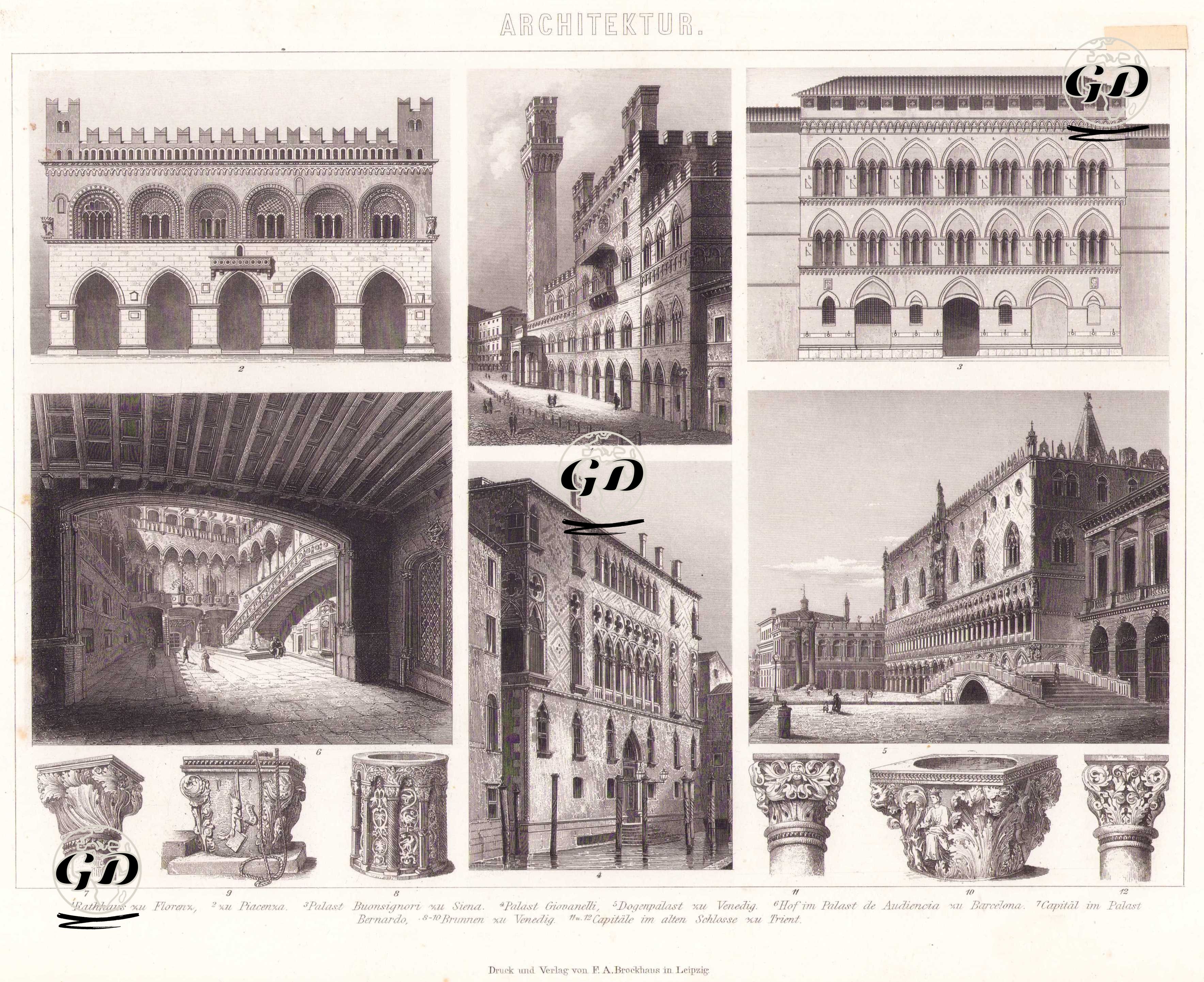
This engraving brings together select examples representing the medieval and pre-Renaissance city palaces (palazzos) and municipal buildings (palazzo pubblico / comunale) that flourished in Italy between the 13th and 15th centuries. The engraving illustrates the public building aesthetics of Tuscany and Venice through their formal, structural, and ornamental features. The buildings in the upper row represent the administrative centers of Italian city-states. On the left, the Palazzo del Podesta (Bargello) in Florence, built around 1255, reflects the defensive character of early municipal architecture with its pointed arches, crenellated eaves, and towering form. In the center, the Palazzo Pubblico in Siena is a spatial symbol of the city's democratic administrative structure. Designed with the soaring Torre del Mangia tower, the building is an architectural expression of public power and the will of the people. On the right, the Palazzo dei Diamanti in Ferrara, with its diamond-shaped façade stones, is a pioneer of Renaissance decorative design. This arrangement creates surface movement through the play of light and shadow. In the lower right corner is the Doge's Palace (Palazzo Ducale). Reflecting 14th-century Gothic elegance, the building, with its columned loggias and carved stonework on the lower floors, represents the power and wealth of the Republic of Venice. The palace's façade, which merges with the bridge, emphasizes the Doge's function as a symbol of both government and justice. The ancient palace courtyard in Florence, seen in the lower center, is an example of the specific architecture of the city's aristocracy. Such inner courtyards served as transitions between public and private spaces and were adorned with statues, wells, and column capitals. The Corinthian and composite column capitals in the lower section reflect the decorative transformation seen in Italian Late Gothic and the Early Renaissance. The vegetal curves, figural motifs, and mythological reliefs are considered a reinterpretation of ancient heritage in the artistic understanding of the period.